Minitropicarium of the Real Jardín Botánico Juan Carlos I (Orquidearium and Crassuletum)
Alcalá de Henares, Community of Madrid
Entry updated on October 5, 2026
- Year
- 1997 (Orquidearium opened in 1999)
- Style
- Converted research greenhouse with a floor dug below ground level
- Dimensions
- About 400 m²
- Status
- Open to the public (university botanic garden)
Opened in 1994 on the University of Alcalá campus, the Real Jardín Botánico Juan Carlos I shows its glasshouse plants in a 'minitropicarium': a research greenhouse given by the Complutense University of Madrid and adapted for display in 1996, with some of its compartments removed and its floor dug out to gain height. Open to the public since 1997, it gathers orchids and rainforest plants in its largest room (the Orquidearium, 1999), while three compartments provisionally hold part of the garden's cactus collection, the richest in Spain.
Affiliate links — booking through Verrière helps fund our research, at no extra cost to you.
History
1 min
The Real Jardín Botánico Juan Carlos I was founded in 1990 on the initiative of the University of Alcalá, with support from the Community of Madrid, when a technical office was set up to design and build it. European FEDER regional funds granted in 1991 paid first for the nursery, completed in 1992, and then for the taxonomic garden, whose first plantings in 1994 came from donations by the City of Madrid and the Real Jardín Botánico de Madrid. The garden was inaugurated the same year.
In 1996 a greenhouse donated by the Complutense University of Madrid was adapted into a display 'minitropicarium' for cacti and tropical plants. It opened to the public in 1997, together with the Crassuletum, and the garden's cactus society (ACUA) was founded that year. The Orquidearium followed in 1999, showing among other things tropical plants brought from the Americas for the Expo 92 site.
The garden has kept growing since: a rose garden inaugurated in 2005, a river park completed at the end of 2006 and a service building opened in 2010, which has been the main entrance ever since. Wikipedia credits it with 22 hectares in use out of a planned 26. For the greenhouse, the same source mentions undated plans: modular greenhouses and shade houses in the centre of the garden to take the cacti, and a tropicarium, after which the minitropicarium would be given over entirely to tropical plants.
Architecture and engineering
1 min
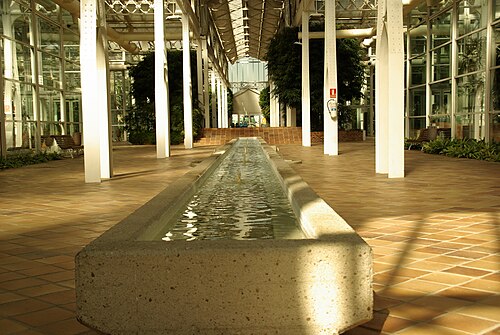
The minitropicarium was not designed for visitors: it is a research greenhouse from the Complutense University that the garden turned into a display house. According to the garden's website and Wikipedia, internal compartments were removed and the floor was dug out below ground level to give the plants more usable height. Wikipedia puts its area at about 400 m².
The space is still divided: the largest room holds the tropical plants and orchids, three other compartments the cacti. For lack of room, part of that collection is also grown under a lean-to shelter against the greenhouse and in an acclimatisation tunnel. Wikipedia gives 1,500 m² as the garden's total area under glass. In the nursery, a 1,000 m² production greenhouse split into four compartments keeps, on 330 m², the tropical plants of the scientific collection intended for the future tropicarium. None of the sources consulted names the builder of the minitropicarium or the date it was built.
Plant collections
1 min
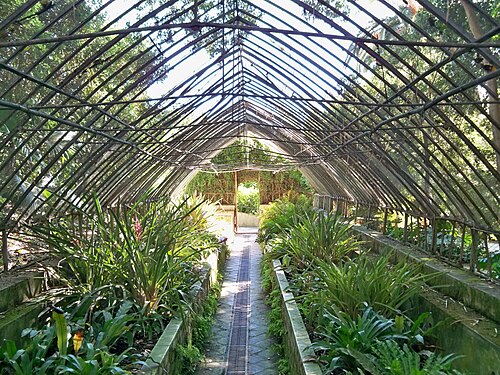
The minitropicarium's main room recreates a dense tropical setting, where climbers, shrubs, small trees, dead trunks and hanging plants frame the collections. Orchids dominate, though the figures differ between sources: nearly 220 species among 271 rainforest species according to the garden's website, nearly 300 among 360 according to Wikipedia. An initial group of 30 Cuban orchids was later joined by a collection of 280 tropical orchids. A small collection of carnivorous plants, epiphytes including epiphytic cacti, tropical ferns and begonias complete the display.
The other three compartments belong to the Crassuletum. According to Wikipedia, the garden's cactus collection, one of the most diverse in Europe, numbers more than 3,000 plants and 1,853 species, the largest in Spain, with 105 of the 113 described genera, alongside other families of succulents.
Visiting
1 min
The garden occupies part of the University of Alcalá's outer campus, reached from exit 32 of the A-2 motorway; since 2010 the way in has been through the service building, which has a car park. The minitropicarium belongs to the special collections area, together with the cycads, conifers, exotic trees, rose garden and medicinal plants.
Half a day leaves time for the arboretums and the regional flora park, which covers about twelve hectares and presents the flora of Madrid and Guadalajara. The visit can be extended into the historic centre of Alcalá de Henares, whose university was recognised as a World Heritage Site by UNESCO in 1998.
40.51° N, 3.34° W
Greenhouses nearby
More greenhouses — Spain
Do you have a good photo of this greenhouse? Suggest it for this page →