Hivernacle del Parc de la Ciutadella
Barcelona, Catalonia

Sources checked September 2026
- Year
- 1888
- Architect
- Josep Amargós i Samaranch
- Style
- Iron architecture (iron, cast iron and glass), three naves, decoration by Alexandre de Riquer
- Dimensions
- About 1,000 m², three naves
- Status
- Open to the public since reopening on 18 December 2023
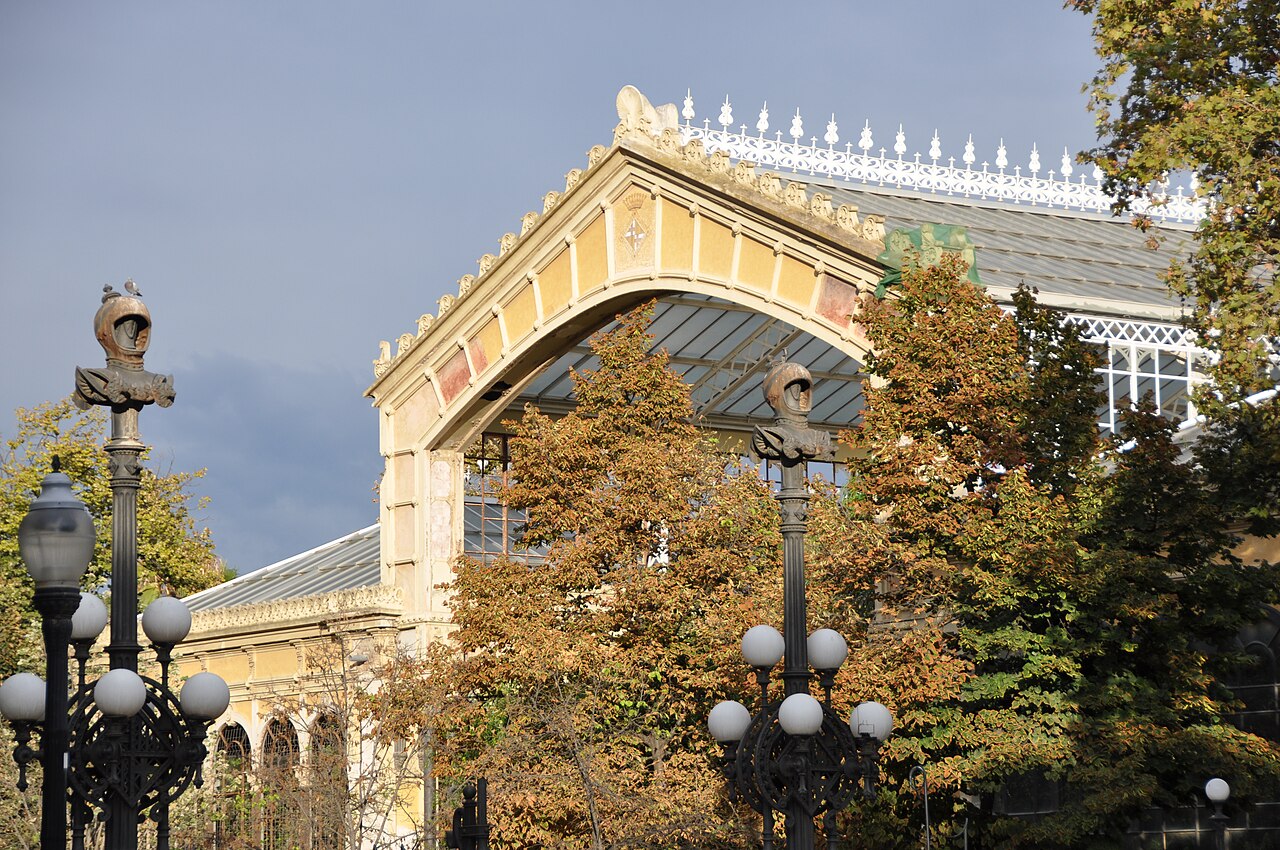
Designed by the municipal architect Josep Amargós i Samaranch to replace Fontserè's greenhouse, wrecked by hail in September 1887, the Hivernacle of the Parc de la Ciutadella was rushed up for the 1888 Universal Exposition, which opened before it was finished. Its three iron-and-glass naves, covering about 1,000 m², have served many purposes: botanical collection, menagerie, canary contests, concerts, bar-restaurant. Closed to the public after 2007, it was restored in 2022-2023, recovering its original green paintwork, Alexandre de Riquer's decoration and a planting of more than a hundred species.
Affiliate links — booking through Verrière helps fund our research, at no extra cost to you.
History
The present greenhouse replaced an earlier one, among the few buildings that the master builder Josep Fontserè, winner of the 1871 competition to lay out the Parc de la Ciutadella, managed to complete: a rectangular iron-and-glass structure open to the public by 1875. On 7 September 1887 a violent hailstorm wrecked it; judged unsafe, it was dismantled and its collection was lost.
In October 1887 plans for a more ambitious replacement by the municipal architect Josep Amargós i Samaranch were presented, and in November the job went to Isidre Basso, who brought in two iron foundries to meet the deadline. Even so, the Universal Exposition opened in April 1888 with the greenhouse unfinished, and planting only began that summer. Its decoration was by Alexandre de Riquer, an attribution confirmed only recently through an article published in 1890.
A chequered history followed: an aborted handover to the Barcelona publicists' association (1893-1894); a 1907 proposal by the Junta de Ciències Naturals to keep birds, reptiles and fish in what was by then an almost ruinous building, with use granted to the Junta in 1909; canary contests from 1925; Civil War bomb damage, repaired from 1940; a 1965 renovation led by Lluís Riudor; exhibitions and Grec festival concerts in the 1980s; and a bar-restaurant installed in 1995. After roof works in 2007-2009 the greenhouse stayed closed, and a project restarted in 2015 stalled in 2016 when the contractor went bankrupt. The restoration designed by Marc B. Trepat and Marta Urbiola began in September 2022 at a cost of about two million euros and ended with the reopening on 18 December 2023.
Architecture and engineering
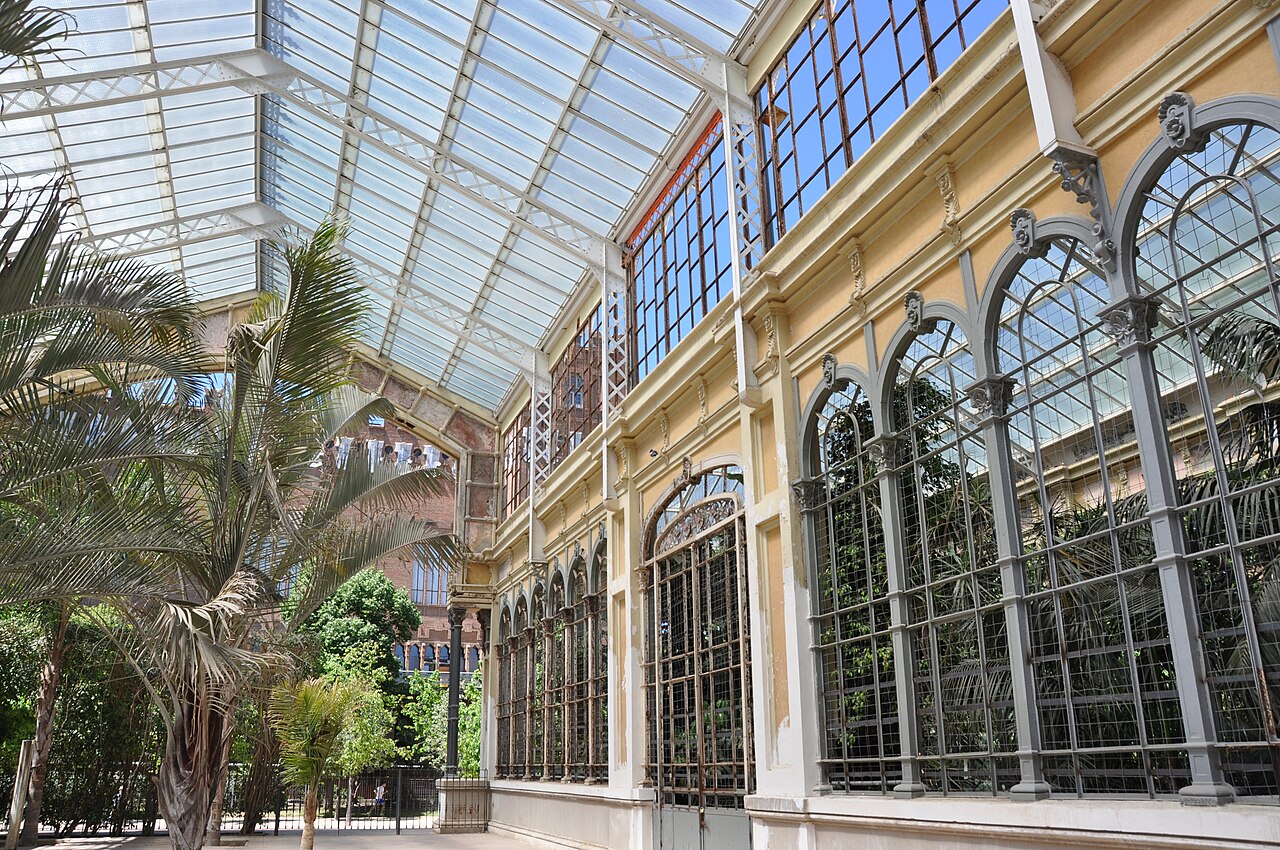
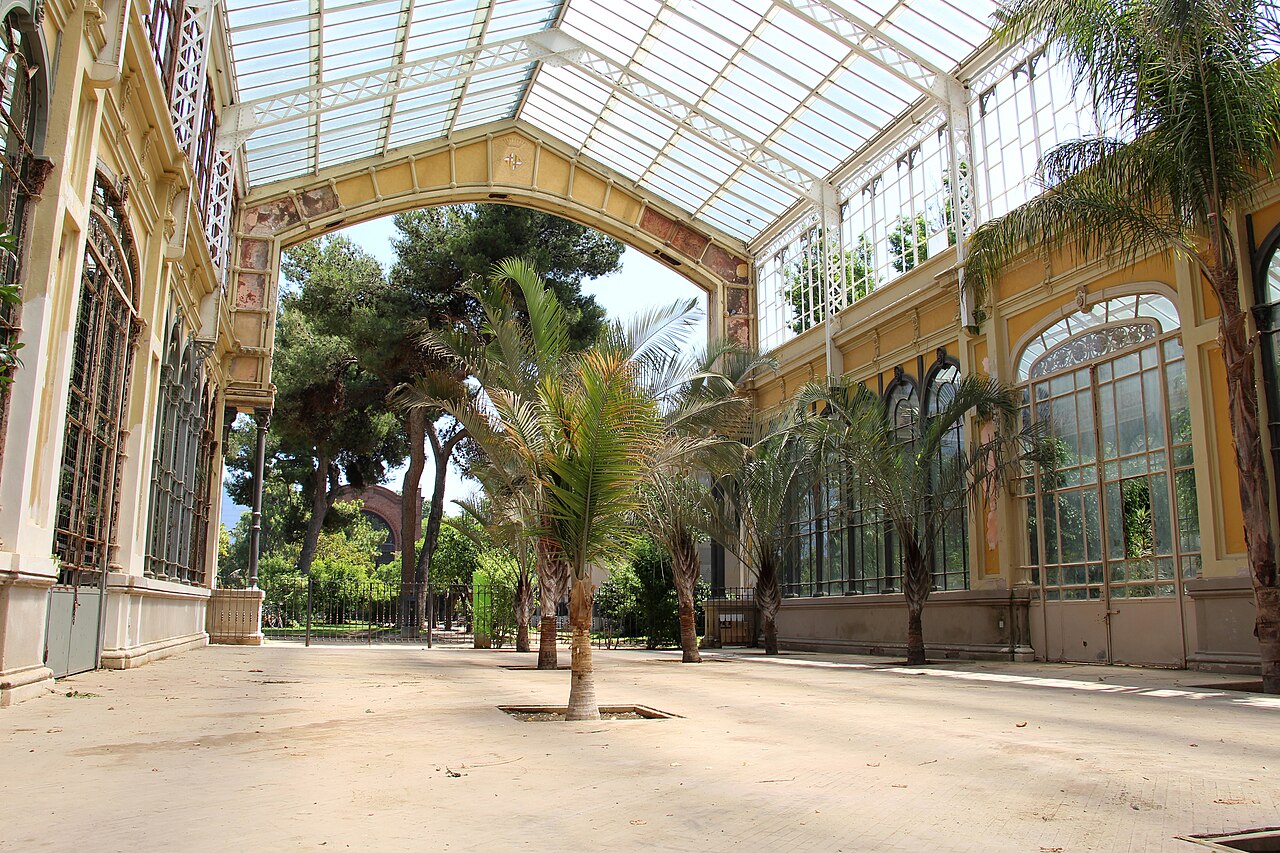
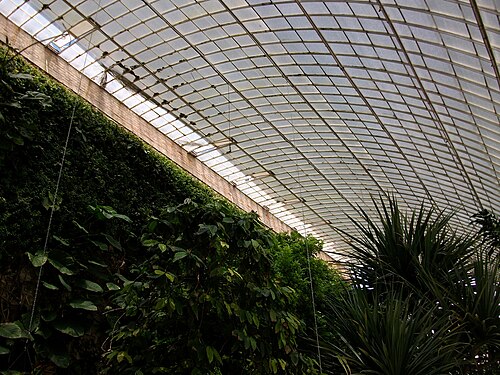
The Hivernacle exemplifies the iron architecture born of the Industrial Revolution, which Fontserè had planned for several buildings in the Ciutadella alongside the Born market and the Umbracle. Covering about 1,000 m², it lines up three large naves: the taller Central nave, flanked by the Magnòlies and Picasso naves, named after the walks that border them. The end walls planned for the central nave were never built, so it remains open on two sides beneath its double-pitched roof, while the side naves are fully enclosed in iron and glass; the heating budgeted for them was never installed. Cast-iron palmettes and Barcelona's coat of arms, set in the tympanum of the central nave, enliven the structure.
The 2022-2023 restoration stripped the whole frame, welded in new metal where corrosion had gone too far and revealed that the ironwork had originally been painted green, a colour now restored. Riquer's panels, halfway between stucco and mural painting, were uncovered beneath several layers and restored, or reproduced where they had been lost. The Magnòlies nave received tougher glazing, downpipes were moved inside, and motorised windows and roof lights controlled by sensors now regulate the temperature, supported by humidifiers, misting and drip irrigation.
Plant collections
With no continuous planting over the years, the greenhouse keeps no original collection. Fontserè's predecessor was known for a rare "Musaneta" (Ensete ventricosum), noted by the press in 1875. The golden age came in the 1960s, when Lluís Riudor and the botanical technician Joan Pañella gathered tropical and subtropical plants from the Americas, Asia, Oceania, the Canary Islands and Guinea, including coffee, bananas, philodendrons, monsteras and sansevierias, listed in a municipal catalogue published in 1966.
The 2023 planting scheme numbers more than a hundred species, almost all new, chosen to cope with a cold greenhouse with neither heating nor shading and to evoke the years 1965-1980. The Magnòlies nave holds most of the labelled botanical circuit, while the Central nave receives palms. Classic nineteenth-century glasshouse plants (Asplenium nidus, Dicksonia antarctica, Howea, Stephanotis floribunda) grow beside food, medicinal and fibre species (Coffea arabica, Carica papaya, Mangifera indica, Ananas comosus, Moringa oleifera, Pandanus utilis) and a few recent cultivars.
Visiting
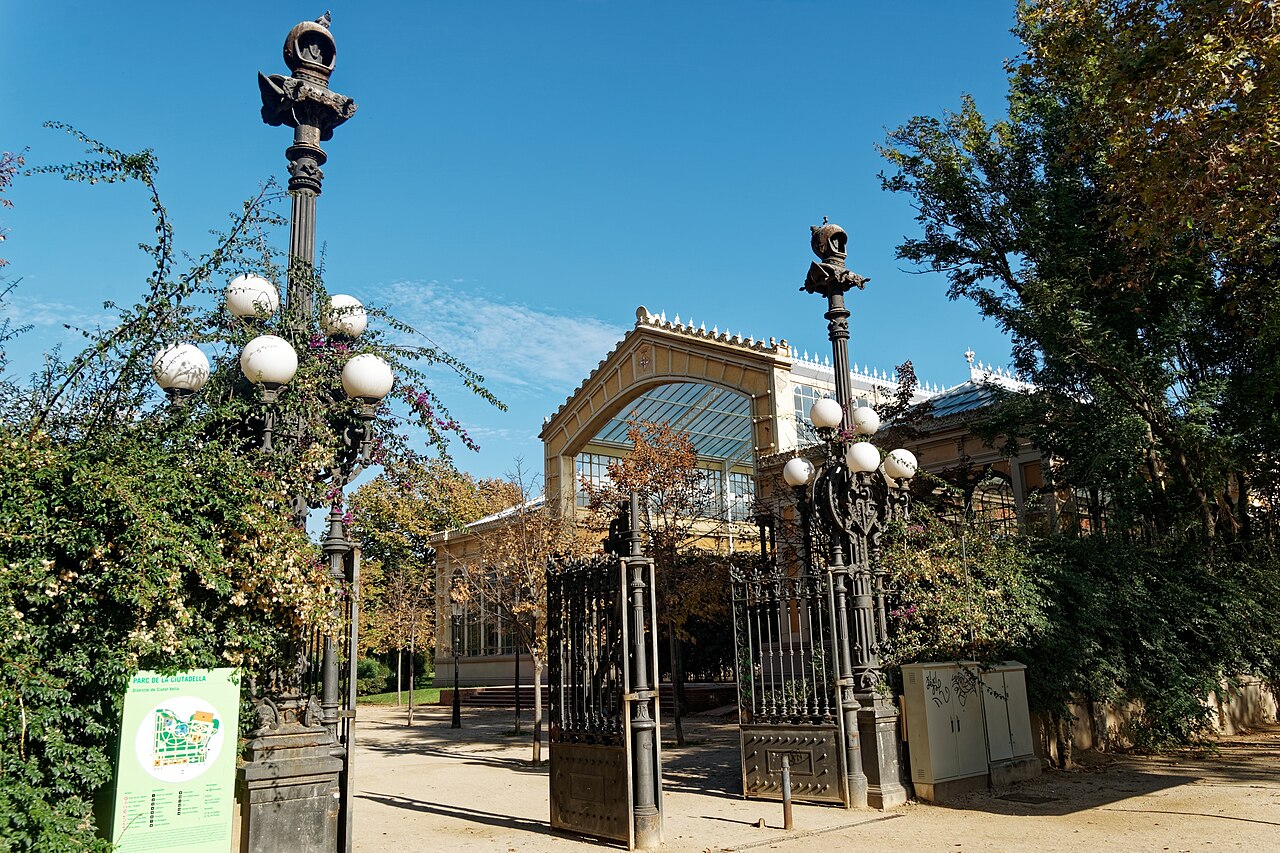
The Hivernacle stands at the heart of the Parc de la Ciutadella, in front of the Castell dels Tres Dragons and close to the Umbracle and the Museu Martorell, three buildings conceived in the late nineteenth century for a park with a scientific vocation and now grouped in the city's "Ciutadella del Coneixement" project.
The Central nave houses an information point on Barcelona's green spaces, the Picasso nave small workshops and activities, and panels trace the history of each nave. The greenhouse is part of the guided tour of the park and hosts exhibitions such as "Màquina Climàtica", announced for 2024 and devoted to the evolution of greenhouses. The park, protected as a cultural asset of national interest, invites a longer walk as far as the neighbouring zoo.
41.39° N, 2.18° E
Greenhouses nearby
Architecture nearby
More greenhouses — Spain
Do you have a good photo of this greenhouse? Suggest it for this page →
Sources (5)
- ajuntament.barcelona.cat/premsa/2023/12/18/la-ciutadella-del-coneixement-pren-forma-amb-la
- prod.premsa.dtibcn.cat/premsa/wp-content/uploads/2023/12/DOSSIER_HIVERNACLE_DIGITAL_13_12_
- ca.wikipedia.org/wiki/Hivernacle_(Barcelona)
- 3cat.cat/324/barcelona-comenca-a-rehabilitar-lhivernacle-de-la-ciutadella-abandonat-durant
- openstreetmap.org/way/33570471
Affiliate links — booking through Verrière helps fund our research, at no extra cost to you.