Palacio de Cristal
Retiro Park, Madrid

Sources checked September 2026
- Year
- 1887
- Architect
- Ricardo Velázquez Bosco
- Style
- Iron and glass on a brick base
- Dimensions
- Dome over 22 m high
- Status
- Closed since May 2023 for restoration; reopening planned for 2027
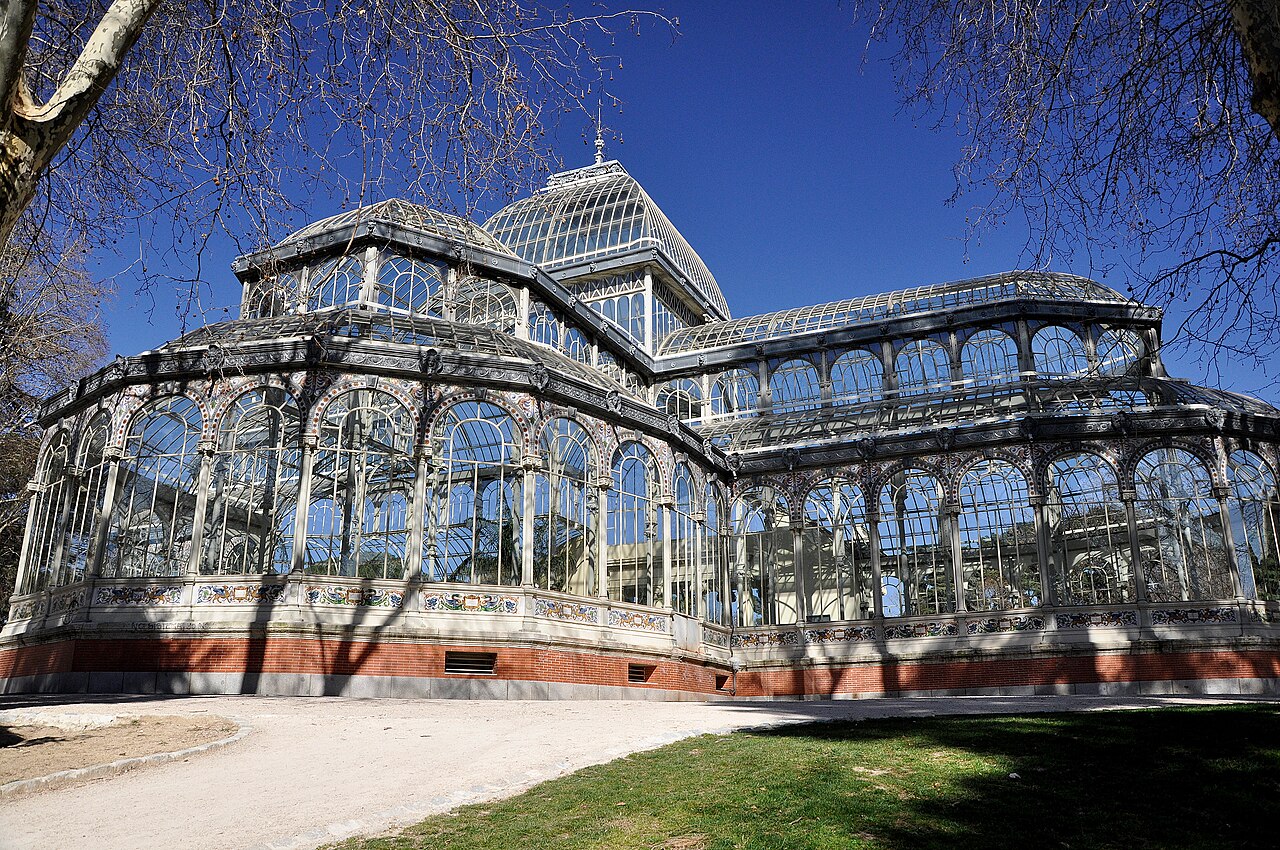
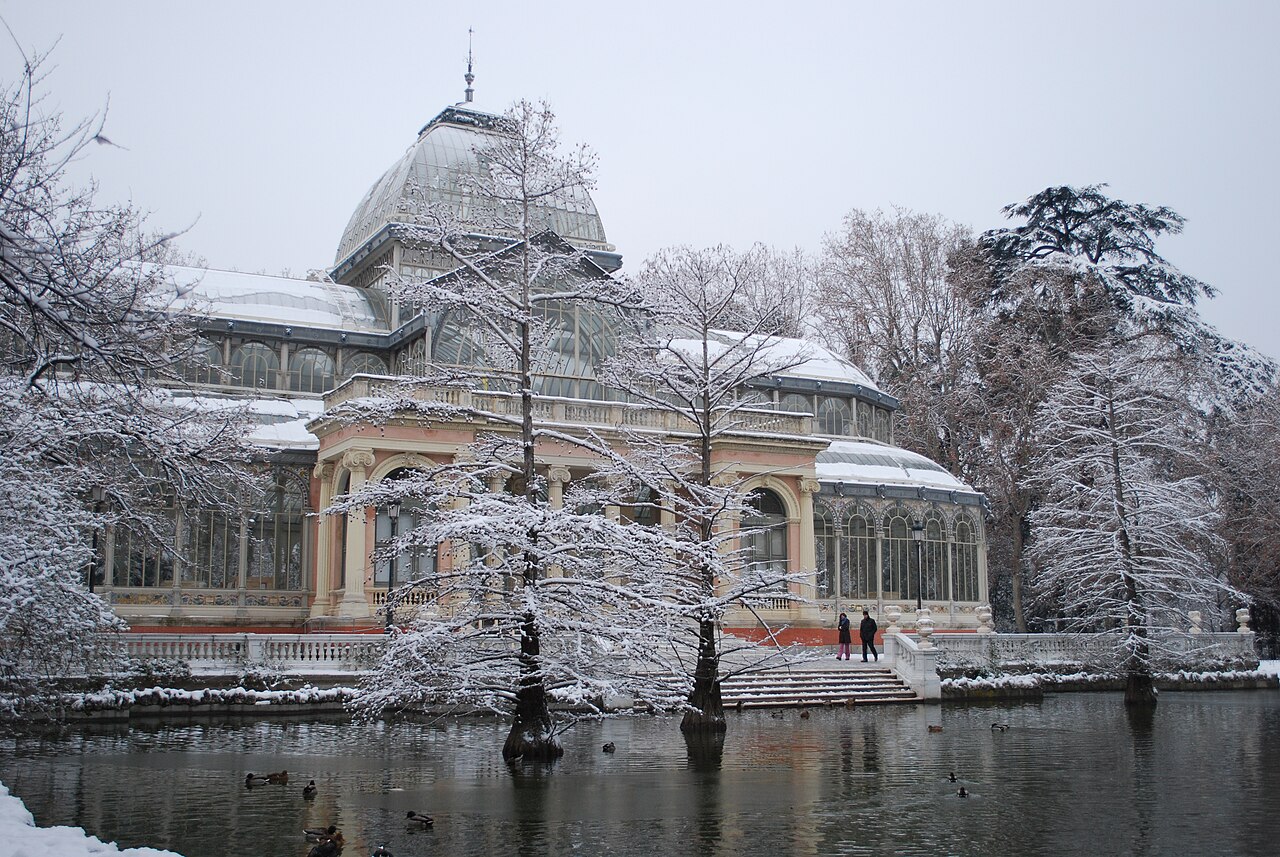
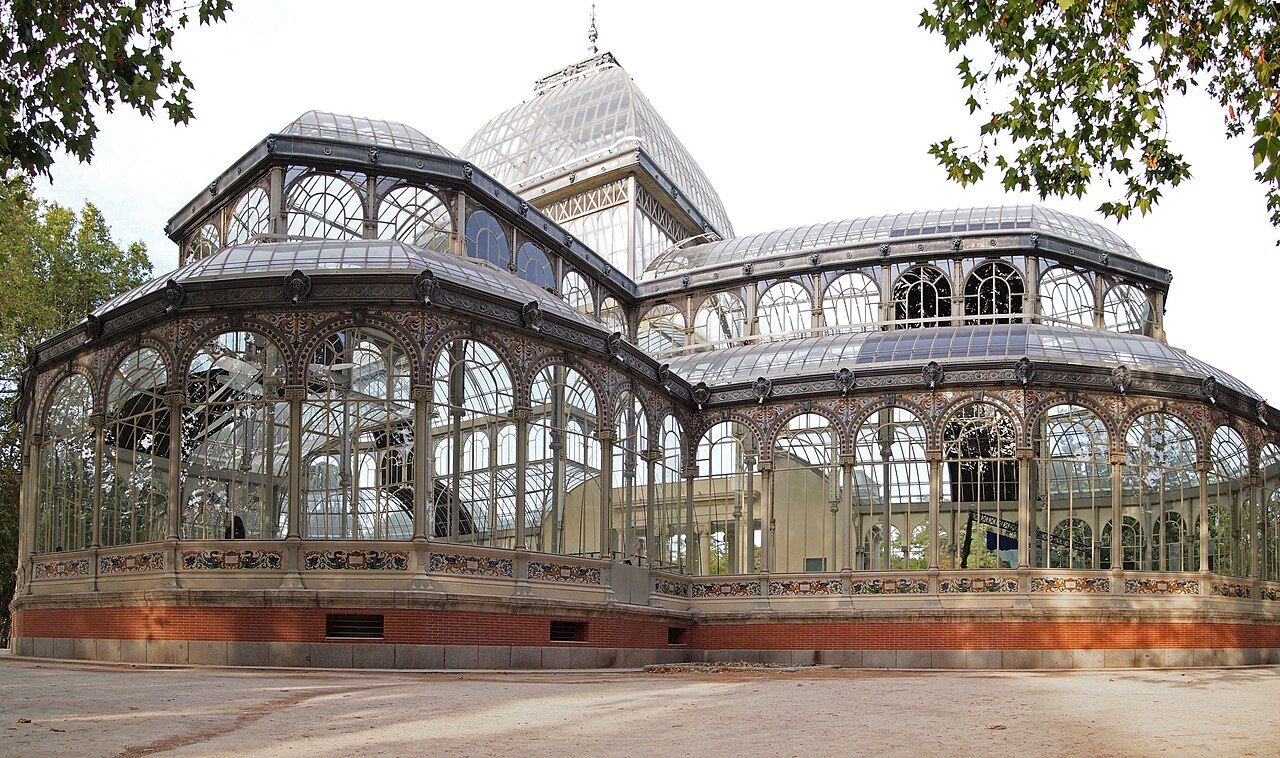
Built in record time to serve as a pavilion for exotic plants at the 1887 Philippines Exposition, when the Philippines was still a Spanish colony, the Palacio de Cristal follows a Greek-cross plan inspired by the Victorian greenhouses of Paxton and Burton. Its iron structure, cast in Bilbao, rests on a brick base adorned with ceramic tilework. Now an exhibition space of the Reina Sofía museum, it has lost its botanical function but retained its role as a glass cathedral at the heart of the Retiro.
Practical info
- Tickets
- The Reina Sofía Museum states free access all year to its two Retiro venues, the Palacio de Cristal and the Palacio de Velázquez; the esMadrid tourism site also lists the price as free (information listed in October 2026).
- Opening hours
- Palacio de Cristal closed temporarily for works (until 2027 according to esMadrid); the museum invites visitors to see the art installation covering it. Hours for the two Retiro palaces from October to March: 10am–6pm (until 5pm on 24 and 31 December); closed 1 and 6 January, 1 May and 25 December.
- Getting there
- Paseo de República de Cuba, 4, 28009 Madrid (Retiro Park). Metro: Retiro (L2), Ibiza (L9) or Estación del Arte (L1); Cercanías: Madrid-Atocha. The museum gives 10 minutes on foot from the Puerta de Alcalá and 7 from Avenida Menéndez Pelayo.
Frequently asked questions
Is the Palacio de Cristal open?
No, it is closed temporarily for works: until 2027 according to esMadrid, the city's tourism site.
Is admission charged?
No: the museum announces free access all year to its two Retiro venues, the Palacio de Cristal and the Palacio de Velázquez. esMadrid also lists it as free.
Can the palace close on certain days?
Yes: the museum says that, given the building's characteristics, the Palacio de Cristal may stay closed on rainy days and heat-alert days, besides the closures on 1 and 6 January, 1 May and 25 December.
What can't I bring in?
According to the museum: no food or drink, no pets (assistance dogs only), no suitcases; handbags and backpacks of 40x30x10 cm at most. Under-14s must be accompanied by an adult.
History
The Palacio de Cristal was built for the General Exhibition of the Philippine Islands, held in the Retiro in 1887 when the archipelago was still a Spanish colony. Ricardo Velázquez Bosco designed it; the engineer Alberto de Palacio Elissagüe calculated the structure, the contractor Bernardo Asins assembled it, and the brothers Germán and Daniel Zuloaga supplied the ceramic decoration. Prefabrication allowed the whole building to go up in less than five months. It was meant to display Philippine plants, but the exhibition also staged something now openly condemned: the public display of people brought from the islands, regarded as Spain's first 'human zoo'.
Conceived as a permanent structure, possibly a future overseas museum, the pavilion went on to serve many purposes. In May 1936 its glass walls were hung with curtains so that it could host the assembly that elected Manuel Azaña President of the Republic. Protected as Spanish heritage since 1935, it was repaired after the Civil War and restored in 1975 under Ángeles Hernández-Rubio; a further campaign in 1994–1998, led by José de la Dehesa, accompanied its transfer to the Museo Reina Sofía, which uses it for temporary exhibitions. Since 2021 it has formed part of the UNESCO World Heritage property 'Paseo del Prado and Buen Retiro'.
In May 2023 pieces falling from the structure forced its closure. After emergency shoring, a full restoration of the ironwork and glazing, budgeted at nearly €7.5 million, got under way, with reopening scheduled for 2027.
Architecture and engineering
The building follows a Greek-cross plan, its crossing crowned by a glazed dome; its height runs from just over 22 metres to 24 metres, depending on whether the vault or the top of the dome is measured. A Bilbao-made iron frame carries a skin that is almost entirely glass, set on a stone and brick plinth enlivened by the Zuloagas' glazed ceramic friezes. The prefabricated components that made such rapid construction possible also meant the pavilion could, in principle, be taken down and re-erected.
Its lineage runs back to the great British iron-and-glass buildings, Joseph Paxton's Crystal Palace and Decimus Burton's Palm House at Kew, and it is often described as Spain's most significant contribution to that tradition. The interior encloses roughly 13,000 cubic metres. Such transparency has its drawbacks: summer temperatures inside can reach 50 °C, and condensation and corrosion lie behind the current works, which include replacing some 5,000 panes of glass.
Plant collections
The Palacio de Cristal no longer houses plants. In 1887 it displayed tropical vegetation from the Philippines; today it is an empty, light-filled hall that the Museo Reina Sofía hands over to contemporary artists, often for installations made specifically for the space.
During the restoration the museum has turned the building's protective wrapping into a canvas. A large photographic frieze by Miguel Ángel Tornero, assembled from images of Madrid, came first; in 2026 the Peruvian artist Andrea Canepa wrapped the palace in coloured fabric inspired by the pre-Columbian textiles of Paracas, a work titled 'Fardo'.
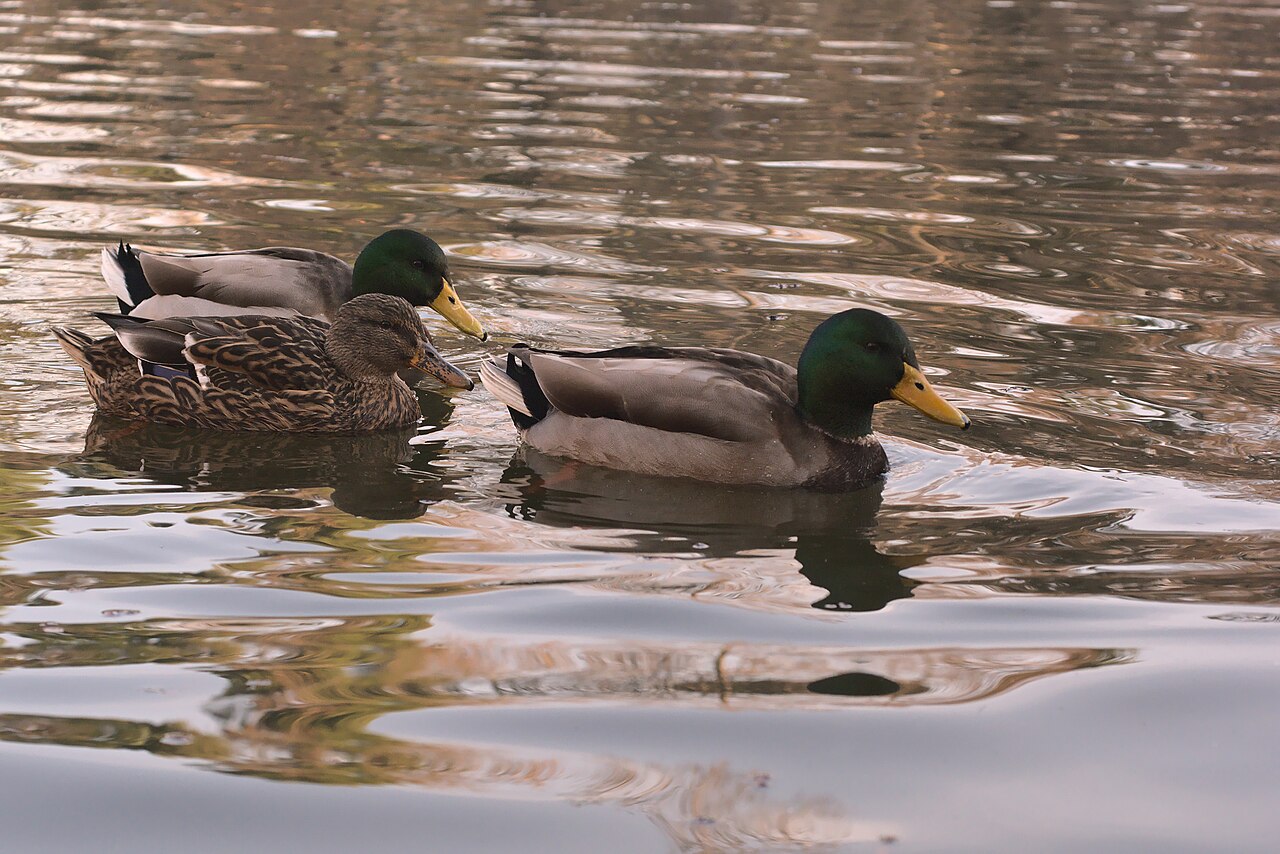
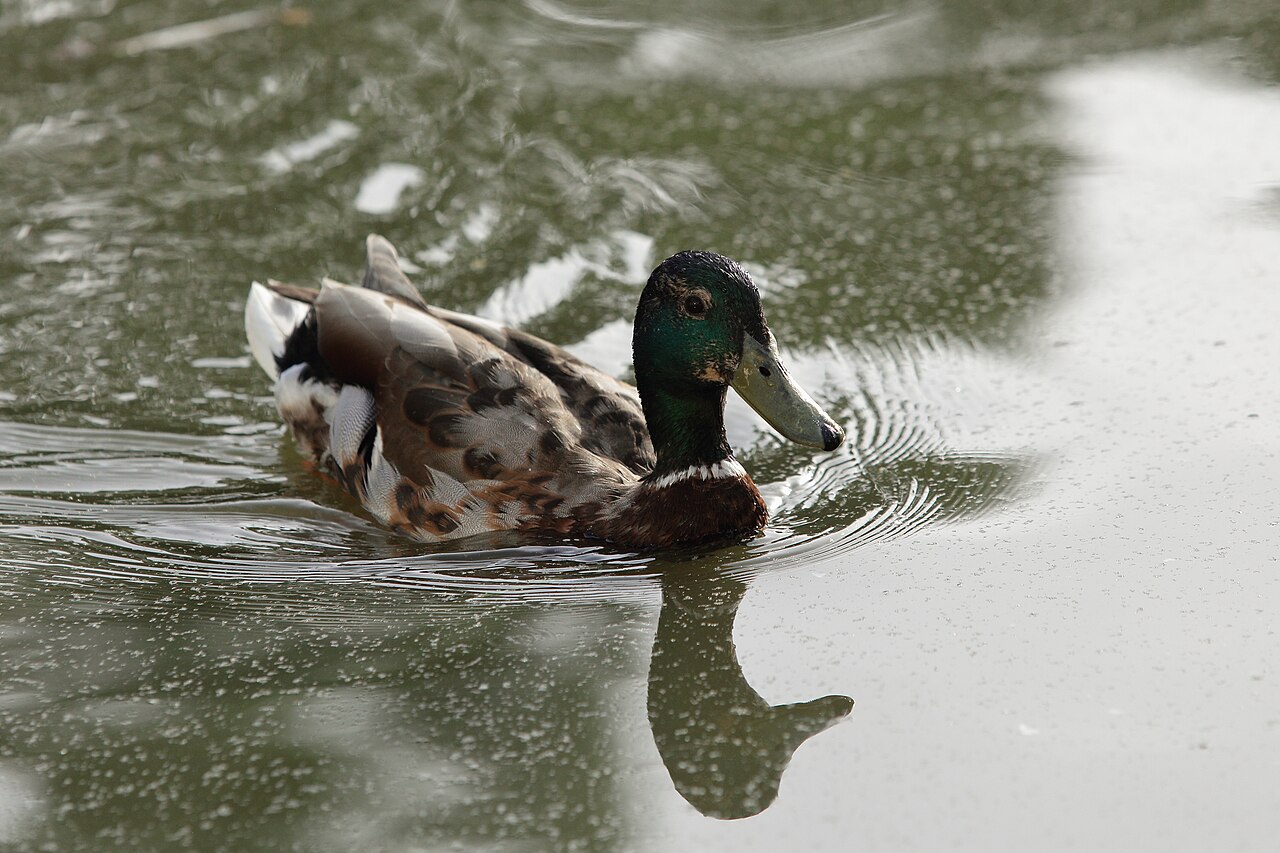
The greenery is now outdoors: horse chestnuts ring the palace, and its artificial pond is home to ducks, geese and turtles.
Visiting
The palace stands in the middle of the Retiro, south of the large boating lake, beside its own small pond and a short walk from the Palacio de Velázquez, the Reina Sofía's other venue in the park. While it is closed for restoration it can still be seen from outside until the planned reopening in 2027, and the artworks covering the scaffolding are worth the walk in themselves. When open, the exhibitions are free. An hour covers the palace and its surroundings, easily combined with a longer stroll through the Retiro and the museums of the Paseo del Prado beyond.
40.41° N, 3.68° W
Greenhouses nearby
More greenhouses — Spain
Do you have a good photo of this greenhouse? Suggest it for this page →
Sources (8)
- museoreinasofia.es/museo/patrimonio-arquitectonico/palacio-cristal-palacio-velazquez/
- esmadrid.com/en/tourist-information/palacio-de-cristal
- en.wikipedia.org/wiki/Palacio_de_Cristal_del_Retiro
- eldiario.es/madrid/somos/adios-5-000-viejos-cristales-palacio-cristal-joya-retiro-renueva-
- revistadearte.com/exposiciones/el-museo-reina-sofia-renovara-el-palacio-de-cristal-del-ret
- timeout.es/madrid/es/noticias/el-arte-vuelve-a-este-icono-centenario-del-parque-de-el-reti
- madridarteycultura.es/palacio-de-cristal/
- openstreetmap.org/way/23596451