Tepidarium of the University of Catania Botanical Garden (Orto Botanico)
Catania, Sicily
Entry updated on October 5, 2026
- Year
- 2008 (rebuild of a 19th-century greenhouse demolished in 1958)
- Architect
- Original greenhouse: Maison Lefebvre O'Reilly et Dormois (Paris)
- Style
- Large tropical glasshouse, rebuilt in 2008
- Dimensions
- Garden of 16,000 m² (Hortus Generalis 13,000 m², Hortus Siculus 3,000 m²)
- Status
- Open to the public (guided tours by appointment)
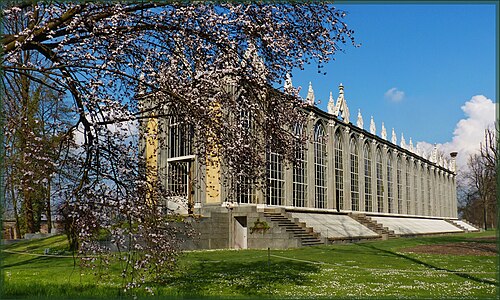
The Tepidarium is the large tropical glasshouse of the botanical garden founded in Catania in 1858 by the Benedictine monk Francesco Tornabene. The original greenhouse, supplied by the Paris firm Lefebvre O'Reilly et Dormois and described by Tornabene in 1887 as modelled on Palermo's, was demolished in 1958 after the severe damage it suffered in the wake of the Second World War. Rebuilt by the university for 425,954 euros, it was inaugurated on 15 September 2008 and holds more than 160 species, coffee and papaya among them.
Affiliate links — booking through Verrière helps fund our research, at no extra cost to you.
History
1 min
Catania's botanical garden owes its existence to the Benedictine monk Francesco Tornabene Roccaforte, who held the chair of botany from 1843. In 1847 he obtained a plot of land from the university, but the revolutions of 1848 wrecked this first attempt; an endowment for upkeep was set in 1854, the architect Mario Di Stefano was commissioned to design the buildings in 1856, and the garden was founded in 1858. The first plants, sent by other botanic gardens, went into the ground in 1862.
The great greenhouse, the Tepidarium, was supplied by a Paris company, the Maison Lefebvre O'Reilly et Dormois, based in the Rue du Faubourg-du-Temple. In his Hortus Botanicus, published in 1887, Tornabene described it as designed on the model of the greenhouse in Palermo's botanic garden. Badly damaged in the aftermath of the Second World War, it defeated every attempt at restoration, and the director Valerio Giacomini decided to pull it down: a 2008 article dates that decision to 1956, while the Italian botanic gardens portal and other sources place the demolition in 1958.
Half a century later the university rebuilt the greenhouse under the direction of Pietro Pavone, as part of a coordinated Catania-Lecce project funded by the Italian Ministry of Universities and the European Community, at a cost of 425,954.04 euros. The new Tepidarium was inaugurated on 15 September 2008, with Giovanna Cosentino Di Rondé, president of the Catania Garden Club, acting as patroness of the ceremony.
Architecture and engineering
1 min
The original Tepidarium was an imported building: its supplier, the Maison Lefebvre O'Reilly et Dormois, worked in Paris, and Tornabene likened the Catania greenhouse to the one in Palermo's botanic garden. The texts call it a large, monumental greenhouse and an imposing structure, without giving its dimensions.
The greenhouse rebuilt in 2008 is intended for growing tropical plants, which calls for a very humid atmosphere inside.
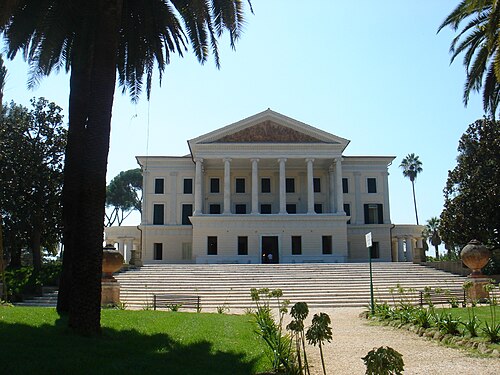
It stands in a 16,000 m² garden divided into two parts: the Hortus Generalis, about 13,000 m², devoted to exotic plants, and the Hortus Siculus, 3,000 m², set aside for the Sicilian flora. At the end of the main avenue, in a semicircular clearing, rises Mario Di Stefano's temple-like neoclassical building: a marble stairway leads up to its portico with a double row of columns, framed by two huge Dracaena draco.
Plant collections
1 min
The new Tepidarium holds more than 160 tropical species, both ornamental plants and food plants. The article announcing its inauguration names breadfruit, coffee, cacao, papaya and tamarind, and a 2018 article singles out coffee and papaya.
Around the glasshouse the garden keeps four main collections: succulents, with about 2,000 species, palms, with some fifty species, the Sicilian flora, and trees and shrubs, alongside many other exotic species. The Hortus Siculus gathers plants typical of Sicily and of the Mediterranean climate, while two huge Dracaena draco frame the marble stairway of the neoclassical building designed by Mario Di Stefano.
Visiting
1 min
The botanical garden is at Via Etnea 397 in Catania, and guided tours can be booked. The Tepidarium is one stop on a route that also takes in the large succulent collection and the palms, then the Hortus Siculus with its island flora. Allow about an hour for the whole garden, longer for anyone lingering among the succulents. Mario Di Stefano's neoclassical building at the end of the main avenue, framed by its two huge Dracaena draco, deserves a closer look before leaving the garden.
37.52° N, 15.08° E
Greenhouses nearby
More greenhouses — Italy
Do you have a good photo of this greenhouse? Suggest it for this page →
Sources (5)
- unictmagazine.unict.it/lorto-botanico-internazionale-dei-catanesi
- ortobotanicoitalia.it/sicilia/catania/
- tecnicadellascuola.it/nuovo-tepidarium-all-orto-botanico-di-catania-inaugurazione-il-15-se
- catania.liveuniversity.it/2018/09/22/catania-orto-botanico-polmone-verde-centro-citta/
- en.wikipedia.org/wiki/Orto_Botanico_dell%27Universit%C3%A0_di_Catania