Serre Ducali, Modena Botanical Garden
Modena, Emilia-Romagna
Entry updated on October 1, 2026
- Year
- 1836
- Style
- Classical-style winter greenhouses, linked by a herbarium building
- Dimensions
- About 300 m² for all the garden's greenhouses (per English Wikipedia)
- Status
- Open to the public since the reopening of 30 May 2025, after more than six years of works
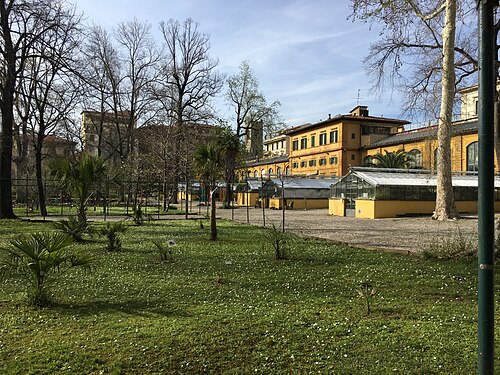
In the heart of the botanical garden founded in 1758 by Duke Francesco III d'Este, the two large Serre Ducali, completed in 1836, were built to shelter exotic potted plants in winter. They were later linked by a building intended as a museum and herbarium. Today they are arranged as a zone for succulents and a hot, humid zone where Victoria cruziana, among others, grows, and they have been restored in a works programme of more than six years that ended with the garden's reopening on 30 May 2025. A succulent house from the 1980s and a semi-underground serretta of 1994 complete the group.
Affiliate links — booking through Verrière helps fund our research, at no extra cost to you.
History
1 min
Modena's botanical garden was founded in 1758 by Duke Francesco III d'Este, who set aside part of the ducal garden for growing medicinal plants. It passed to the university in 1772 and has remained inside the ducal garden, today one of the emblematic places of the university.
As travel and international exchanges increased interest in foreign plants, the garden acquired wintering facilities. In 1836 the two large Serre Ducali were completed; they were later linked by a building intended to serve as a museum and herbarium. That block now houses the garden's historic collections: the herbarium, the wood collection (xiloteca) and the fruit collection (carpoteca). English Wikipedia describes them as the garden's most important building. The sources read do not name an architect.
In the twentieth century the garden gained a succulent house, built in the mid-1980s, and in 1994 a semi-underground serretta near the entrance for exotic plants of hot, humid climate. Closed for more than six years, the group was restored with regional post-earthquake funds, university resources and the national recovery plan (PNRR) for historic parks and gardens, at a cost of about 720,000 euros according to the press. The garden reopened on 30 May 2025.
Architecture and engineering
1 min
The Serre Ducali belong to the classical greenhouse architecture of the nineteenth century. They were designed, according to the collecting principles of the period, to hold a large number of potted plants through the cold season. The heritage site places them in front of the symmetrical parterre laid out at the end of the eighteenth century. Two glazed bodies are united by a central building, originally planned as a museum and herbarium.
The restoration completed in 2025 covered the greenhouse glazing, the perimeter walls, the timber frames and the panes. Press reports also mention consolidation of vaults, reinforcement of foundations and new electrical and safety systems. The historic parterre was restored with a drip-irrigation system fed by a deep well, and the central pool was restored.
Beside this historic block stand the 1980s succulent house and the 1994 serretta, semi-underground near the entrance. According to English Wikipedia the garden's greenhouses cover 300 m² in all. The dimensions of the Serre Ducali themselves do not appear in the sources consulted.
Plant collections
1 min
The Serre Ducali are now divided into two zones: one for succulents, the other hot and humid, which hosts tropical species such as Victoria cruziana, a giant water lily whose leaves measure about a metre across according to the heritage site consulted. The 1994 serretta brings together carnivorous plants, ferns and orchids; the succulent house of the mid-1980s is devoted to those plants.
Outdoors, the garden of about one hectare grows roughly 700 species in the parterre-school, including more than a hundred iris varieties, and an arboretum of some 200 woody plants on the Montagnola, where a terebinth (Pistacia terebinthus) of about 150 years is cited. English Wikipedia gives about 1,400 species for the whole garden, whereas the 2025 press speaks of more than 500 species after the restoration.
Visiting
1 min
The garden is on viale Caduti in Guerra in Modena and covers almost a hectare. The ducal greenhouses stand in front of the symmetrical eighteenth-century parterre, which includes a pool with a fountain; the Montagnola holds the arboretum.
Allow about an hour for the parterre, the ducal greenhouses and the serretta. As the garden reopened in May 2025 after more than six years of closure, it is worth checking access arrangements before visiting. The parterre irises are best seen in spring, while the greenhouses can be visited all year.
44.65° N, 10.93° E
Greenhouses nearby
More greenhouses — Italy
Do you have a good photo of this greenhouse? Suggest it for this page →