Boboli Gardens Limonaia (Lemon House)
Florence, Tuscany
Entry updated on October 1, 2026
- Year
- 1777-1778
- Architect
- Zanobi Del Rosso
- Style
- Late 18th-century lemon house with pilastered façade and large glazed openings
- Dimensions
- ≈106 m long, 9 m deep
- Status
- Open to the public at certain times (late winter and spring)
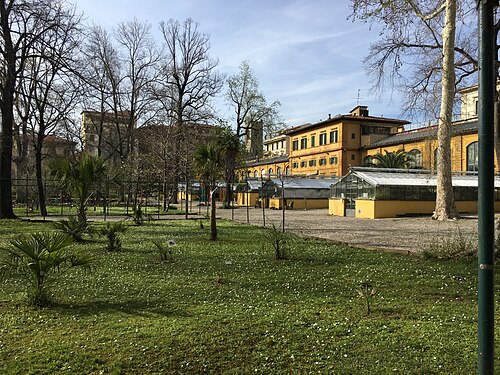
Built in 1777-1778 by Zanobi Del Rosso for Grand Duke Peter Leopold of Lorraine, the limonaia is a long building of about 106 by 9 metres, with a slightly trapezoidal plan, set in the Boboli Gardens in Florence. It replaced an older plant shelter and stands on the site of an animal enclosure laid out in 1677. Wide glazed openings admit light and warmth for the roughly 500 citrus trees in Impruneta terracotta pots that winter inside. Restored in 2002-2005, it opens to visitors only at certain times of year.
Affiliate links — booking through Verrière helps fund our research, at no extra cost to you.
History
1 min
The Boboli Gardens, which passed in turn to the Pitti, the Medici, the Habsburg-Lorraine, the Savoy and finally the Italian state, once sheltered their winter citrus trees in a modest shed known as the Stanzonaccio. As part of the garden's reorganisation ordered by Grand Duke Peter Leopold of Lorraine, a proper limonaia was built in 1777-1778 to a design by Zanobi Del Rosso. It rose on the site of the Serraglio degli Animali, an enclosure for exotic animals established in 1677.
At the time, growing citrus was both an agricultural activity and a mark of prestige for the great families. The building has remained regarded as one of the most elegant and modern in the Florence of its day.
In 1816 a side extension is attributed to Giuseppe Cacialli: a small room for materials and tools and a room for the head gardener. The fence was rebuilt in 1822. Work on the ironwork and the façade took place between 1879 and 1888. From 1966 to 1968 the building was temporarily converted into an emergency workshop for restoring damaged paintings. A comprehensive restoration, including recovery of the plasterwork, was carried out in 2002-2005.
Architecture and engineering
1 min
The building measures about 106 metres in length and 9 metres in depth, on a slightly trapezoidal plan. Its façade, described as late Baroque or Rococo in Florence's register of civic architecture, is articulated by pilasters and repeated bays; each bay is pierced by windows topped by framed openings with decorative cartouches, and the whole is crowned by a moulded cornice.
The large glazed openings on the front serve the purpose of the place: they store heat and let in as much natural light as possible, which plants spending the cold season under cover cannot do without. The 1816 extension, attributed to Giuseppe Cacialli, added small service rooms on the left-hand side.
Plant collections
1 min
During the winter the limonaia shelters about 500 citrus trees in Impruneta terracotta pots. All the plants descend from Medicean cultivars, that is, varieties grown in Florence since the Medici period. They include lemons, citrons, grapefruits, citranges, bitter oranges, chinotti, mandarins and limes.
Several specimens have particular historical and botanical value: the ribbed orange (Citrus aurantium 'Canaliculata'), introduced to Florence under Francesco I de' Medici according to local press; the citrus known as 'Bizzarria'; and the Buddha's hand citron.
In spring and summer, from May to October, the pots leave the limonaia and are set out around the Isolotto basin, in the adjoining garden and in the lower botanical garden.
Visiting
1 min
The limonaia stands within the Boboli Gardens, whose main entrance is shared with the Palazzo Pitti (Piazza de' Pitti). According to local press, it has opened to the public on certain days between February and April, with free entry and a voluntary contribution towards upkeep and restoration; the dates change from year to year and are best checked with the garden's administration before travelling.
From May to October the citrus trees are outdoors, so they are better sought in the gardens themselves. A visit to the limonaia takes little time and combines naturally with the rest of the Boboli Gardens and the Palazzo Pitti.
43.76° N, 11.25° E
Greenhouses nearby
More greenhouses — Italy
Do you have a good photo of this greenhouse? Suggest it for this page →