Serra Moresca of Villa Torlonia
Rome, Lazio
Entry updated on September 30, 2026
- Year
- 1839-1841
- Architect
- Giuseppe Jappelli
- Style
- Neo-Moorish, Alban stone, cast iron and coloured glass
- Dimensions
- Seven-bay façade
- Status
- Open to the public (closed in July and August)
Commissioned by Prince Alessandro Torlonia from the Venetian architect Giuseppe Jappelli, the Serra Moresca of Villa Torlonia was designed in 1839, begun in 1840 and completed with the neighbouring tower and grotto around 1841. Inspired by the Alhambra of Granada, it combines Alban-stone columns, hexagonal cast iron and polychrome stained glass behind a seven-bay façade. Degraded during the 20th century, it underwent a two-phase restoration from 2007 and reopened on 8 December 2021, after fourteen years of closure, as part of the Museums of Villa Torlonia.
Affiliate links — booking through Verrière helps fund our research, at no extra cost to you.
History
1 min
Prince Alessandro Torlonia commissioned the Venetian architect Giuseppe Jappelli to remodel the southern part of his estate on the Via Nomentana. In 1839 Jappelli first imagined a group combining a grotto, an armoury, a nymph's fountain and an Indian pagoda, before settling on the idea of a Moorish-looking greenhouse, in the spirit of the gardens of the Lombard-Venetian kingdom. He may have drawn on the engravings of James Cavanah Murphy's Arabian Antiquities of Spain (1816), and Giacomo Caneva assisted him. Construction began in 1840; according to the museums' official site the three main elements, greenhouse, tower and grotto, were finished by 1841, and two coloured Jappelli drawings date from 1842. Extensions continued until about 1865.
The complex remained intact until around 1930. Fragile materials, then neglect linked to the war, badly damaged it: rooms for the gardener were added at the rear in 1905, and the grotto was largely demolished in 1908. Closed for fourteen years, the greenhouse underwent a two-phase restoration, the first from 2007 to 2013 at a cost of about 4.9 million euros, the second, devoted in part to vegetation and to the museum fit-out by the architect Maria Cristina Tullio, completed before the reopening on 8 December 2021.
Architecture and engineering
1 min
The main façade of the greenhouse is divided into seven bays, separated by polychrome glazing carried on hexagonal cast-iron columns; columns of Alban stone (peperino) bear scratched designs of Moorish inspiration. The entrance opens through a horseshoe arch topped by a blue pediment strewn with golden stars, with an inscription in Kufic-style script honouring Alessandro and Teresa Torlonia; marble lions once flanked it. Inside, wooden columns supported planters and a painted wooden ceiling, which included a movable panel on the north side.
The programme is not limited to the greenhouse. A small building with a horseshoe entrance and painted façade, a three-storey tower reached by a spiral staircase (bedroom, kitchen, hexagonal dining room, cast-iron and coloured-glass windows, polychrome stucco) and an artificial grotto with imitation stalactites, lakes and wooden bridges form a route of fantasy. The tower's dining room held a divan-baldachin with a mechanism and lead basins in which fish swam behind the windows.
Plant collections
1 min
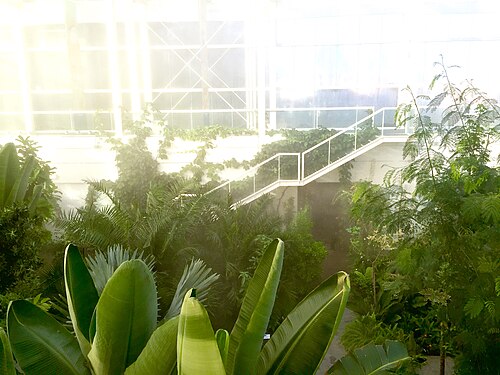
The greenhouse now displays exotic and rare plants, among them palms, agaves, pineapples and aloes, around a fountain that runs again. It thus resumes the building's original function: sheltering species that Rome's climate did not allow to grow outdoors, while serving as a reception room.
The grotto, conceived as a nymph's sanctuary, the Nymphae Loci, holds cascades and small basins planted with water lilies and lotus. Vegetation, long invasive, required a specific clearing operation before the reopening. More than a scientific botanical garden, the place is a horticultural stage set in which plants contribute to the overall effect, together with the light filtered through coloured glass.
Visiting
1 min
The Serra Moresca stands in the park of Villa Torlonia, whose main entrance is on Via Nomentana, at number 70; it belongs to the circuit of the Museums of Villa Torlonia. Allow about an hour for the greenhouse, the grotto and the exterior of the tower, plus time for the park. It is closed in July and August, which points the visit towards spring, autumn or winter. The visit combines naturally with the other buildings of the villa, including the Casina delle Civette.
41.91° N, 12.51° E
Greenhouses nearby
Do you have a good photo of this greenhouse? Suggest it for this page →
Sources (7)
- museivillatorlonia.it/it/infopage/il-complesso-della-serra-moresca
- turismoroma.it/en/places/musei-di-villa-torlonia-complex-serra-moresca
- it.wikipedia.org/wiki/Serra_moresca
- villegiardini.it/serra-moresca-villa-torlonia/
- romatoday.it/eventi/cultura/riapertura-serra-moresca-villa-torlonia.html
- en.wikipedia.org/wiki/Villa_Torlonia_(Rome)
- mapcarta.com/W297155397