Serra Carolina (Giardino d'Inverno)
Palermo
No freely licensed photo of this greenhouse yet. Do you have one? Suggest it for this page →
Sources checked October 2026
- Year
- 1823
- Style
- Winter garden, rebuilt in cast iron in the second half of the 19th century
- Dimensions
- about 1,300 m² for all the garden's greenhouses combined
- Status
- In operation, open to the public within the Orto Botanico di Palermo
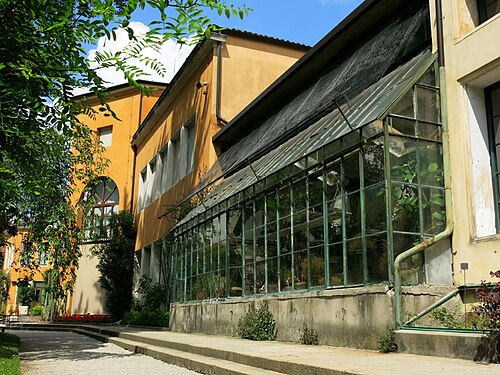
At the heart of the Orto Botanico di Palermo, one of Europe's oldest botanical gardens, the Serra Carolina — or Giardino d'Inverno — takes its name from Queen Maria Carolina of Austria, wife of Ferdinand I of the Two Sicilies, who donated it to the institution in 1823. Originally built of wood and heated by stoves, the greenhouse was entirely rebuilt in cast iron in the second half of the 19th century, following the rise of metal-framing techniques imported from England and France. It complements the neoclassical ensemble designed by French architect Léon Dufourny for the garden's reception buildings, completed as early as 1789. Beneath its glass roof, coffee trees, papayas, bougainvillea, cinnamon trees, and mimosas from Africa, the Americas, and Asia enjoy the Sicilian mildness, alongside neighboring smaller greenhouses devoted to orchids and carnivorous plants. All the garden's greenhouses together now cover about 1,300 square meters, making this royal winter garden a discreet but precious milestone in the history of botanical acclimatization in the Mediterranean.
Affiliate links — booking through Verrière helps fund our research, at no extra cost to you.
History
The Orto Botanico of Palermo grew out of the chair of botany created in 1779 at the Regia Accademia degli Studi, forerunner of the university. First laid out near Porta Carini, the garden moved to its present site on the Piano di Sant'Erasmo; work on its neoclassical buildings began in 1789 and the garden was inaugurated in 1795.
The glasshouse is named after Queen Maria Carolina, born an Archduchess of Austria and wife of Ferdinand of Bourbon. Several descriptions say the queen donated it in 1823, while one description of the garden states that the glasshouse, ordered from England for the royal palace at Caserta, was given as early as 1799 but only put up in 1823. The university museum, for its part, mentions a wood-and-iron glasshouse donated in the 18th century. The first structure was of timber and heated by stoves.
In the second half of the 19th century the architect Carlo Giachery rebuilt it in cast iron; a municipal record dates the work to 1859. Giachery, who had designed the garden's custodian's house and storerooms in 1838, thus gave the Giardino d'Inverno the form it keeps today. The university presents it as one of the garden's emblems.
Architecture and engineering
The Serra Carolina is an iron-and-glass greenhouse on a rectangular plan, the largest in the Orto Botanico. The university museum singles out the elegance of its forms, the lightness of its structure, its decorative details and its imposing size. It replaced a timber building warmed by stoves, and its 19th-century rebuilding in cast iron gave it a slimmer, more durable frame.
In front of the glasshouse lies a small square with a fountain whose basin holds a statue of Paris carved by Nunzio Morello in 1838. The building complements the neoclassical core designed by the French architect Léon Dufourny — a central Gymnasium flanked by the Tepidarium and Calidarium — on which Giuseppe Venanzio Marvuglia also worked.
Together, the garden's glasshouses cover about 1,300 square metres.
Plant collections
Conceived as a winter garden, the Serra Carolina shelters, in pots and in open beds, plants that cannot survive a Palermo winter outdoors or that are vulnerable to unusual cold snaps, such as coffee.
The other glasshouses round out the collection: the Serra della Regione is given over to plants of hot, humid climates, among them the traveller's palm, aroids, Anthurium and Codiaeum; the succulent house shows plants adapted to drought; two small houses are devoted to orchids and carnivorous plants; and a final one, a rescue centre linked to the CITES convention, holds mainly American succulents.
Visiting
The Orto Botanico, the University of Palermo's garden, covers some ten hectares and holds more than 12,000 species. The Serra Carolina is reached on a walk that also takes in Dufourny's neoclassical buildings, the 1798 Aquarium with its three concentric pools and the great Ficus macrophylla brought from Norfolk Island in 1845.
Two hours allow an unhurried visit. The Sicilian climate makes the garden pleasant in any season, though the glasshouse makes most sense in winter, when the tropical plants take refuge there.
38.11° N, 13.37° E
Greenhouses nearby
More greenhouses — Italy
Do you have a good photo of this greenhouse? Suggest it for this page →
Sources (8)
- musei.unipa.it/it/serra-carolina
- ortobotanico.palermo.it/mappa-dellorto-botanico-di-palermo/
- docs.comune.palermo.it/verde-pubblico-dettaglio.php?id=151
- royaldistrict.it/siti-borbonici/orto-botanico-di-palermo-2/
- rocaille.it/lorto-botanico-di-palermo/
- antropocene.it/en/2023/01/30/botanical-garden-of-palermo/
- gali.news.blog/2021/03/15/lorto-botanico-di-palermo/
- openstreetmap.org/way/346039068
Affiliate links — booking through Verrière helps fund our research, at no extra cost to you.