Orchid Greenhouse, Sanjiangkou Botanical Garden (福州三江口植物园兰花温室)
Fuzhou (Cangshan District), Fujian
No freely licensed photo of this greenhouse yet. Do you have one? Suggest it for this page →
Sources checked October 2026
- Year
- 2024
- Architect
- Guangzhou Landscape Architecture Planning and Design Institute (广州园林建筑规划设计研究总院)
- Style
- Orchid-petal greenhouse: steel lattice shell, glass façades, three terraces
- Dimensions
- 2,200 m² (about 1,900 m² of exhibition space); three halls
- Status
- Open to the public (paid admission from 1 January 2026, 27 yuan announced; online reservation)
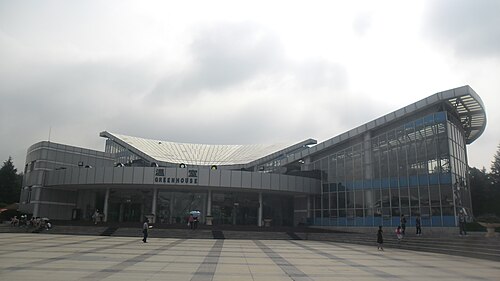
On the south-eastern slope of Qingliang Hill, the first phase of Sanjiangkou Botanical Garden in Fuzhou is organised around "a stream, a lake, a valley and a greenhouse" devoted to orchids. The greenhouse, of 2,200 m², is a steel shell with glass façades that follows the terrain: three oval halls stepped on terraces, the Aerial Garden (about 800 m², tropical forest), the Cloud Valley (about 560 m², subtropical habitats) and the Alpine Cliff (about 300 m²). It opened on 31 December 2024 and official sources describe it as the largest in China devoted to orchids.
Affiliate links — booking through Verrière helps fund our research, at no extra cost to you.
History
Sanjiangkou Botanical Garden in Fuzhou is a project launched in 2021: it plans four sites, two hills (Qingliang and Chengmen) and two wetlands (Mahangzhou and Donghu), according to an article on the website of the Fuzhou political consultative conference. The first phase covers 20.72 hectares at the foot of Qingliang Hill, in Cangshan District; a local property-news site puts its cost at 642 million yuan, and work began in 2023. The public notice of July 2024 on the architectural and landscape scheme of this phase names the client, Fuzhou Construction Development Group, and the designer, the Guangzhou Landscape Architecture Planning and Design Institute (广州园林建筑规划设计研究总院), for ten service buildings; the greenhouse is not mentioned there. The greenhouse is the subject of a design article in the Chinese journal Jianshe Keji (2026), whose author appears to belong to the same team judging by the page header; the article describes a hillside site in terraces with a level difference of about 6 m.
In March 2024 excavation of the orchid greenhouse foundations was under way; by the end of June the foundations were being built while the neighbouring orchid bridge had completed its structure. The garden opened on 31 December 2024 as a trial operation, with free admission by reservation announced until 31 May 2025, then extended to 30 September 2025. According to Fujian Daily, free booking remained possible through 31 December 2025, and paid ticketing, at 27 yuan per person for the first phase, was announced from 1 January 2026.
A second phase, which is to include a group of greenhouses set into the hillside, was announced as early as March 2024 and was still under way in August 2026. In September 2026 the orchid greenhouse itself was renewed: entrance gateway, vertical orchid displays and a misting system.
Architecture and engineering
The greenhouse has 2,200 m² of built area, of which about 1,900 m² is exhibition space and 300 m² technical rooms, according to the design article published in 2026 in Jianshe Keji; the official page speaks of a 2,200 m² footprint. On a slope of Qingliang Hill, the plan places three oval halls, linked by a central space and spread over three terraces: the Aerial Garden (空中花园馆, about 800 m²) at level 46.6 m, partly sunk into the ground; the Cloud Valley (云谷幽境馆, about 560 m²) at 44.2 m; and the Alpine Cliff (高山崖壁馆, about 300 m²) at 41.6 m, embedded in the existing rock face.
The form is inspired by orchid petals: an undulating double-curved roof carried by a single-layer steel shell of square tubes in a radial grid, which spans up to 38 m without columns; adjustable bearings absorb the differences in level. The façades are a curtain wall of extra-clear tempered glass, with light transmission set between 70 and 75%, and horizontal aluminium sunshades; the roof glass is treated to filter part of the strong light and movable shade curtains hang under the skylights. The growing conditions given by the designers are 25 to 28°C by day in summer and 18 to 21°C in winter, with 50 to 70% humidity and high-pressure misting. The technical rooms, covered with earth, stand to the north-east.
Plant collections
The garden reports nearly 1,000 orchid species and cultivars and more than 1,200 species and cultivars of plants for the whole first phase. In the greenhouse, the Aerial Garden gathers mainly tropical orchids, including cattleyas, phalaenopsis and vandas, shown from cantilevered walkways and tiered plantings that evoke the layers of the tropical forest. The Cloud Valley, made misty by fog devices and water features, combines subtropical epiphytic orchids with terrestrial ones: cymbidiums, coelogynes, slipper orchids (paphiopedilums) and Cleisostoma. The Alpine Cliff shows mostly terrestrial orchids of alpine and temperate habitats, among them Pleione, Gastrodia and Calanthe, with epiphytes and widely distributed species, set on the original rock faces. These genus names translate the Chinese names given on the official page.
The garden also conserves orchids native to Fujian. It had commissioned Fujian Agriculture and Forestry University to run an introduction programme of 423 species; more than 150 varieties were already gathered by March 2024. In autumn 2026 the renovated greenhouse shows Chinese orchids (国兰) grouped by flower colour, dendrobiums and oncidiums on vertical panels, and a composition of flowering dead wood; the displays are to change with the seasons.
Visiting
The greenhouse stands in the orchid area of the first phase of the garden, on the south-eastern slope of Qingliang Hill. The route suggested by local press starts at the visitor centre, passes the Plant Life House (植物生活馆) and the discovery pavilion (奇思妙探展示馆), then the Flower Stream Post Station (花涧驿站) and the banyan-culture quarter. It continues to the Orchid Fragrance Hall (兰香馆) beside the lake, crosses the Yonghui Bridge (咏蕙桥) to the greenhouse and ends at the orchid lecture platform (兰花讲坛), given over to activities and meetings.
Entry, paid since 1 January 2026 (27 yuan announced for the first phase), is reserved online through the mini-program of the garden's WeChat account. In autumn 2026 the garden also offered an exhibition of live insects and a medicinal-plant pavilion alongside the renovated greenhouse. Work on the second phase, now under way, is to add greenhouses and several themed gardens, according to the programme announced in 2024.
25.97° N, 119.40° E
Greenhouses nearby
More greenhouses — China
Do you have a good photo of this greenhouse? Suggest it for this page →
Sources (10)
- ylj.fuzhou.gov.cn/zwgk/ztzl/gyjq/202509/t20250917_5079233.htm
- m.horticulture.cn/p-19111.html
- fjdaily.com/app/content/2025-01/01/content_3018159.html
- local.cctv.com/2025/01/01/ARTIVMRSzKjBEtPEPWVPhfS4250101.shtml
- fzxq.fuzhou.gov.cn/xxgk/xqyw/tpxw/202403/t20240313_4790707.htm
- zx.fuzhou.gov.cn/zz/csfz/tpxw/202407/t20240703_4853710.htm
- sohu.com/a/790446765_410388
- m.fznews.com.cn/fzyw/20260831/25DC920561.shtml
- 52hrtt.com/fj/n/w/info/F1789960130820
- fz.fjsen.com/2025-05/25/content_31910552.htm
Affiliate links — booking through Verrière helps fund our research, at no extra cost to you.