Jungle Dome, Geoje Botanical Garden (거제식물원 정글돔)
Geoje (South Gyeongsang)

Entry updated on October 5, 2026
- Year
- 2020
- Architect
- Unknown
- Style
- Contemporary geodesic glass dome
- Dimensions
- 4,468 m², 29.6 m high, 90.4 × 58.5 m
- Status
- Open to the public
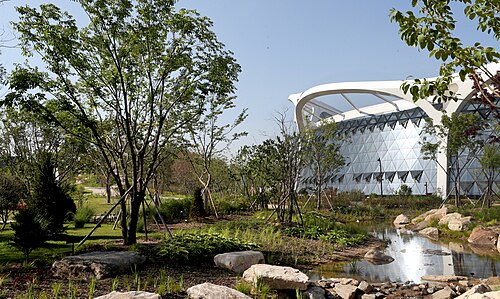
The centrepiece of Geoje Botanical Garden, laid out beside the city's agricultural development centre, the Jungle Dome opened on 17 January 2020 after an investment of 28 billion won. Its oval shell, pieced together from roughly 7,500 triangular glass panes, rises to 29.6 metres and covers 4,468 m². Inside grow about 300 tropical species and around 10,000 plants, staged around a 10-metre waterfall, a rock garden, an illuminated cave and an elevated skywalk.
Affiliate links — booking through Verrière helps fund our research, at no extra cost to you.
History
1 min
Geoje Botanical Garden grew out of a nature-themed park project in the township of Geoje-myeon, right beside the city's agricultural development centre. The scheme cost 28 billion won, of which 13 billion came from the national government, 3.8 billion from South Gyeongsang Province and 11.2 billion from the city. On a 36,664 m² plot it combines the domed glasshouse with an outdoor ecological pond, a lawn and visitor facilities.
Ahead of its formal opening the dome was previewed from 26 October to 3 November 2019, during the 14th Geoje Island Flower Festival; around 62,000 people went in, admitted in groups of about fifty every five to ten minutes. It opened officially on 17 January 2020, with some 2.5 million visitors a year expected.
The site has since grown: a wetland centre named Jintlium and a 'Jungle Tower' with a slide have been added. Press reports state that the garden passed three million cumulative visitors six years after opening and that it was included in the official list of 100 Korean tourist destinations for 2025-2026.
Architecture and engineering
1 min
The Jungle Dome is a geodesic shell on an oval plan, likened by the Korean press to an egg cut in half. According to the figures released at its opening, it stands 29.6 metres high, with a long axis of 90.4 metres and a short axis of 58.5 metres, and covers 4,468 m². It is described as the largest dome-shaped glass greenhouse in the country.
The envelope is made entirely of triangular glass panels joined into a lattice. Their number varies between sources: about 7,400, 7,472, 7,500 or 7,540; the figures given at the 2019 preview (29.7 metres high, 4,100 m²) also differ slightly from the final ones. Inside, the average temperature is kept at around 25 to 26 °C and never below 15 °C on winter mornings, to protect the tropical plants. The volume contains an artificial landscape of rocks and caves, a 10-metre waterfall, a 105-metre skywalk and a two-level observation deck looking down onto the canopy.
Plant collections
1 min
The dome holds about 300 tropical species, some 10,000 plants at opening (11,000 according to more recent figures), while the outdoor areas contain around 20,000 more. Reports mention Canary Island palms, baobabs, rubber trees and lantanas; several specimens carry an explanatory banner, among them a tree set in front of the waterfall and presented as 300 years old, the tallest in the collection. Tropical trees over 20 metres tall are also announced.
The route runs through a series of scenes: a flowering green wall at the entrance, a valley threaded with water, a rock garden, a cactus area and a 'light cave' where shifting lighting and projections conjure up jungle animals. The neighbouring Jintlium centre shows more than forty species of mosses and ferns in a misty atmosphere.
Visiting
1 min
The garden lies in Geoje-myeon township, in the south-west of Geoje Island, at 3595 Geoje-namseo-ro. The signposted route through the dome takes about an hour and follows a set direction; animals (other than assistance dogs), food and tripods are not allowed, and entry is regulated to limit crowding.
Outside, an aquatic garden, a four-seasons garden and a 'jungle village' extend the visit, as does the Jintlium wetland centre. The dome itself was unveiled during the Geoje Island Flower Festival in late October 2019, so the local festival calendar is worth checking to combine the two.
34.86° N, 128.58° E
Greenhouses nearby
More greenhouses — South Korea
Do you have a good photo of this greenhouse? Suggest it for this page →