Tropical and Subtropical Greenhouses, Korea National Arboretum
Pocheon (Gwangneung Forest)
No freely licensed photo of this greenhouse yet. Do you have one? Suggest it for this page →
Sources checked September 2026
- Year
- 2008
- Style
- Subtropical greenhouse in the form of a glass pyramid and a tropical greenhouse with a metal frame
- Dimensions
- 3,824 m² (tropical greenhouse)
- Status
- Open to the public, managed by the Korea National Arboretum
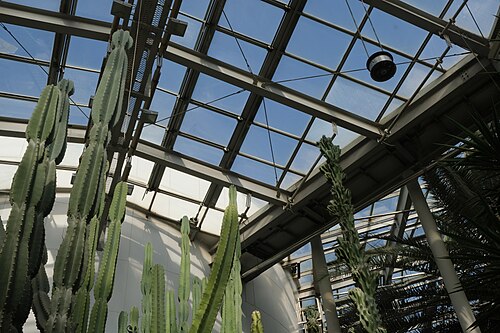
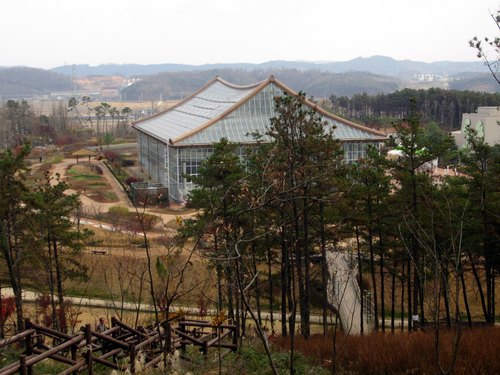
Within the Gwangneung Forest, a UNESCO-recognized biosphere reserve, the Korea National Arboretum opened a 3,824 m² tropical greenhouse with a metal structure in 2008, designed to collect and conserve tropical plant resources while conducting international scientific cooperation programs. It stands next to a subtropical greenhouse shaped like a glass pyramid, dedicated to warm-temperate and subtropical plants native to the islands south of the peninsula and to Jeju Island. Together the collections are organized by broad geographic zones and taxonomic groups, spanning rainforest habitats and dry tropical environments. Both a scientific and educational space, it is one of the few large public greenhouses in South Korea located outside Seoul.
Affiliate links — booking through Verrière helps fund our research, at no extra cost to you.
History
The Korea National Arboretum's glasshouses stand in a landscape that has been protected for more than five centuries. Gwangneung Forest takes its name, and owes its survival, to the royal tomb of King Sejo and Queen Jeonghui of the Joseon dynasty: siting the tomb here brought a strict ban on cutting the surrounding woods, a protection upheld through later periods. The tomb is now part of the Royal Tombs of the Joseon Dynasty World Heritage Site.
After damage during the Korean War, the site, then a forestry research station, was developed between 1983 and 1987 into an arboretum with a forest museum. The Gwangneung Arboretum opened to the public on 5 April 1987 and in May 1999 became the National Arboretum, the first institution of its kind in the country.
The large glass facility, officially the Tropical Plant Resources Research Center and generally known as the tropical greenhouse, was completed in January 2008. The arboretum describes it as a tool for collecting and conserving plant resources, built up through cooperation with Korean and foreign gardens and research institutes, and as a way of introducing the public to tropical flora. In June 2010 Gwangneung Forest was designated a UNESCO biosphere reserve, and the arboretum now frames these collections in terms of climate-change preparedness and biodiversity conservation.
Architecture and engineering
The complex pairs two buildings of very different shape. The tropical greenhouse is a glass building on a steel frame; the arboretum gives its total floor area as roughly 3,800 m², with 3,834 m² on the research-center page and 3,824 m² on the greenhouse page. Its interior is conditioned to support both rainforest plants and those of dry tropical environments, arranged in two main display zones, with collections ordered by geography and taxonomy.
Beside it stands the 'nandae' greenhouse, a Korean term for the warm-temperate to subtropical climate belt. It takes the form of a glass pyramid, which sets it clearly apart from the larger metal-framed hall next door. Its role is more regional: providing suitable growing conditions for species that cannot survive winters in the centre of the peninsula.
Plant collections
According to the arboretum, the tropical greenhouse holds some 3,000 species, including rare and endangered plants. The rainforest zone shows around 800 of them, among them the staghorn fern Platycerium bifurcatum and the bromeliad Aechmea fasciata. The subtropical zone, devoted to dry-tropical and Mediterranean-type plants, holds about 1,600, including Aloe arborescens, the dragon tree Dracaena draco and, most notably, Welwitschia mirabilis from the Namib Desert, a plant seldom seen in cultivation.
The pyramid greenhouse concentrates on Korea's own mild-climate flora: temperate trees and subtropical plants native to the southern islands, the south coast and Jeju Island. It also holds the ferns of these warmer regions, complementing the outdoor fern garden, which is limited to species hardy in central Korea.
Visiting
The greenhouses are part of a network of about 25 themed gardens spread over roughly 102 hectares, where the arboretum displays close to 4,900 species. A visit pairs naturally with those gardens, the forest museum and the paths beneath Gwangneung's old trees; half a day covers the essentials. The glasshouses are at their most rewarding in winter, when the outdoor collections are dormant. According to the official site, visitors arriving by car must book in advance, while those on foot, by bicycle or by public transport can enter without a reservation.
37.75° N, 127.16° E
Greenhouses nearby
More greenhouses — South Korea
Do you have a good photo of this greenhouse? Suggest it for this page →
Sources (7)
- kna.forest.go.kr/kfsweb/kfi/kfs/cms/cmsView.do?cmsId=FC_003313&mn=UKNA_04_05
- kna.forest.go.kr/kfsweb/kfi/kfs/cms/cmsView.do?mn=UKNA_01_04&cmsId=FC_003690
- kna.forest.go.kr/kfsweb/kfi/kfs/cms/cmsView.do?mn=UKNA_06_04&cmsId=FC_003280
- kna.forest.go.kr/kfsweb/kfi/kfs/cms/cmsView.do?mn=UKNA_01_04&cmsId=FC_003163
- kna.forest.go.kr/kfsweb/kfs/subIdx/Index.do?mn=UKNA
- en.wikipedia.org/wiki/Korea_National_Arboretum
- ko.wikipedia.org/wiki/국립수목원
Affiliate links — booking through Verrière helps fund our research, at no extra cost to you.