Donggung Botanical Garden, Gyeongju Donggungwon (경주동궁원 동궁식물원)
Gyeongju (Bomun tourist complex), North Gyeongsang
Entry updated on October 5, 2026
- Year
- 2013
- Architect
- Unknown
- Style
- Glasshouse modelled on Silla-period traditional architecture
- Dimensions
- 3,908 m² (main hall and second hall)
- Status
- Open to the public
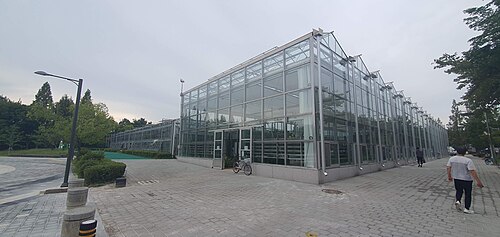
Opened by the city of Gyeongju on 10 September 2013 in the Bomun tourist complex, this glasshouse botanical garden takes its name from Donggung, the eastern palace of the Silla kingdom, where a pond and artificial hills were made in 674 to grow flowers and keep rare birds and animals. The building borrows the forms of Silla-period architecture, with golden chimi ridge ornaments and lotus-patterned roof tiles. The main hall, with around 400 species, and a second hall opened in 2016 cover 3,908 m² together, and a walk-in bird park stands next door.
Affiliate links — booking through Verrière helps fund our research, at no extra cost to you.
History
1 min
The name Donggungwon refers to Donggung, the eastern palace of the Silla kingdom, associated with Wolji pond. The Samguk sagi records that in 674, the fourteenth year of King Munmu's reign, a pond was dug and hills were raised there so that flowers could be grown and rare birds and animals kept. Gyeongju city chose this distant precedent of a garden filled with exotic species when it created, in the Bomun tourist complex, a site combining a botanical glasshouse and a bird park on 64,380 m² of land, intended to give the city's tourism a new draw.
The site opened on 10 September 2013. The glasshouse is run by the city, while the bird park is operated by a private concessionaire. It proved popular at once: about 77,000 visitors came in the first month, against an annual target of 300,000, and Korean press reported some 600,000 visits within fifteen months, with around a thousand visitors a day on weekdays and about three thousand at weekends.
A second botanical hall opened in June 2016, devoted to year-round flowering and to so-called healing plants. On 3 April 2026 the city opened Rawon nearby, a large cultural garden developed in connection with Donggungwon and built around digital installations on Silla legends.
Architecture and engineering
1 min
The glasshouse takes its cue from Silla-period architecture and from the buildings of Donggung and Wolji pond; the city describes it as a Silla-style hanok structure. The glazed volume carries traditional roofs: both ends of the ridge bear golden chimi, traditional ornamental ridge-end tiles, and the roof tiles incorporate a lotus motif. To lend the route a Silla atmosphere, the decor draws on themes specific to Gyeongju, with references to the Cheonmado, Jaemaejeong and Anapji, and the floor reproduces tiles unearthed during the excavation of Wolji pond.
At opening, the main glasshouse covered 2,353 m². With the second hall added, the botanical garden reaches 3,908 m² according to the city and the Korean-language encyclopedia. The tour of the main hall follows an elevated walkway 7 m above the floor that passes through a cave with a waterfall. The neighbouring bird park occupies a building of about 5,000 m², which the city describes as the largest single-building facility of its kind in Korea.
Plant collections
1 min
The main hall is divided into five themed gardens, for palms, foliage plants, flowering shrubs, aquatic plants and tropical fruit, with smaller areas for ferns, carnivorous plants and a rock garden. The city counts about 400 species and 5,500 plants. Highlights listed include butia palms, a baobab, papaya, plumeria, nepenthes and a so-called corpse flower (시체꽃).
The second hall focuses on colour in every season and shows around 100 species and 6,500 plants, among them healing plants such as graviola, moringa and cinnamon. It holds two old specimens: a 300-year-old bodhi tree (보리수), presented as the oldest greenhouse plant in the country, and a 250-year-old red rubber tree, along with a tricolour bougainvillea. Other halls house an insect exhibition, a 'hide-and-seek garden' and a pressed-flower workshop. The bird park keeps 250 species and 3,000 birds, which visitors meet inside large walk-in aviaries.
Visiting
1 min
Donggungwon lies in Gyeongju's Bomun tourist complex, not far from Bomun Lake. The botanical glasshouse and the bird park are separate visits side by side; together they easily fill half a day. In summer the glasshouse offers blueberry and cherry picking.
Rawon, opened in April 2026 a few hundred metres away, extends the visit with outdoor gardens and digital halls devoted to Silla legends. To understand where the name comes from, the visit pairs naturally with the site of Donggung Palace and Wolji pond in Gyeongju's historic centre.
35.85° N, 129.26° E
Greenhouses nearby
More greenhouses — South Korea
Do you have a good photo of this greenhouse? Suggest it for this page →