Conservatory of Seoul Botanic Park
Seoul (Gangseo-gu, Magok)

Sources checked September 2026
- Year
- 2018–2019
- Style
- Contemporary concave saucer-shaped structure of steel and glass
- Dimensions
- 100 m in diameter, 25 m high, around 4,600 plant species
- Status
- Open to the public
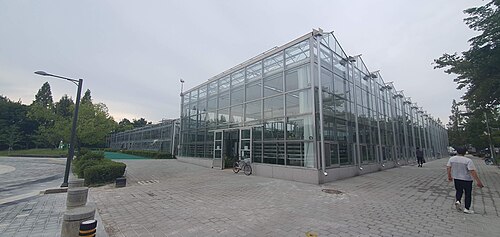
Opened in 2019 at the heart of the new Seoul Botanic Park in the Magok district, this vast glass pavilion takes an unusual concave form, like an inverted dish 100 meters across and 25 meters high. Designed as an explicit echo of Britain's Eden Project and Singapore's Gardens by the Bay, it maintains a year-round temperature of 22°C and 80% humidity to house distinct Mediterranean and tropical zones. An elevated walkway 8 meters above the ground, the “skyway,” lets visitors walk at canopy height among trees reaching 25 meters.
Affiliate links — booking through Verrière helps fund our research, at no extra cost to you.
History
The conservatory is the outcome of a long-running urban project tied to the development of the new Magok district in Gangseo, western Seoul. In July 2007 the city launched an international design competition for a waterfront site, and the winner was announced in June 2008. The programme then shifted several times: in 2011 it was reoriented towards a park centred on a lake and culture, and in October 2012 it adopted the concept of a Bio Botanic Park.
The master plan was unveiled in August 2013 under the name Seoul Botanic Park, the design was finalised in November 2014, and ground was broken for Magok Central Park on 14 November 2015. The park's official name was fixed on 12 May 2016. The project took Britain's Eden Project and Singapore's Botanic Gardens as its models.
The park opened provisionally to the public on 11 October 2018 and was formally inaugurated on 1 May 2019. It received the Presidential Landscape Award on 15 October 2019 and was registered as a Seoul public arboretum on 28 June 2021. In 2024 a Spring Garden and a Sunshine Garden were added.
Architecture and engineering
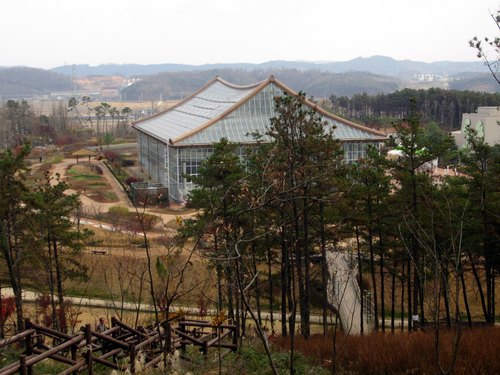
The garden describes the conservatory as the world's only greenhouse shaped like a concave dish: instead of the usual dome, the glass roof dips towards the centre, forming a bowl set on the ground. The building is part of the Plant Culture Center, which also houses a large auditorium (Botanic Hall), a specialist botanical library and exhibition halls; shops and a café occupy the first and fourth floors.
The interior is divided into two main climate halls, one tropical and one Mediterranean. A suspended walkway, the Skywalk, crosses the conservatory at height, giving views down onto the tropical plants. The garden warns that the interior is much warmer than outside; cold-air blowers are installed at the entrances to both halls and near the fountain on Rome Plaza, whose rest area is air-conditioned.
Plant collections
The conservatory is organised around the flora of twelve cities with tropical or Mediterranean climates, each represented by its plants and the plant culture that grew up there. The tropical hall features Hanoi, Jakarta, São Paulo and Bogotá; the Mediterranean hall brings together Barcelona, San Francisco, Rome, Tashkent, Athens, Perth, Istanbul and Cape Town.
Across the whole park, the institution aims to assemble more than 8,000 plant species. The conservatory also hosts seasonal themed exhibitions.
Visiting
Seoul Botanic Park covers 504,000 m² and is divided into four areas: the Open Forest, the Lake Garden, the Wetland Garden and the Thematic Garden. The conservatory stands in the Thematic Garden, alongside eight themed gardens devoted to Korean plants and garden culture. The forest and wetland areas are free to enter, whereas the Thematic Garden and the conservatory require a ticket.
Allow one to two hours for the conservatory and the Thematic Garden, more to walk on to the lake. The conservatory is a particularly welcome refuge in winter. The LG Arts Center, completed in 2022, stands on the edge of the park.
37.57° N, 126.83° E
Greenhouses nearby
More greenhouses — South Korea
Do you have a good photo of this greenhouse? Suggest it for this page →
Affiliate links — booking through Verrière helps fund our research, at no extra cost to you.