Tropical House and glasshouses, National Botanic Garden of Nepal
Godawari, Lalitpur District
Entry updated on October 3, 2026
- Year
- 1966 and 1974
- Architect
- Tony Schilling (Special Garden glasshouses); Tropical House: not documented
- Style
- 1960s–1970s botanic garden glasshouses
- Dimensions
- Tropical House: 294 m² floor area, 12 m high
- Status
- Open to the public
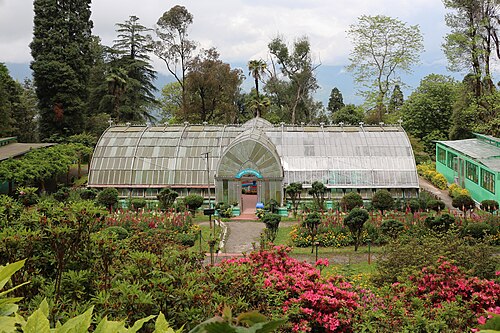
At the foot of Phulchowki, 16 km south of Kathmandu, the National Botanic Garden of Nepal was inaugurated in October 1962 by King Mahendra, who said he had been inspired by the Royal Botanic Garden Edinburgh. Its glasshouses form two groups: at the top of the Special Garden, the orchid, cyclamen and cactus houses built in 1966 by the Kew horticulturist Tony Schilling; further on, the Tropical House of 1974, 12 m high with a floor area of 294 m², which shelters sandalwood and sal among other species. Its plantings were renewed in 2016.
Affiliate links — booking through Verrière helps fund our research, at no extra cost to you.
History
1 min
The National Botanic Garden of Nepal grew out of a royal wish. Returning from a visit to the United Kingdom in 1960, King Mahendra declared that he had been inspired by his official visit to the Royal Botanic Garden Edinburgh, where he had planted a tree. A site near the village of Godavari, at the foot of Phulchowki, was chosen with the help of the British naturalist Geoffrey Herklots, and the king inaugurated the garden in October 1962 — on the 20th according to a profile in the journal Sibbaldia, on the 28th according to the garden's own factsheet. It was run by the Department of Medicinal Plants, today the Department of Plant Resources.
Herklots, an orchid specialist, illustrator and architect, spent two years of his retirement advising the Nepalese government: he played a major part in laying out the Special Garden, designing its gravity-fed fountain, its paths and some of its glasshouses. He was followed by Tony Schilling of the Royal Botanic Gardens, Kew, seconded in 1965–1966, who created the Rock Garden — elephants helped to move its boulders into place — and built the glasshouses at the top of the Special Garden in 1966.
The Tropical House followed in 1974. First known as the Royal Botanical Garden, the garden took its present name in 2006. In 2016 the bicentenary of diplomatic relations between Nepal and Britain led to a partnership with Edinburgh, which produced a Biodiversity Education Garden and a renewal of the Tropical House plantings.
Architecture and engineering
1 min
The glasshouses fall into two groups. The first stands at the top of the Special Garden, a sloping area that looks down over ornamental beds and the fountain pond: at the head of the slope are the orchid, cyclamen and cactus houses attributed to Tony Schilling, Herklots having earlier designed some of the glasshouses in this part of the garden. An alpine glasshouse completes the group; in 2017 the garden's managers described it as in need of renewal.
The second is the Tropical House of 1974, a glasshouse with a floor area of 294 m² rising to 12 m, tall enough to shelter tropical trees. In front of it lies the Coronation Pond, marked by a 7 m pillar raised for the coronation of King Birendra in 1975, and the house can also be seen from the lawn of commemorative plantings.
These shelters answer the climate of a site at about 1,500 m: summer days can reach 30 °C, yet light night frosts occur in late December and January: conditions the garden's managers consider ideal for the hardier subtropical and warm-temperate plants, while tropical species find shelter under glass.
Plant collections
1 min
The Tropical House conserves tropical plants regarded as important, among them Indian rosewood (Dalbergia latifolia), sandalwood (Santalum album) and sal (Shorea robusta). Its plantings were rejuvenated in 2016 as part of the partnership with Edinburgh.
In the Special Garden, the orchid house holds more than forty epiphytic species; orchids are in fact the garden's best-represented family, with 89 species recorded. The neighbouring houses display cacti, succulents, cyclamen and other show plants, and one house is given over to bonsai.
Close by, the Fern Garden shelters tree ferns (Cyathea spinulosa) about 5 m tall and, under a renovated shelter, potted ferns such as Pteris cretica, Polystichum squarrosum and Aglaomorpha coronans.
Visiting
1 min
The garden lies about 16 km south of Kathmandu, at the foot of Phulchowki (2,765 m), the highest mountain in the valley. It receives some 300,000 visitors a year, many of them school groups who come to picnic. The Special Garden glasshouses stand at the top of the slope, a few steps from the Fern Garden; the Tropical House can be spotted from the lawn of trees planted by visiting heads of state, where Marshal Tito planted a rhododendron in 1974 and Queen Elizabeth II a holly in 1986. The monsoon months, June to August, belong to the Lily Garden, and the site is known for its birdlife.
27.60° N, 85.38° E
Greenhouses nearby
Do you have a good photo of this greenhouse? Suggest it for this page →