Lloyd Botanical Garden Conservatory & Orchidarium
Darjeeling

Sources checked September 2026
- Style
- British colonial horticultural glasshouse
- Status
- Open to the public
Founded in 1878 on land given by William Lloyd, this 40-acre garden at about 1,800 metres was created as an annexe to the Calcutta botanical garden. It includes a conservatory holding a collection of 150 cactus species, plus a separate orchidarium displaying around 2,500 orchids across some fifty varieties, most of them from the neighbouring Singalila National Park. The garden also conserves threatened Himalayan species — rhododendrons, magnolias, bamboos — and stays open to visitors year-round.
Affiliate links — booking through Verrière helps fund our research, at no extra cost to you.
History
Lloyd Botanical Garden was founded in 1878, when 40 acres (about 16 hectares) were acquired in Darjeeling to serve as a distant annexe of the Calcutta Botanical Garden.
The land was provided by William Lloyd, after whom the garden is named and who owned a Darjeeling bank in the British period; the site was handed over to Sir Ashley Eden. The garden was laid out under the supervision of George King, then superintendent, who arranged it in three distinct tiers down the hillside.
The garden remains one of Darjeeling's main public green spaces, devoted to conserving both common and rare Himalayan plants.
Architecture and engineering
The garden occupies an open slope just below the former Eden Sanatorium, bounded by Cart Road, Victoria Road, Jail Road and Hari Ghose Road, and is entered by four gates. Its layout follows the gradient in three sections: the upper tier holds Himalayan plantings, the middle tier ferns, conifers and the glasshouses, and the lower tier exotic plants from other continents.
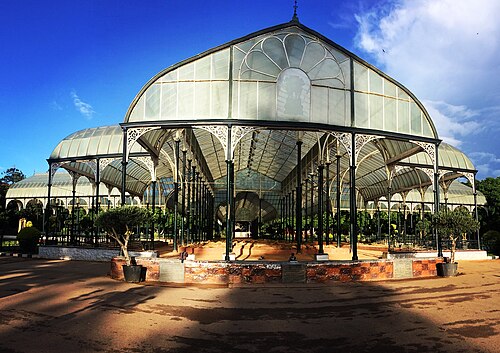
The sheltered collections are divided between two buildings: a conservatory, which houses the cactus section among others, and a separate orchid house.
Plant collections
The conservatory holds a cactus and succulent collection of around 150 species, an unexpected sight in Darjeeling's damp climate. The orchid house displays some 2,500 orchids in about fifty varieties, most of them from Singalila National Park on the road to Sandakphu; this collection of native orchids is regarded as rare. Species associated with the garden include Coelogyne cristata and Dendrobium nobile, which flower in spring, Cymbidium tracyanum and Paphiopedilum insigne in autumn, and Cymbidium grandiflorum in winter.
Outdoors the garden keeps bamboos, oaks, magnolias, arisaemas, cotoneasters, wild geraniums and rhododendrons, patches of forest with Cryptomeria, Bucklandia and alder, and trees from Europe, East Asia and Australasia, including a Ginkgo biloba.
Visiting
The garden is a short walk from the Chowk Bazaar taxi stand along Victoria Road. Some paths are steep; the conservatory and orchid house sit in the middle tier, so they fit naturally into a walk between the Himalayan plantings and the exotic trees. One to two hours allows an unhurried visit. The orchid flowering calendar runs through the whole year, so every season has species in bloom. The Padmaja Naidu Himalayan Zoological Park, likewise focused on Himalayan species, makes a good companion visit in town.
27.04° N, 88.26° E
More greenhouses — India
Do you have a good photo of this greenhouse? Suggest it for this page →
Affiliate links — booking through Verrière helps fund our research, at no extra cost to you.