Crystal Palace Greenhouse, Hamamatsu Flower Park (はままつフラワーパーク 大温室)
Hamamatsu, Shizuoka Prefecture
Entry updated on October 5, 2026
- Year
- Renovated 2003
- Style
- Large contemporary glasshouse with sashless glazing
- Dimensions
- 2,161.2 m², 14.6 m high
- Status
- Open to the public
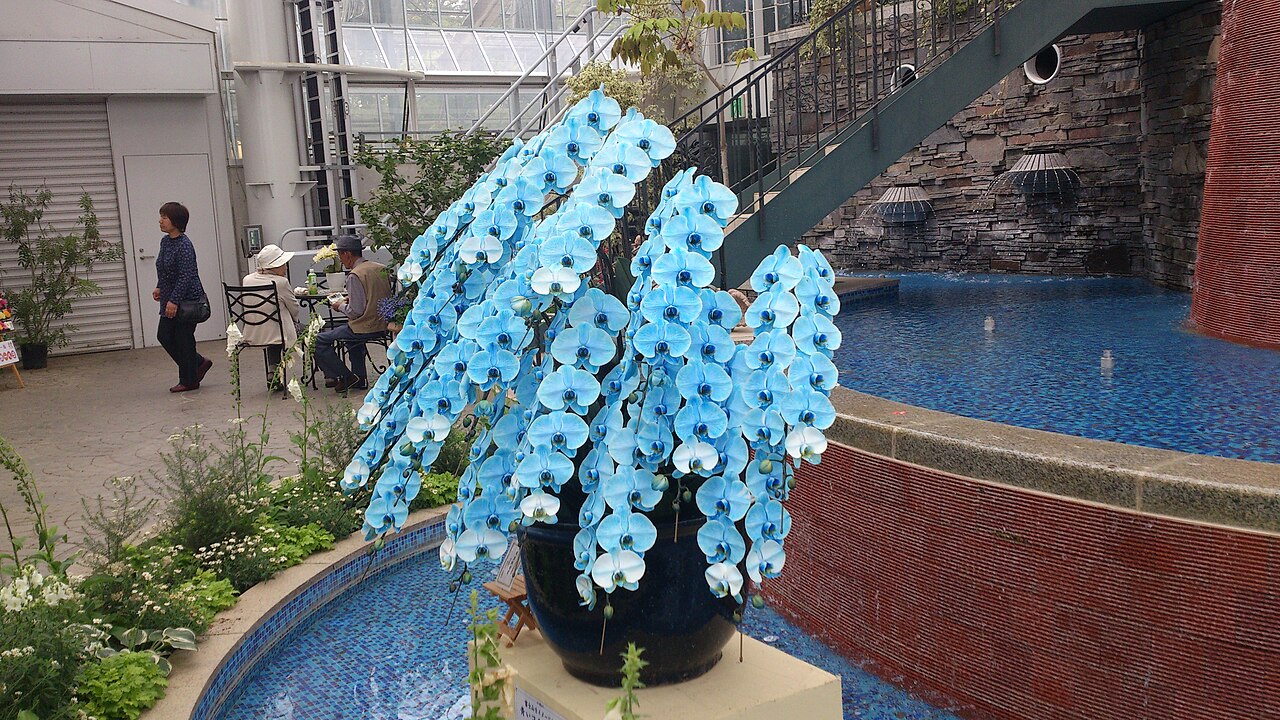
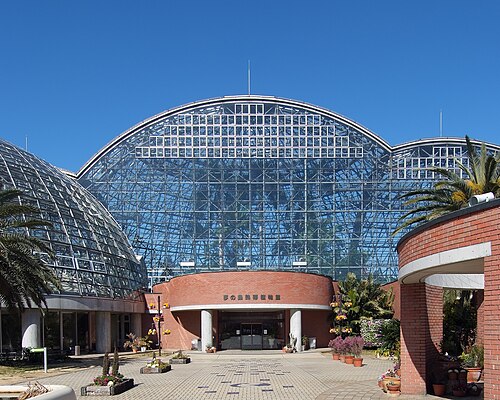
Hamamatsu Flower Park, opened in 1970 in the Kanzanji district, has a large glasshouse nicknamed the 'Crystal Palace' after the glass hall of the 1851 London exhibition. Renewed during the overhaul of the park completed in March 2003, it was given glazing fixed without sashes, described as a first in Japan. Standing 14.6 m high over 2,161 m², it holds 5,800 plants of 540 kinds in three areas: a 'garden theatre' whose floral displays change five or six times a year, a Bali-inspired tropical garden and a Mexican garden of cacti and succulents.
Affiliate links — booking through Verrière helps fund our research, at no extra cost to you.
History
1 min
Hamamatsu Flower Park (はままつフラワーパーク) opened on 10 September 1970, as part of the celebrations for the city's 60th anniversary, on some 30 hectares in the Kanzanji district. Originally run by a municipal public corporation (浜松市フラワー・フルーツパーク公社), it is now managed by a public-interest foundation, the Hamamatsu Flower and Greenery Promotion Foundation (浜松市花みどり振興財団).
The park underwent major works in 2002 and 2003 and reopened on 21 March 2003. The large glasshouse was renewed on that occasion: according to local tourism material, it was the first in Japan to be glazed without sashes (サッシを使わないガラス工法). Its nickname, the 'Crystal Palace' (クリスタルパレス), refers to the glass hall of the 1851 Great Exhibition in London and to its own resemblance to a giant crystal. The sources consulted give neither the construction date of the original glasshouse nor the names of the 2003 designers.
The park went on to host two major horticultural events: the Hamamatsu Mosaiculture World Exhibition, from 19 September to 23 November 2009, and the Hamanako Flower Expo 2014 (浜名湖花博2014), from 20 March to 15 June 2014.
Architecture and engineering
1 min
The large glasshouse covers 2,161.2 m² and rises to 14.6 metres. Its glass silhouette, likened to a giant crystal, explains the nickname. When it was renewed in 2003 it was given glazing fixed without sash frames, a technique that local sources describe as new to Japan at the time. Visitors enter through wooden automatic doors.
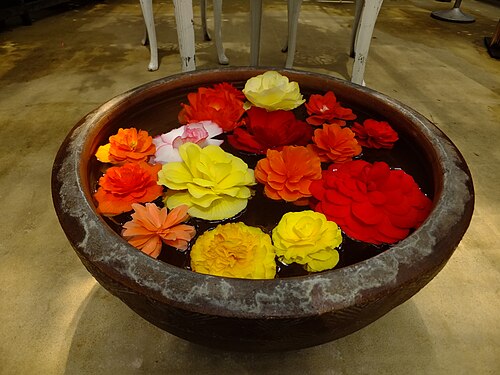
The interior is divided into three areas. At the centre, the Garden Theater (ガーデンシアター) serves as the main stage for floral displays and houses a small café. On one side lies the Bali Garden (バリガーデン), devoted to tropical plants; on the other, the Mexican Garden (メキシカンガーデン), given over to plants of dry lands. The arrangement places humid and arid settings side by side under a single envelope. The glasshouse stands just beyond the park's main gate and the dancing fountain, forming the first major set piece of the visit.
Plant collections
1 min
The glasshouse displays 5,800 plants of 540 kinds, gathered from around the world. In the Garden Theater, large seasonal displays are changed five or six times a year; at the end of the year it becomes the main stage of the Christmas illuminations, around a decorated 8-metre fir. The Bali Garden shows colourful tropical plants, also rearranged through the year; its most unusual specimen is the Tacca 'Black Cat' (タッカ属ブラックキャット), presented as the only variety in the world bearing black flowers with long drooping 'whiskers'. The Mexican Garden gathers succulents, cacti and desert wildflowers, a microcosm of dry, sandy wilderness.
The park as a whole holds about 3,000 species and varieties, including 1,700 cherry trees of 160 varieties, 500,000 tulips and 1,300 roses of 300 varieties.
Visiting
1 min
The glasshouse stands just past the main gate and the dancing fountain, which often makes it the first stop of a visit. The park, some thirty hectares in all, is served by a flower train with live commentary and by a rail-mounted slope car (スロープカー). Spring is the high season, with the cherry blossom followed by half a million tulips; wisteria and roses take over later. At the end of the year the Christmas illuminations make the glasshouse the focus of the evenings. The neighbouring Hamamatsu Zoo is linked to the park by a footpath.
34.76° N, 137.63° E
Greenhouses nearby
More greenhouses — Japan
Do you have a good photo of this greenhouse? Suggest it for this page →