Atagawa Tropical & Alligator Garden (熱川バナナワニ園)
Higashi-Izu, Shizuoka Prefecture
Entry updated on October 3, 2026
- Year
- 1958
- Style
- Greenhouses heated by hot-spring steam
- Dimensions
- 8 greenhouses in the main garden, 6 in the annex
- Status
- Open to the public
Opened on 20 September 1958 in the hot-spring resort of Atagawa, this combined botanical garden and zoo runs on geothermal heat: steam from the springs, close to 100 °C, warms the eight greenhouses of the main garden and the six of the annex opened in 1971. Some 5,000 tropical species are grown, including more than twenty kinds of banana and about sixty water lilies that are always in flower. Its Japanese name, 'banana and crocodile garden', points to its other speciality: a collection of crocodilians of sixteen species.
Affiliate links — booking through Verrière helps fund our research, at no extra cost to you.
History
1 min
The garden opened on 20 September 1958 in the hot-spring resort of Atagawa, in the town of Higashi-Izu. It opened as a zoological and botanical garden, showing crocodiles, still rare in Japan at the time, alongside tropical plants grown using the heat of the local hot springs. Its Japanese name, Banana-Wani-en, literally 'the banana and crocodile garden', sums up this double programme.
A second site, the annex (分園), opened on 1 March 1971. In 1976 the establishment was recognised as a museum under Japan's Museum Act.
The garden now consists of three parts: in the main garden, the crocodile section and the botanical section, and then the annex, whose greenhouses are devoted in particular to bananas and tropical fruit. The animal collection also includes species rarely seen in Japan: it is the only place in the country to show an Amazonian manatee and the western red panda.
Architecture and engineering
1 min
What sets the Atagawa greenhouses apart is the way they are heated. Steam from an Atagawa hot spring, at a temperature close to 100 °C, is used to warm the greenhouses and keep a tropical climate in them all year round; the same heat keeps the water of the pools at around 30 °C.
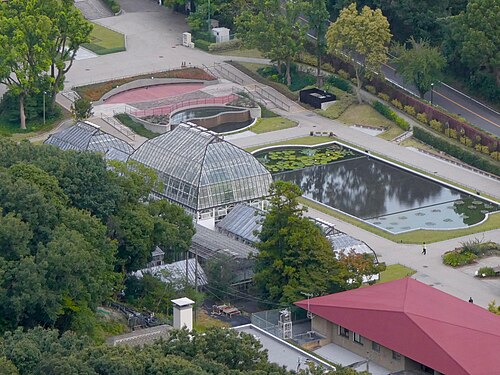
The main garden has eight numbered greenhouses, shared between orchids, tropical water lilies, carnivorous plants and bromeliads. The annex adds six more, given over to bananas, tropical fruit trees and begonias. The whole is organised in three separate parts: the crocodile section and the botanical section of the main garden, and then the annex. The sources consulted give neither the designer nor the construction date of the individual greenhouses.
Plant collections
1 min
The garden claims some 5,000 species of tropical plants. Bananas, which gave it its name, are represented by more than twenty varieties, alongside other tropical fruit trees. Tropical water lilies are one of its strengths: about sixty varieties are in flower at any time, and two giant water lilies are grown, Victoria amazonica (オオオニバス) and Victoria cruziana (パラグアイオニバス). The greenhouses also show many orchids, carnivorous plants and bromeliads.
On the animal side, the garden keeps a collection of crocodilians of sixteen species, hybrids included, described as one of the most varied in the world. It is the only establishment in Japan to show an Amazonian manatee and the western red panda (ニシレッサーパンダ), and it also keeps tortoises, flamingos and giant salamanders.
Visiting
1 min
The garden lies in the hot-spring resort of Atagawa, in Higashi-Izu, Shizuoka Prefecture. A full visit takes in the main garden, with its greenhouses and crocodile pools, and then the annex, devoted to bananas and tropical fruit; about two hours is enough to see everything. The heated greenhouses and the water lilies, in flower all year, make the garden worth visiting in any season, winter included. It pairs naturally with a stay at Atagawa's hot-spring baths, whose heat keeps the greenhouses alive.
34.82° N, 139.07° E
Greenhouses nearby
More greenhouses — Japan
Do you have a good photo of this greenhouse? Suggest it for this page →