Rose Garden Greenhouses, Konopiště Château (Růžová zahrada)
Konopiště, Benešov, Central Bohemian Region

Sources checked October 2026
- Style
- Glazed greenhouse with masonry parts, at the head of a French-style rose garden
- Dimensions
- About 1,200 m²
- Status
- Open in season (April to October); rebuilt 1995-2000
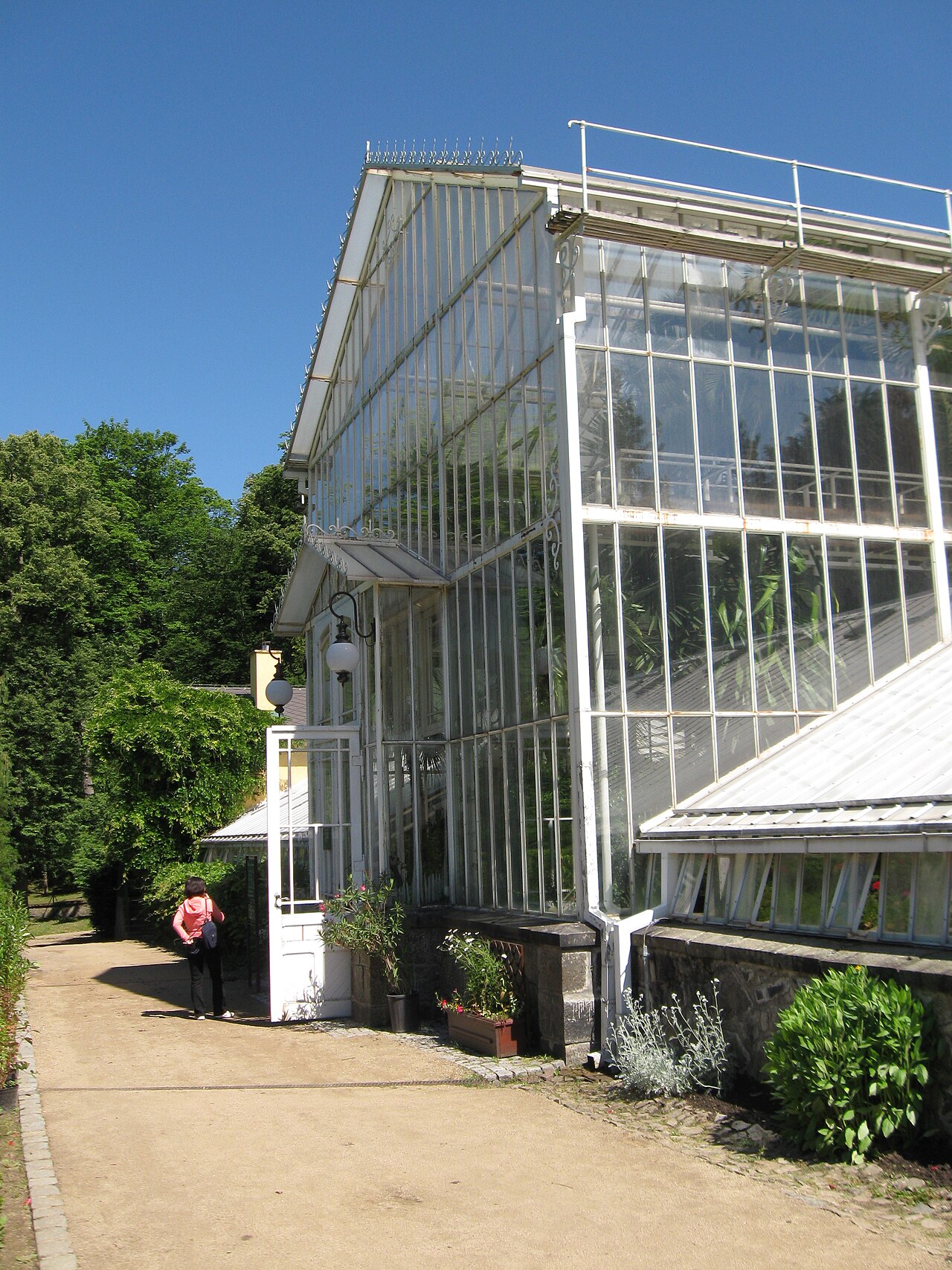
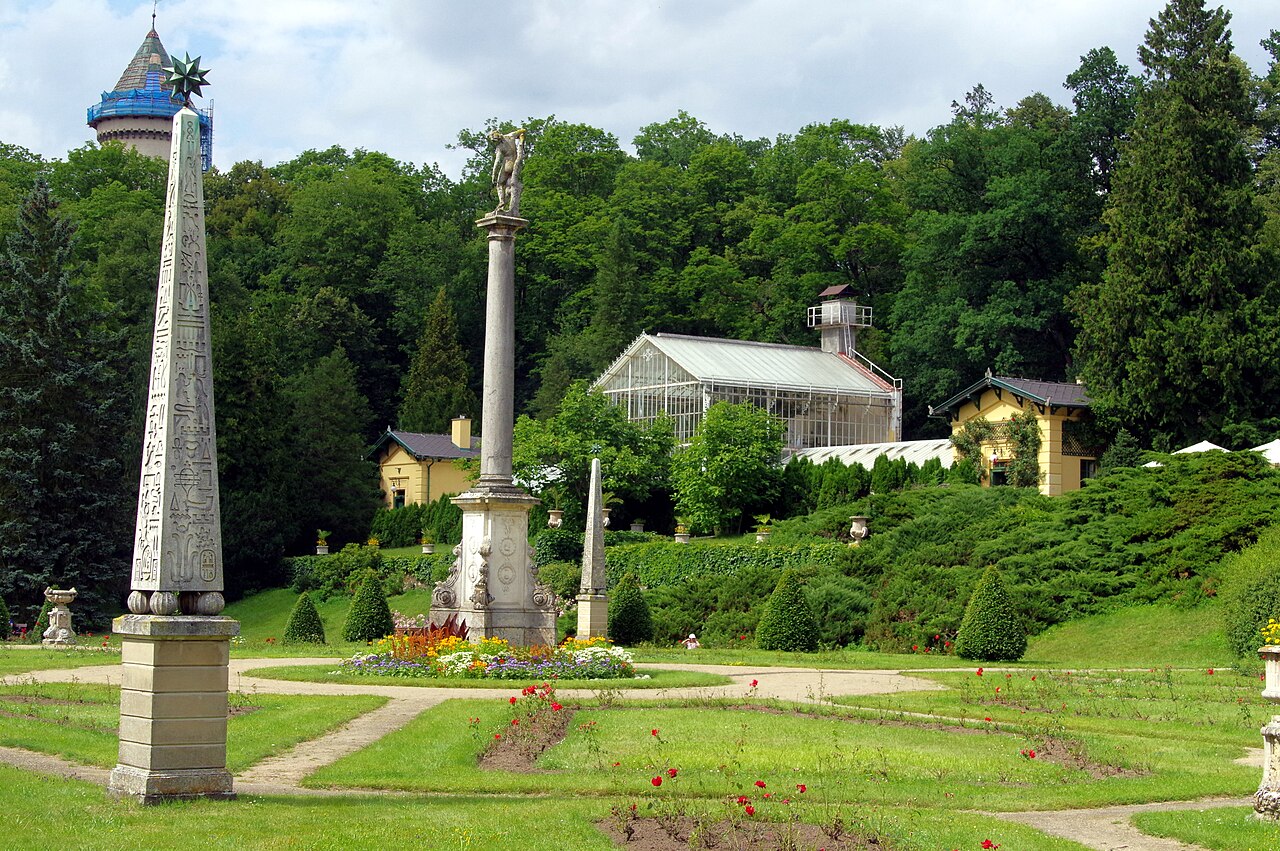
At the upper end of the rose garden of Konopiště Château, once the residence of Archduke Franz Ferdinand d'Este, a greenhouse of about 1,200 m² shelters subtropical plants in three parts: palms, a pool of fish and turtles ringed with ferns, and cacti, bonsai and bromeliads. The palms were planted at the archduke's request. The glasshouses were rebuilt between 1995 and 2000 and then opened to the public; they can be visited in season, on a château tour of about half an hour.
Affiliate links — booking through Verrière helps fund our research, at no extra cost to you.
History
Konopiště, at first a Gothic fortress, became the property of Archduke Franz Ferdinand d'Este in 1887, the future heir to the Austro-Hungarian throne, who lived there with his wife, the Czech countess Sophie Chotek, and their three children. He had a large landscape park laid out, whose main creators were, according to Czech Wikipedia, the Viennese landscape gardener Mösmer and Karel Rozínek, head gardener of Prague's Royal Game Reserve (Královská obora).
The rose garden and its greenhouses were set, according to several accounts, on the site of an earlier baroque garden. The château's website credits the archduke with the rose garden "around 1900", while Czech Wikipedia dates it to 1906-1913; in June 1914, English Wikipedia says, Franz Ferdinand invited Wilhelm II to see his roses. The archduke had palms planted there that still grow today.
After the Second World War the rose garden's plantings, overgrown, were badly damaged; the garden was entirely remade in the 1960s to a design by Bohumil Kavka and Milada Opatrná. The greenhouses were rebuilt between 1995 and 2000, a reconstruction a tourist portal calls long and costly, and opened to the public in 2000.
Architecture and engineering
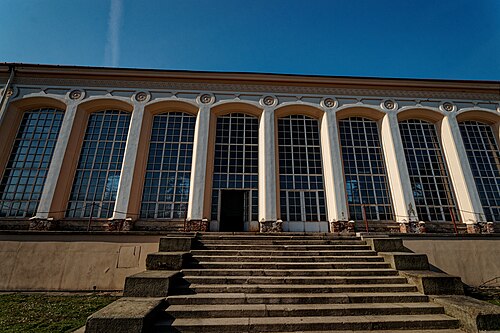
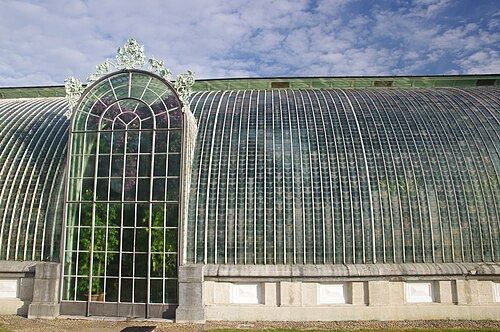
The greenhouse occupies the upper part of the rose garden, above the parterre, and covers 1,200 m² according to Czech Wikipedia; it produces plants for the rose garden and for the whole estate. The survey of historic Czech orangeries and glasshouses carried out in 2021 by the Faculty of Horticulture of Mendel University (Lednice), for a programme of the Ministry of Culture, ranks it among greenhouses proper (type 4: at least one wall and the roof glazed). It is described there as a free-standing building whose façade distinguishes a central block and flanks, and as "altered" (upravená): the main parts of the original structure are preserved or well restored, but some details were lost in adapting it to its present use. The survey also notes a significant share of masonry and states that the structure forms part of a national cultural monument.
Inside, the space is divided into three parts. Outside, the building is surrounded by Chinese wisteria, a farm building and a café. The rose garden itself, of about 5 ha, is enclosed: it is entered through a neo-baroque gate adorned with allegorical statues of Labour and Science, and its French-style parterre is dominated by a 9 m statue of Lucretia.
Plant collections
The greenhouse shelters heat-loving and subtropical plants, arranged in three parts. The first gathers palms: those Franz Ferdinand had planted still grow there. The second holds a pool with fish and turtles, surrounded by ferns. The third is devoted to cacti, bonsai and bromeliads. Orchids, citrus and banana plants are also found. According to Czech Wikipedia, the exotic section, with orchids and a small fish pond, is the paid part open to visitors, while the greenhouse as a whole supplies plants to the rose garden and the estate.
The rose garden originally held up to 200 rose cultivars and species, mostly shrub roses; it also includes a water-lily pond edged with an alpine garden.
Visiting
The greenhouse stands at the very top of the rose garden, which is entered through the neo-baroque gate, where the tourist train stops. The garden is freely accessible, the greenhouse excepted; the château's "Rose Garden with Greenhouses" circuit lasts about 30 minutes, for 30 people at most. Opening is seasonal, from April to October. According to the 2025 programme, evening tours of the illuminated greenhouses were held every second Wednesday from April to October, by reservation.
It combines with the château, the park's educational trails and the bear enclosure.
49.78° N, 14.66° E
Greenhouses nearby
More greenhouses — Czech Republic
Do you have a good photo of this greenhouse? Suggest it for this page →
Sources (8)
- zamek-konopiste.cz/cs/informace-pro-navstevniky/prohlidkove-okruhy/90187-ruzova-zahrada-se
- zamek-konopiste.cz/cs/informace-pro-navstevniky/prohlidkove-okruhy/ruzova-zahrada
- zamek-konopiste.cz/cs/akce/11822-vecerni-prohlidky-skleniku-v-ruzove-zahrade
- cs.wikipedia.org/wiki/Růžová_zahrada_(Konopiště)
- cs.wikipedia.org/wiki/Zámek_Konopiště
- en.wikipedia.org/wiki/Konopiště_Castle
- vylety-zabava.cz/muzea-vystavy-atrakce/stredni-cechy/699-sklenik-v-ruzove-zahrade-konopist
- ubz.zf.mendelu.cz/wcd/w-zf-ubz/projekty/naki-dg18p02ovv007/nmap-historicke-oranzerie/nmap0
Affiliate links — booking through Verrière helps fund our research, at no extra cost to you.