Glasshouses of the Charles University Botanical Garden (Na Slupi)
Prague, New Town (Na Slupi)
Entry updated on October 3, 2026
- Year
- 1946–1949
- Architect
- 1990s rebuild: architect Dvořák, contractor Konsit
- Style
- Post-war glasshouses rebuilt to their 1940s appearance
- Status
- Open to the public
Founded in 1775 in Smíchov and moved to the Na Slupi slope in 1898–1900 after the flood of 1890, the Charles University Botanical Garden inherited glasshouses built in 1882 for a horticultural society. Divided between the Czech and German universities, it lost the German glasshouses in the Allied bombing of 14 February 1945; the damaged Czech houses were replaced in 1946–1949 and rebuilt in the late 1990s to their original appearance. They show tropical, subtropical and succulent plants and old specimens, including a Cycas circinalis more than 130 years old.
Affiliate links — booking through Verrière helps fund our research, at no extra cost to you.
History
1 min
The Prague university botanic garden was founded in 1775 in Smíchov, where it had as many as nine glasshouses. Badly hit by the flood of 1890, it was moved in 1898–1900 to the Na Slupi slope in the New Town. There the university bought the 'Společenská zahrada', a garden acquired in 1842 by Prince Rohan and run by an aristocratic horticultural society, the Böhmische Gartenbaugesellschaft; its glasshouses, put up in 1882 at the corner of Benátská and Na Slupi streets, had mainly served for exhibitions and social occasions.
As the university was then split in two, the lower part with the glasshouses went to the Czech university, at the choice of the botanist Ladislav Josef Čelakovský, while most of the upper terraces went to the German university, which built seven glasshouses there in 1897–1898; the Czech section gained a long orchid house the same year. The ceremonial opening took place in the autumn of 1898.
On 14 February 1945 a mistaken Allied air raid on Prague destroyed the German glasshouses and damaged the Czech ones. New glasshouses, divided into fourteen separate spaces, were built in 1946–1949. After 1970 the garden's inspector Pavel Smrž was the first since the war to open them to the public again. They were completely rebuilt in the late 1990s, from 1995 to 1998 according to the botanist Lubomír Hrouda and from 1996 to 1999 according to other sources; the work began in November and coincided with hard frosts that killed part of the collection.
Architecture and engineering
1 min
The complex stands in the lower part of the garden, at the corner of Benátská and Na Slupi streets, where the glasshouses of 1882 already stood. The houses of 1946–1949 comprised fourteen separate spaces, complemented at the same time by a central pool for aquatic and marsh plants. Before the war the old complex also included a glasshouse built specially for the giant waterlily (Victoria amazonica): the garden's first guide, published in 1938, carries a famous photograph of a little girl sitting on one of its leaves.
The late-1990s rebuild, designed by the architect Dvořák and carried out by the Prague firm Konsit, followed the wish of the heritage authorities to give the glasshouses back their 1940s appearance. According to Lubomír Hrouda the design nevertheless had technical flaws, so that the houses are still being improved. The 2015 guide describes this complete rebuild and the new arrangement of the spaces, whose collections are looked after by a dedicated curator, Tomáš Procházka.
Plant collections
1 min
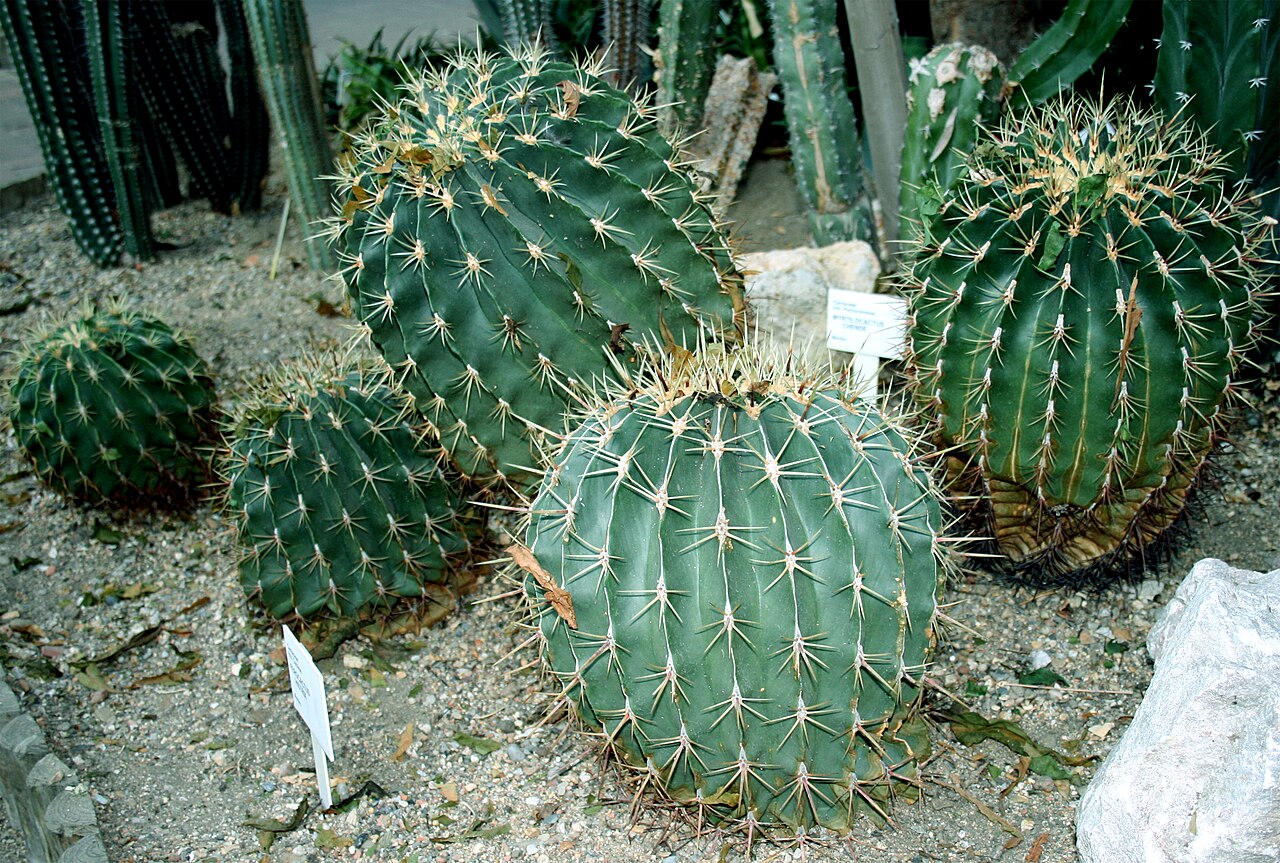
The glasshouses are divided by theme. The tropical section displays the Santa Cruz waterlily (Victoria cruziana), a giant South American waterlily, every year among palms, ferns and orchids with imposing leaves. A section on plant evolution shows cycads, including a Cycas circinalis more than 130 years old. The subtropical house holds container-grown collections from October to May, and the succulent house gathers cacti and other succulents from the Americas and Africa in small settings of sand and stone.
In front of the glasshouses, a Caucasian wingnut (Pterocarya fraxinifolia) recalls the old society garden, and a male ginkgo with the shape of a bonsai, known as 'Goethe's ginkgo' (cultivar 'Praga'), probably dates from the 1870s. For the garden's 250th anniversary in the autumn of 2025, exhibitions of orchids, citrus, bonsai and exotic birds were staged.
Visiting
1 min
The garden covers about 3.5 hectares and rises from 195 to 225 metres above sea level between Na Slupi, Benátská, Kateřinská, Viničná and Apolinářská streets, with the church of St Apollinaire in the background. The glasshouses are in the lower part, at the corner of Benátská and Na Slupi; allow an hour for them and another for the outdoor terraces, including the Karlštejn rock garden with its grotto, laid out in 1904. The heated houses and subtropical collections make the garden worthwhile in winter, while the warm months favour the outdoor displays. The garden receives more than 100,000 visitors a year.
50.07° N, 14.42° E
Greenhouses nearby
More greenhouses — Czech Republic
Do you have a good photo of this greenhouse? Suggest it for this page →
Sources (4)
- cs.wikipedia.org/wiki/Botanick%C3%A1_zahrada_Univerzity_Karlovy
- ziva.avcr.cz/files/ziva/pdf/botanicka-zahrada-prf-uk-na-slupi-vcera-dnes-a-zit.pdf
- encyklopedie.praha2.cz/park/1468-botanicka-zahrada-prirodovedecke-fakulty-univerzity-karlo
- cesky.radio.cz/prazska-botanicka-zahrada-univerzity-karlovy-250-let-stara-ucebna-prirody-s