Lednice Castle Greenhouse (zámecký skleník)
Lednice, South Moravia
Entry updated on September 30, 2026
- Year
- 1843–1845
- Architect
- Peter Hubert Desvignes and Georg Wingelmüller (sources differ)
- Style
- Monumental cast-iron, iron and glass greenhouse, mid-nineteenth century
- Dimensions
- 92 m long, 13–14 m wide, 10 m high; 1,304 m² built area
- Status
- Open to the public (seasonal); restored 1997-2004
From 1843 Prince Alois II of Liechtenstein had this great cast-iron-columned greenhouse built on the site of a wooden orangery of 1717 and other buildings that were demolished. It is 92 metres long and 10 high, covers 1,304 m² and is roofed by a vault of some 65,000 scale-shaped panes. Sources credit its design to the Englishman Peter Hubert Desvignes and to the architect Georg Wingelmüller. Restored between 1997 and 2004 for 43.3 million crowns, it belongs to the Lednice-Valtice cultural landscape, a UNESCO site since 1996, and grows about 250 tropical and subtropical species.
Affiliate links — booking through Verrière helps fund our research, at no extra cost to you.
History
1 min
At Lednice, the former summer residence of the Princes of Liechtenstein, a wooden orangery founded in 1717 stood on the site of today's greenhouse. Prince Alois II Josef ordered its replacement in 1842; according to an architectural study of the restoration, the idea of a great glazed building dates from September 1840. A castle theatre, the baroque orangery and a classical temple were demolished in 1842-1843, and work began on 16 July 1843. The building was completed in 1845 according to official sources, while one Czech tourism site gives 1851, a discrepancy left unresolved here.
Two men are credited with the design. The architect Georg (Jiří) Wingelmüller, who died in 1848, appears in the castle's documentation; the Englishman Peter Hubert Desvignes, the prince's architect, is credited with the overall appearance and with the London 'winter garden' model. The cost came to nearly 160,000 florins. Around 1880 the house, until then used to overwinter tender plants, became a winter garden in use all year round.
Listed as a technical monument, it was included in 1998 in the World Monuments Watch together with other deteriorating features of the park. Its restoration, to plans by the Brno studio OK-Design, ran from 1997 to 2004 and cost 43.3 million crowns.
Architecture and engineering
1 min
The greenhouse is 92 metres long, 13 to 14 metres wide and 10 metres high, with 1,304 m² of built area and a volume of 6,181 m³. It is a nave with two rows of columns: 44 iron cores, hidden under cast-iron sleeves decorated with zinc banana leaves and flowers, carry iron profiles that support a vault of about 65,000 scale-shaped panes. The Sobotín ironworks, owned by the Klein brothers, supplied the metalwork; stone bases and timber beams complete the structure.
Inside, three classical portals punctuate the space, while exterior iron portals fitted with ventilation lunettes animate the façades. The wooden ceiling, backed with reed, is finished in lime plaster. According to a tourism record, the original colours combined grey-red portals, pea-green ornament and white ribs. The 1997-2004 restoration renewed the heating, the five entrance portals, the insulation and the shading systems.
Plant collections
1 min
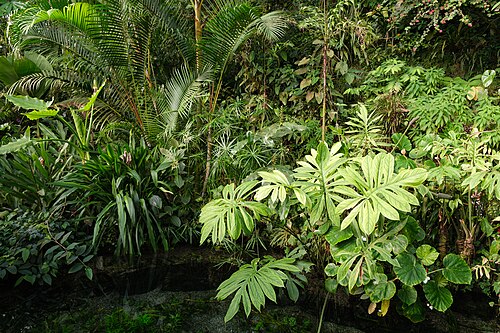
The greenhouse now grows about 250 tropical and subtropical species. Its present planting was recomposed from about ten old photographs, to recover the atmosphere of a nineteenth-century landscape biotope. Gardeners once gathered seed on expeditions to South America, and the scheme is meant to keep at least one plant in flower in every season.
The senior resident is a cycad, Encephalartos altensteinii, estimated to be 300-400 years old. Palms and other tropical plants make up most of the vegetation. Historically the house also served to overwinter some 3,000 orange and other citrus trees.
Visiting
1 min
The greenhouse stands beside Lednice Castle, in the park, and is visited on a self-guided basis; it opens seasonally, with a maintenance closure in January according to one tourism site. About an hour covers the nave and its planting.
The place makes most sense within the Lednice-Valtice cultural landscape, a UNESCO site since 1996: the castle, its park of roughly 200 hectares and its follies can be covered on foot or by bicycle in a day. The vineyards of South Moravia nearby make a natural extension.
48.80° N, 16.81° E
Greenhouses nearby
More greenhouses — Czech Republic
Do you have a good photo of this greenhouse? Suggest it for this page →
Sources (7)
- zamek-lednice.com/en/visitors-information/tours/780-greenhouse
- archiweb.cz/b/renovace-oranzerie-u-zamku-lednice-na-morave
- turistika.cz/mista/lednice-zamecky-sklenik/detail
- visitczechia.com/en-us/things-to-do/places/nature/botanical-gardens-and-parks/c-lednice-ch
- eghn.org/en/lednice-castle-park-2/
- en.wikipedia.org/wiki/Peter_Hubert_Desvignes
- en.wikipedia.org/wiki/Lednice_Castle