Tropisch Paradijs, tropical hall of the Mondo Verde park
Landgraaf, Limburg

Sources checked October 2026
- Style
- Tropical hall in a leisure park, horticultural-greenhouse roof on a steel frame, waterfalls and ponds
- Dimensions
- Over 4,000 m²
- Status
- Open with the park's admission ticket (2026 official calendar through 3 January 2027, attractions open on a rotating basis out of season); aviaries being renovated step by step according to the press of September 2025
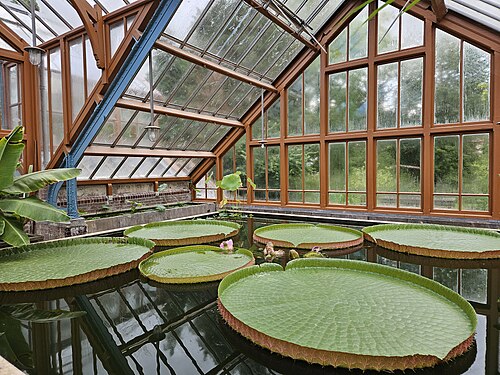
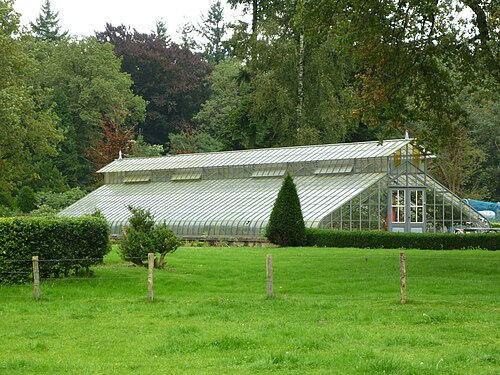
In the Mondo Verde leisure park at Landgraaf, the Tropisch Paradijs is a covered hall of over 4,000 m² that evokes the tropical forests of East Asia, Africa and South America, with waterfalls, ponds and a rain shower. Dutch Wikipedia counts thousands of tropical trees and plants and more than a hundred free-flying birds there, at a minimum of 20 °C. The photographs show a horticultural-greenhouse roof on a steel frame with small transparent panels, glass-like in appearance.
Affiliate links — booking through Verrière helps fund our research, at no extra cost to you.
History
The Tropisch Paradijs is the tropical hall of the Wereldtuinen Mondo Verde park, opened on 24 March 2002 at Landgraaf, in Dutch Limburg, on the site of a former mine spoil heap that was partly dug away (Dutch Wikipedia). The park, laid out by a Belgian designer for the owner of the Kasteeltuinen in Arcen, fell short of its visitor targets: the company went bankrupt at the end of 2006, and two buyers, already owners of Kinderstad in Heerlen, relaunched it in 2007 before an official reopening on 1 April 2008. The Dutch buildings register (BAG), imported into OpenStreetMap, dates to 2002 a building of about 4,100 m² whose area matches the hall's, but that identification rests on area alone.
In September 2025 the magazine ZooFlits reported that most of the small aviaries in the hall had been empty for some time and that the park was renovating them step by step: some will stay empty to serve as separation spaces, others will house birds from the collection or new species. Lories have taken over the former hornbill enclosure, and the hornbills have been given a new one.
Architecture and engineering
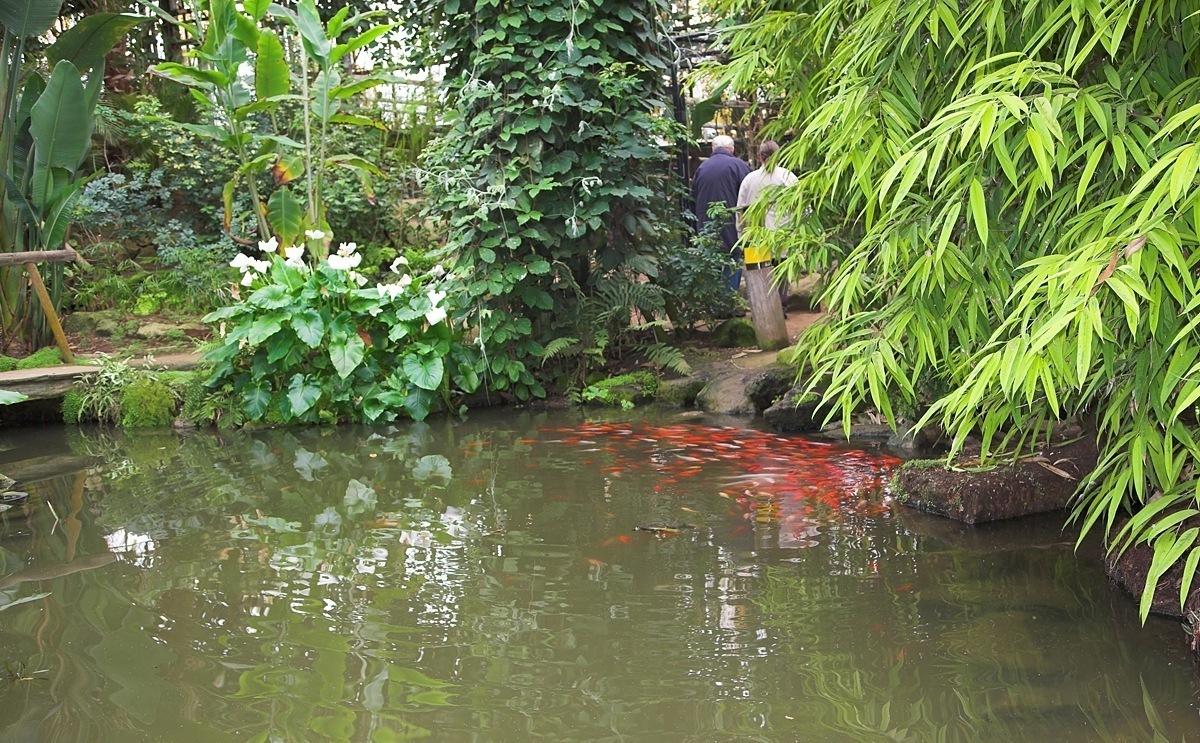
Dutch Wikipedia and ZooFlits give the area (4,000 m², “ruim 4000” for ZooFlits), and ZooFlits speaks of birds living freely “in de kas”, in the greenhouse. On a photograph published by the park on its official page, the roof is that of a horticultural greenhouse: a steel lattice frame and small transparent panels between slender bars, above dense foliage; a Wikimedia Commons photograph shows the same light roof above palms and a pond. The material looks like glass, without certainty.
The interior is laid out as a route on several levels, with waterfalls and ponds (Dutch Wikipedia) and low stone walls visible in the photographs. The park also describes a rain shower that recreates the daily downpours of tropical forests. Dutch Wikipedia says the hall is kept at a minimum of 20 °C; the official page gives 28 to 30 °C, but for the climate of tropical forests in general, without attributing it to the hall. The building identified on OpenStreetMap, from the BAG register, covers about 4,100 m².
Plant collections
The official page presents the flora and fauna of East Asia, Africa and South America, and details four plants: the cycad Cycas revoluta, male and female, whose female cones bear orange-coated seeds; the weeping fig Ficus benjamina, shown as a “bonsai” version 2.5 to 3 m tall; the walking palm Socratea exorrhiza, with aerial roots; and the Chinese hibiscus Hibiscus rosa-sinensis, cut back every year to 5 cm so that the flowers also grow low on the trunk. Dutch Wikipedia speaks of thousands of trees and plants, and a tourist portal of many tropical plants and shrubs planted in recent years.
As for animals, Dutch Wikipedia counts more than a hundred free-flying tropical birds, a few monkeys, hornbills, toucans, reptiles, amphibians and turtles. The official page links to five bird species: green-winged macaw, Papuan hornbill, scarlet ibis, a “rosse neushoornvogel” (a hornbill) and Victoria crowned pigeon. ZooFlits lists flamingos, ibises, “dolksteekduiven”, weavers, “nachtegalen” and turacos living freely in the greenhouse, while the small aviaries are almost all empty in 2025.
Visiting
The hall is part of the Mondo Verde park (Groene Wereld 10, Landgraaf) and is visited with the park admission. The official page says the route crosses three continents, and pictograms on it announce temperature changes and the possibility of getting wet. The constant warmth of the hall (at least 20 °C according to Dutch Wikipedia) makes it a useful refuge in the cool season.
Out of season, the 2026 official calendar reduces the park's opening days (closed on Mondays and Tuesdays from 2 November to 18 December) and says that attractions open on a rotating basis. The park's world gardens, arranged by country, combine with the visit.
50.89° N, 6.03° E
Greenhouses nearby
More greenhouses — Netherlands
Do you have a good photo of this greenhouse? Suggest it for this page →
Sources (8)
- wereldtuinenmondoverde.nl/nl/wereldtuinen/tropisch-paradijs/
- wereldtuinenmondoverde.nl/nl/prijzen-info/openingstijden/
- nl.wikipedia.org/wiki/Wereldtuinen_Mondo_Verde
- zooflits.nl/lege-verblijven-in-tropenhal-van-limburgs-dierenpark-dit-gaat-er-veranderen/
- telegraaf.nl/binnenland/elk-plantje-oip-de-juiste-plek-in-mondo-verde/65411745.html
- vakantieparknederland.nl/uitstapje/mondo-verde/
- commons.wikimedia.org/wiki/File:MondoVerde003.JPG
- openstreetmap.org/way/283482595
Affiliate links — booking through Verrière helps fund our research, at no extra cost to you.