Victoriakas (Hortus Botanicus Leiden)
Leiden

Sources checked September 2026
- Year
- 1870 · current house 1936–1938
- Style
- Victorian iron-and-glass greenhouse, a 19th-century structure rebuilt in 1937
- Dimensions
- Pool housing giant Victoria water lilies with leaves up to three meters across
- Status
- Open to the public (renovated in 2012-2013)
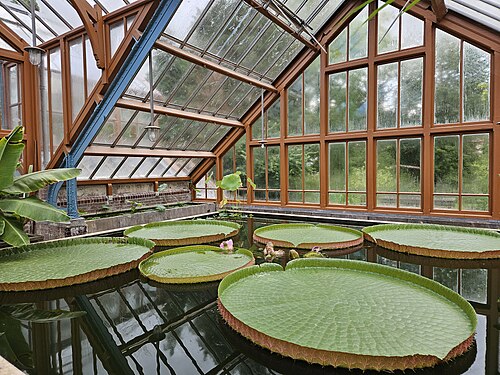
The first Victoria house at the Hortus Botanicus Leiden was built in 1870, literally crowned with a cast-iron ornament, before being replaced by the current structure in 1937. Raised up to escape the shadow of neighboring buildings and maximize sunlight, it has housed the spectacular blooming of the giant Victoria water lilies since 1872, their leaves reaching up to three meters across. It is the warmest spot in the garden, where the flowers, white then pink, release their characteristic pineapple scent for just two nights.
Affiliate links — booking through Verrière helps fund our research, at no extra cost to you.
History
The Hortus Botanicus Leiden, founded by the university in 1590 and shaped by its first director Carolus Clusius, is the oldest surviving botanical garden in the Netherlands. Its first unheated glasshouse appeared around 1680, and the nineteenth century brought a proliferation of small specialist houses for orchids, ferns, palms and cacti.
It was in this setting that a house for the giant water lily, Victoria amazonica, was built in 1870–71. It was designed by Mr Schaap, superintendent of the university's buildings, to a brief drawn up by the head gardener and the professor. Topped with an ornamental cast-iron crown, it cost 4,300 guilders and soon drew the public; the first Victoria flower in Leiden opened in 1872.
Between 1936 and 1938 the glasshouses scattered around the garden were replaced by a single complex, and the historic house of 1870 was demolished. Today's Victoria House belongs to that 1930s ensemble. The complex underwent a major renovation from 2012, designed by the Leiden practice Veldman Rietbroek Smit; during the phased demolition, a tented enclosure was raised over the pond to keep the aquatic plants warm. Queen Máxima opened the renovated glasshouses on 4 September 2013.
Architecture and engineering
The first Victoria House was a circular pavilion about 15 metres across and four metres high, carried on gracefully curved iron ribs and crowned with cast iron.
The 1936–38 complex followed a different logic: some twenty compartments of differing heights and temperatures, each with its own climate, arranged around a central Victoria pool with bevelled corners faced in natural stone. The house is raised to escape the shade of neighbouring buildings and catch as much light as possible, making it the warmest spot in the garden.
In the 2012–13 renovation the original steel trusses were kept along with their characteristic riveted joints, some of them heightened by new sections welded beneath. The work added steel walkways, stairs and a viewing platform, together with high-performance insulating glass and interior thermal screens.
Plant collections
The central pool is devoted to Victoria amazonica, the world's largest water lily, whose round leaves can reach three metres across according to the Hortus. Each flower opens for only two nights, white on the first and pink on the second. When a bud is about to open, a scent reminiscent of pineapple fills the house.
Around the giant lily grow many smaller aquatic plants, while hibiscus adds bright colour at the pool's edge. The Victoria House is part of the Hortus's tropical glasshouse sequence, which also displays orchids, giant aroids, carnivorous plants and ant plants.
Visiting
The Hortus lies in the heart of Leiden's historic centre, along the Rapenburg canal, close to the university's older buildings. The Victoria House is reached along the route through the tropical glasshouses, which also includes the High Glasshouse and its walkway added in 2013.
The visit continues outdoors: the reconstruction of Clusius's garden, opened in 2009 from a sixteenth-century plant list; the Japanese garden dedicated to Philipp Franz von Siebold, inaugurated in 1990; and the monumental orangery of 1740–44, still used to overwinter tender potted plants.
52.16° N, 4.49° E
Greenhouses nearby
More greenhouses — Netherlands
Do you have a good photo of this greenhouse? Suggest it for this page →
Sources (7)
- hortusleiden.nl/zien-en-doen/ontdek-de-botanische-tuin/kassen/victoriakas
- hortusleiden.nl/zien-en-doen/ontdek-de-botanische-tuin/historie
- hortusleiden.nl/de-hortus/kassen/tropische-kassen
- kasseninnederland.nl/wp-content/uploads/Kassenboek-web-03-Hoofdstuk-3.pdf
- nationalestaalprijs.nl/project/restauratie-en-uitbreiding-hortus-botanicus
- bouwwereld.nl/bouwtechniek/historische-kassen-leiden-gerenoveerd/
- en.wikipedia.org/wiki/Hortus_Botanicus_Leiden
Affiliate links — booking through Verrière helps fund our research, at no extra cost to you.