Tropikhuset (Tropical House), Trädgårdsföreningen
Linköping, Östergötland

Sources checked October 2026
- Year
- 2004
- Style
- Contemporary glass tetrahedron attached to the park's greenhouses
- Dimensions
- 17 m high
- Status
- Open to the public (café-restaurant; park free to enter all year)
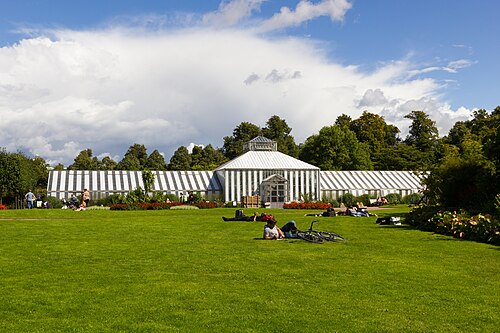
In the park of the Linköping Horticultural Society, founded in 1859, the Tropikhuset was built in 2004 as a glass prism, a tetrahedron 17 metres high set against the existing greenhouses. The city intended it for overwintering Mediterranean plants and for a collection of subtropical useful plants, with a restaurant and café among the plants. It thus took over from the restaurant of 1881, destroyed by fire in April 1977 and never rebuilt. The 13-hectare park, a municipal foundation since 1894, remains free to enter all year round.
Affiliate links — booking through Verrière helps fund our research, at no extra cost to you.
History
The Linköping Horticultural Society was founded on 22 March 1859 at a meeting in the town's castle, on the initiative of Provost Petter Nejdel of Skönberga. The first plan of the park was drawn by Carl Ferdinand Liepe of Gothenburg, and Christian Frederik Kroné, the first head gardener with the title of director, ran it until 1893. The aim was twofold: to give the town a public park, its green lung, and to awaken an interest in gardening, vegetables and fruit. In 1881 the restaurant, a 'schweizeri' described by the European Garden Heritage Network as Moorish in style, was completed at the far end of the central axis, together with the belvedere tower; the restaurant gained an upper floor in 1882 to become a proper inn. On 12 January 1894 the society was dissolved and the estate became a municipal foundation, on condition that the land remain intact for the park.
In April 1977 the restaurant burned down and was never rebuilt; a rotunda of roses and a pergola leading the eye to the great fountain took its place. Restoration of the park in a nineteenth-century spirit began in 2000, with the entrance lodges rebuilt to their original state and a new entrance area by the landscape architect Ulf Nordfjell inaugurated on 4 June 2001. In 2004 the city raised the 'glasprismat', a 17-metre glass tetrahedron attached to the existing greenhouses, to overwinter Mediterranean plants, display a collection of subtropical useful plants and house a restaurant and café. Dr Åman's garden followed in 2008, the 150th anniversary in 2009 and the renovation of the belvedere tower in 2010, when it was given a separate café building.
Architecture and engineering
The Tropikhuset breaks with the working greenhouses it extends: the municipality describes it as a glass prism, a tetrahedron 17 metres high, that is a pyramid on a triangular base whose glazed faces rise to a single point. OpenStreetMap records it as a greenhouse building with glass walls and a glass roof at 27 Linnégatan, in the northern part of the park, with two further greenhouses adjoining it, those of the park's plant nursery, which predate it. A photograph of 2006 on Wikimedia Commons calls it simply the park's 'glass pyramid'. The European Garden Heritage Network notes that the 17-metre height and the 2004 opening answered the loss of the restaurant that burned in 1977: the restaurant is therefore set inside the glazed volume itself, among the plants it was built to overwinter. The website of the present operator, a city café and caterer, invites guests into a 'green setting'.
Plant collections
The programme set by the city in 2004 is that of a modern orangery: to overwinter the park's Mediterranean plants and to bring together a collection of subtropical useful plants. The European Garden Heritage Network, which described the place a few years after it opened, speaks of a collection of Mediterranean and useful tropical plants around which the restaurant tables are laid. In the park, two black walnut trees are said to be the largest of their kind in Sweden, Dr Åman's garden, opened in 2008 as a garden of ideas, has a rose pergola and some 80 rose varieties, the municipal nursery sells plants, and an apiary of the Linköping beekeepers' association pollinates the park, under its deed of gift, for a token annual fee.
Visiting
The Tropikhuset stands in the northern part of the park on the Linnégatan side, a few minutes' walk from the centre of Linköping; the park's main entrance is at 45 Drottninggatan. One walks in as into a café: lunch cooked on the premises, cakes and home-made ice cream, which makes the pyramid a convenient shelter on rainy or snowy days. Allow half an hour for the building, more with a meal. The walk continues to the belvedere tower of 1881, 22 metres tall on the rock of Kjettilberget, 45 metres above Lake Roxen, then to Dr Åman's garden, the Krogsfallsgården farm museum moved here in 1913, and the nature centre. The park is free to enter all year round.
58.41° N, 15.62° E
Greenhouses nearby
More greenhouses — Sweden
Do you have a good photo of this greenhouse? Suggest it for this page →
Sources (7)
- linkoping.se/uppleva-och-gora/friluftsliv-och-parker/tradgardsforeningen/parkens-historia
- linkoping.se/uppleva-och-gora/friluftsliv-och-parker/tradgardsforeningen
- eghn.org/?p=9706
- belvederen-tropikhuset.se/
- sv.wikipedia.org/wiki/Tr%C3%A4dg%C3%A5rdsf%C3%B6reningen,_Link%C3%B6ping
- openstreetmap.org/way/203056114
- commons.wikimedia.org/wiki/Category:Tr%C3%A4dg%C3%A5rdsf%C3%B6reningen,_Link%C3%B6ping
Affiliate links — booking through Verrière helps fund our research, at no extra cost to you.