Greenhouse of the Showa Pharmaceutical University Medicinal Plant Garden (昭和薬科大学薬用植物園 温室棟)
Machida, Tokyo
No freely licensed photo of this greenhouse yet. Do you have one? Suggest it for this page →
Sources checked October 2026
- Style
- Glazed greenhouse in a combined greenhouse and administration building, in a university garden
- Dimensions
- Large greenhouse of 270 m², small greenhouse of 32 m²; combined building of 878 m² of floor area
- Status
- Garden open to the public on Saturdays
In the Showa Pharmaceutical University medicinal plant garden in Machida (Tokyo), a combined building of 878 m² brings together a large greenhouse of 270 m², a small greenhouse of 32 m², research rooms and a meeting room. The temperature is computer-controlled, with city gas as the heat source. Photographs on the official site show a volume with glazed walls and roofs. Tropical and subtropical medicinal and fruit plants (banana, mango, vanilla, tamarind) and plants of Ayurvedic medicine are grown there. The garden, opened in April 1990, receives the public on Saturdays.
Affiliate links — booking through Verrière helps fund our research, at no extra cost to you.
History
The greenhouse is part of the Showa Pharmaceutical University medicinal plant garden, on the Machida campus (Tokyo). The university, founded in 1930, has occupied this campus since 1990, according to Japanese Wikipedia; the garden's data sheet gives its opening as April 1990.
The university presents the garden as a "living teaching material": students observe and study the plants at the origin of pharmacy there. It also serves to spread knowledge of common medicinal plants among the public: free medicinal-plant courses are held on several Saturdays a year (six sessions on the 2026 programme, from April to October), and the garden is open to visitors on Saturdays. Area figures differ from page to page: 18,000 m² in the site's introduction and in a 2026 document on medicinal gardens that host training courses, 111,784 m² in the data sheet updated in 2012 (which also counts the fields and the campus green space, including 20,100 m² of specimen garden), and 23,423 m² according to Spanish Wikipedia.
Architecture and engineering
The official data sheet describes a "greenhouse and administration building": 878 m² of floor area in all, with a large greenhouse of 270 m², a small greenhouse of 32 m², a laboratory of 42 m², a preparation room of 26 m² and a meeting room of 52 m² for 30 people, on the upper floor. The large greenhouse is followed by the figure "11.00 m" and the small one by "3.25 m", without the page saying which dimension is meant. Heat comes from city gas and the room temperature is computer-controlled. Spanish Wikipedia, for its part, speaks of several small greenhouses totalling 366 m².
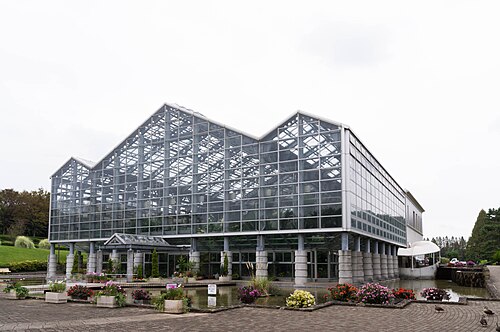
Photographs published on the official site show a building of glass with small panes, with glazed walls and roofs and volumes of different heights; an interior view shows large leaves beneath glass roof panels. The folk-medicine plot occupies the slope along the road in front of the greenhouse, and a nature trail extends to the rise behind it.
Plant collections
According to the official site, the greenhouse shelters tropical and subtropical medicinal plants and fruit trees: banana, mango, vanilla and tamarind, together with plants used in Ayurveda, the traditional medicine of India (myrobalan, beleric myrobalan and the yukan, cited by their Japanese names). Useful plants from regions of the world such as Nepal, Myanmar, Vietnam and Brazil are also shown. The garden's home page lists vanilla among the plants in flower on 15 May 2026.
Outside the greenhouse, the garden is divided into a woodland, a zone of medicinal herbs, a folk-medicine zone, an aquatic and wetland zone and a zone of medicinal trees planted by botanical family. The number of species is about 800 according to a 2026 document on training courses and about 1,200 according to Spanish Wikipedia.
Visiting
The garden can be visited on Saturdays; visitors register at the main gate or the west gate, where a visitor badge is handed out, and the east gate stays closed to the public. The campus has no car park, and the university asks visitors to use public transport: allow about 15 minutes on foot from Tamagawa-gakuen-mae station (Odakyu), or a bus from JR Naruse station to the 観性寺前 stop followed by a 10-minute walk, according to the Machida tourist guide. Staff do not explain the plants on ordinary Saturdays; in 2026, lectures followed by an explanation of the plants on site take place in the afternoon, free and without registration, on the third or fourth Saturdays of the programme.
The introduction page invites visitors to observe the plants of the greenhouse, and the page on public access forbids entry to the campus's other buildings (lecture halls, laboratories, gymnasium): access to the inside of the greenhouse on a given Saturday should be confirmed with the garden. OpenStreetMap places a park, the かしの木山自然公園, about 600 m to the south-west.
35.56° N, 139.47° E
Greenhouses nearby
More greenhouses — Japan
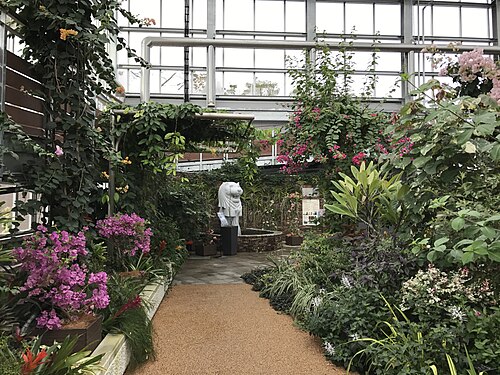
Do you have a good photo of this greenhouse? Suggest it for this page →
Sources (10)
- shoyaku.ac.jp/garden/
- shoyaku.ac.jp/garden/outline/
- shoyaku.ac.jp/garden/area/
- shoyaku.ac.jp/garden/open/
- shoyaku.ac.jp/about/facilities/garden/
- machida-guide.or.jp/post-834/
- ja.wikipedia.org/wiki/%E6%98%AD%E5%92%8C%E8%96%AC%E7%A7%91%E5%A4%A7%E5%AD%A6
- es.wikipedia.org/wiki/Jard%C3%ADn_de_Plantas_Medicinales_de_la_Universidad_de_Farmacia_Sho
- wikidata.org/wiki/Special:EntityData/Q5926941.json
- jpec.or.jp/download/kanpou_yakuyousyokubutsuen_jisyushisetsutokushoku.pdf
Affiliate links — booking through Verrière helps fund our research, at no extra cost to you.