Shimokamo Tropical Garden (下賀茂熱帯植物園)
Shimokamo, Minamiizu (Shizuoka Prefecture)
No freely licensed photo of this greenhouse yet. Do you have one? Suggest it for this page →
Sources checked October 2026
- Year
- 1962 (official opening of the garden)
- Style
- Glazed greenhouse heated by hot-spring water, with a roof of glass panes on glazing bars
- Dimensions
- Garden of about 80 × 70 m (OpenStreetMap outline)
- Status
- Open to the public, free admission since October 2014 (closed on Wednesdays, with exceptions)
In Shimokamo, a hot-spring village in the south of the Izu Peninsula, this garden officially opened in January 1962 around a large greenhouse heated by hot-spring water. It grew out of a family business that had been growing melons under glass in Minamiizu since 1932. After its closure was announced in 2014 for lack of visitors, it carried on welcoming the public, and admission has been free since October 2014. Hibiscus, bougainvillea, papaya and banana can be seen almost all year, the jade vine in spring; the garden also sells plants, runs a fruit parlour and hires out its large hall for events.
Affiliate links — booking through Verrière helps fund our research, at no extra cost to you.
History
The garden continues a family story that predates the war. According to a 2018 interview in the local magazine Minamiizu Shinbun, the first director, then a student in Tokyo, had noticed the value of Minamiizu's hot springs for greenhouse growing and started melons there during his studies; he then left the agricultural university and settled on the spot for good in 1932. The war interrupted the business. Back in 1945, he resumed horticulture with cut flowers and potted flowers. His descendants recall that he brought back plants from his trips abroad and that the tropical plants he had seen during the war had left their mark on him.
The botanical garden officially opened in January 1962. The same interview ties the opening to the arrival of the railway at Shimoda station in December 1961. Admission was free at first; at the request of a coach company wanting to add the place to its tours, it became a paid entry, starting at 50 yen and eventually reaching 500 yen. In the bubble-economy years the garden's restaurant, where Polynesian cooking was popular, reportedly had queues every week; that wooden building burned down at dawn on 29 December 1992, while the plants at the back were spared.
From 2014, the decline in tourism led the family to stop taking tour groups. The closure of its tourist activities was announced for 21 September 2014 (local television KTV-12ch, 15 September 2014), but visitors kept turning up, the garden showed them round, and in October 2014 it declared admission free. It has since lived on plant sales and rentals, a fruit parlour and the hire of its large hall.
Architecture and engineering
The official website names three rooms: a large viewing greenhouse heated by the heat of the hot springs, a room of tropical flowering trees and a plant-sales room, joined by a souvenir shop and the fruit parlour "Hawaiian Room". It presents the greenhouse as "all-weather": visitors can walk through it in the rain. The heat comes from Shimokamo's hot-spring water; according to the 2018 interview it keeps the climate mild from November to April.
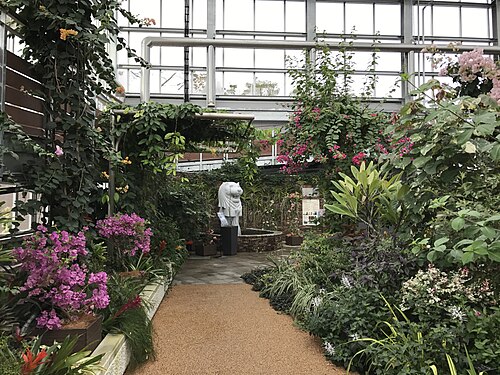
One photograph of the garden shows a roof of glass panes laid on rafters and glazing bars, with tropical plants beneath; another shows glazed walls behind the bougainvillea. At the entrance a large double-height space serves as a café corner, and the garden hires out a hall fitted with tables, a projector and a kitchen. On the aerial orthophotograph of the Geospatial Information Authority of Japan (GSI), several adjoining bays with a gridded roof appear behind a reception building with a brown roof; the OpenStreetMap outline of the garden covers about 80 × 70 m.
Plant collections
The official website sorts the plants by season. Almost all year round: hibiscus, bougainvillea, angel's trumpet, benihimo-no-ki (with long drooping red flower spikes), papaya and banana. In spring, the jade vine, the "Mickey Mouse" tree, medinilla, cacti and mango flowers; in summer, plumeria, miracle fruit, mango, sensitive plant and pitcher plants; in autumn, heliconia and shrimp plant; in winter, poinsettia, dendrobium, heliotrope, cymbidium and cyclamen.
The garden's leaflet describes the jade vine (Strongylodon macrobotrys), native to Luzon in the Philippines: a climber more than 20 m long whose clusters hang about 1 m, usually flowering from late March to early May. The garden also offers a miracle-fruit tasting, whose pulp makes sour foods taste sweet for about an hour, and sells phalaenopsis, cacti and cyclamen.
The number of species is about 2,000 according to the Japanese Wikipedia and a 2016 travel article, more than 100 according to the 2018 interview.
Visiting
The garden stands on the shopping street of the hot-spring village of Shimokamo, 23 minutes by bus from Izukyū-Shimoda station (stop "Shimokamo nettai shokubutsuen-mae"). A local tourist guide allows thirty minutes to an hour for a visit; the fruit parlour serves sorbets of mango, papaya and pineapple, and pineapple, mango and guava juices.
The "Minami no sakura to nanohana" festival (10 February to 10 March) is the liveliest period: about 800 early Kawazu cherry trees bloom over 2 km along the Aono River, a one-minute walk from the garden according to the leaflet, which stays open every day then. The jade vine flowers afterwards, from late March to early May.
34.65° N, 138.86° E
Greenhouses nearby
More greenhouses — Japan
Do you have a good photo of this greenhouse? Suggest it for this page →
Sources (10)
- shimokamo-nettai.jp/information/guide.html
- shimokamo-nettai.jp/information/price.html
- shimokamo-nettai.jp/access/img/pamphlet.pdf
- minamiizu.news/0032.html/
- travel.co.jp/guide/article/15029/
- izumilu.com/list5/tag75/
- ja.wikipedia.org/wiki/%E4%B8%8B%E8%B3%80%E8%8C%82%E7%86%B1%E5%B8%AF%E6%A4%8D%E7%89%A9%E5%9
- wikidata.org/wiki/Q7496970
- shimoda-ktv12ch.jp/%E5%8D%97%E4%BC%8A%E8%B1%86%E3%83%BB%E4%B8%8B%E8%B3%80%E8%8C%82%E3%80%8
- shimokamo-nettai.jp/parlor/parlor.html
Affiliate links — booking through Verrière helps fund our research, at no extra cost to you.