Pyramid Cactus Greenhouses, Izu Shaboten Zoo (伊豆シャボテン動物公園)
Itō, Shizuoka Prefecture

Entry updated on October 5, 2026
- Year
- 1959-1963
- Architect
- Norio Kondō (concept)
- Style
- Five pyramid-shaped glasshouses, each devoted to a region
- Status
- Open to the public
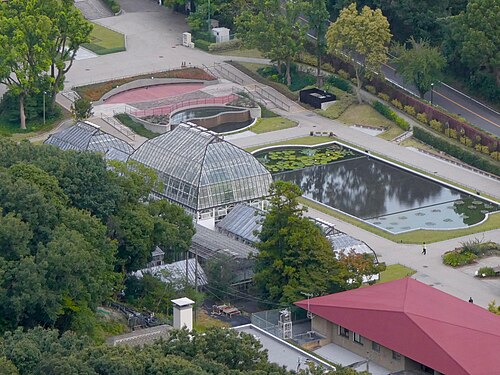
Opened on 22 October 1959 on the north-eastern flank of Mount Ōmuro in Itō, Izu Shaboten Park grew out of a plan by the agronomist Norio Kondō of the Tokyo University of Agriculture for a naturalistic garden of cacti and succulents. Finding the usual greenhouse shape dull, Kondō chose pyramids that would stand out against the mountain's soft curves. Five themed houses, South America, Africa, forest cacti, Madagascar and Mexico, now hold about 1,500 species. With animals steadily added over the decades, the park was renamed a zoo in 2016.
Affiliate links — booking through Verrière helps fund our research, at no extra cost to you.
History
1 min
In a text published in March 1960 in the journal Shaboten, Norio Kondō, head of the plant-breeding research institute at the Tokyo University of Agriculture, explained that he had been planning a naturalistic garden of cacti and succulents in the Izu area for nearly ten years. His first idea was to warm the soil with pipes carrying hot-spring water so that every species could be planted outdoors. Several offers of land came to nothing until an agreement was reached in February 1959 with Tōtaku Izu Kaihatsu, owner of the Ōmuro plateau. Because the site lay at 320 metres and bringing hot-spring water up would take years, Kondō added greenhouses to the plan.
The park opened on 22 October 1959 as Izu Shaboten Kōen, initially attached to Kondō's institute. Guests at the opening included the botanist Eiji Matsuda, who came from Mexico, and the Mexican ambassador to Japan. The first cactus festival was held in 1960, and the operating company's timeline records the completion of the pyramid-type greenhouse in 1963; the sources do not allow each building to be dated. Emperor Shōwa visited in 1970 and 1975.
Animals gradually took a larger place, and on 22 October 2016 the park adopted its current name as a zoo. Kondō died in 1997, aged 81. His model spread: the Kōsan-ji temple on Ikuchi Island built pyramid greenhouses modelled on those at Izu.
Architecture and engineering
1 min
Kondō explained his choice himself. He did not want a mere accumulation of species: each planting was to carry meaning and form a landscape, without neglecting the plants' growth. Seen that way, the usual shape of a greenhouse struck him as dull, so he devised pyramid-shaped houses, whose silhouettes scattered across grassland against the soft curves of Mount Ōmuro would be a sight in themselves.
The scheme divided the roles between outside and inside: open-air planting on the natural lava ground, designed for landscape effect, and the species collection under glass. The site lies on the mountain's north-eastern flank at about 320 metres. Five numbered houses now follow one another, each devoted to a region of the world, and OpenStreetMap places them in the southern part of the park. Outdoors, a rock garden pairs succulents with replica Mesoamerican statues, and one visitor's account notes that geothermal heat allows cacti to be shown outside even in winter. None of the sources consulted gives the dimensions or the materials of the greenhouses.
Plant collections
1 min
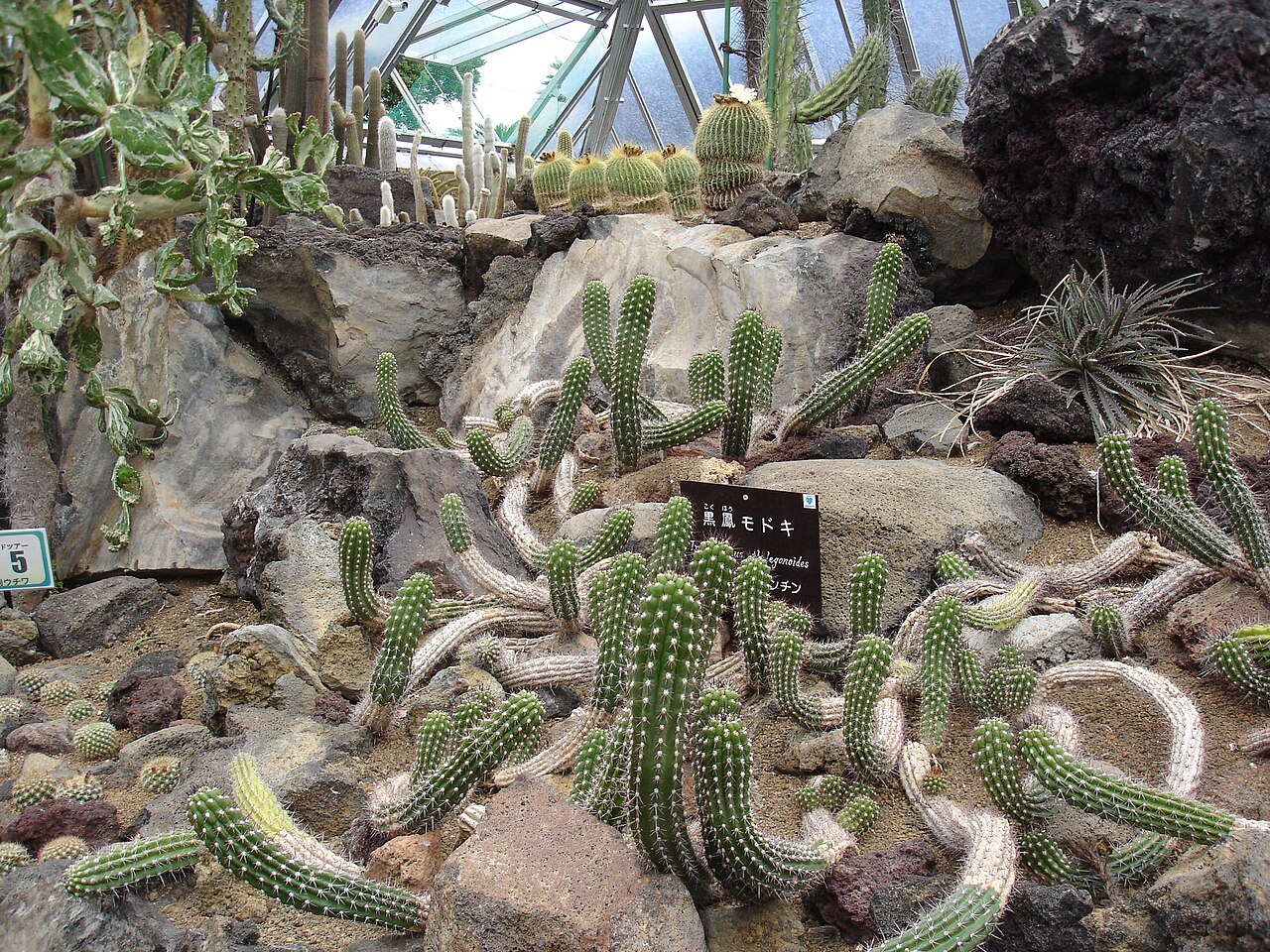
The park displays some 1,500 species of cacti and succulents from around the world. House no. 1, South America, holds tall columnar cacti, prickly pears, small globular cacti and primitive leafy cacti. House no. 2, Africa, contains no cacti at all, since the family does not grow wild there, but succulents such as the dragon tree and lithops. House no. 3 gathers forest cacti that live in jungle trees, including strongly scented night-flowering species whose blooms last a single night, and Christmas cacti that flower profusely in winter. House no. 4 shows Didiereaceae, a family found only in Madagascar, and other rare succulents. House no. 5, Mexico, presents cacti and succulents from Mexico and North America, among them large columnar species and a 'kinshachi' globular cactus about 170 years old, counted among the largest in Japan.
Visiting
1 min
The park covers the north-eastern flank of Mount Ōmuro in Itō, and the mountain still forms the backdrop to the greenhouses, as Kondō intended. The five houses are best taken in numerical order, from South America to Mexico, before the rock garden with its replica pre-Columbian statues. The site is now as much zoo as botanical garden: the capybaras' open-air bath and the animal areas take up much of it. Cactus flowerings are announced regularly on the official website, and in winter the forest-cactus house fills with flowering Christmas cacti. Neighbouring Mount Ōmuro rounds off the visit.
34.91° N, 139.10° E
More greenhouses — Japan
Do you have a good photo of this greenhouse? Suggest it for this page →
Sources (6)
- izushaboten.com/saboten/house_mexico.html
- shaboten.co.jp/company-outline/
- ja.wikipedia.org/wiki/%E4%BC%8A%E8%B1%86%E3%82%B7%E3%83%A3%E3%83%9C%E3%83%86%E3%83%B3%E5%8
- www7a.biglobe.ne.jp/~websabotenkonjaku/kaisou/kaisou_shokubutuen.htm
- sakata-tsushin.com/event/detail_38/
- note.com/nostalgia_zoo/n/n08593a12785b