Large Greenhouse, Aoshima Subtropical Botanical Garden (県立青島亜熱帯植物園 大温室)
Miyazaki, Miyazaki Prefecture

Entry updated on October 5, 2026
- Year
- 1967 (renewed 2016)
- Architect
- Unknown
- Style
- Steel-framed display house with glazed walls and a perimeter ramp on two levels
- Dimensions
- 779.97 m² floor area, 14 m high
- Status
- Open to the public
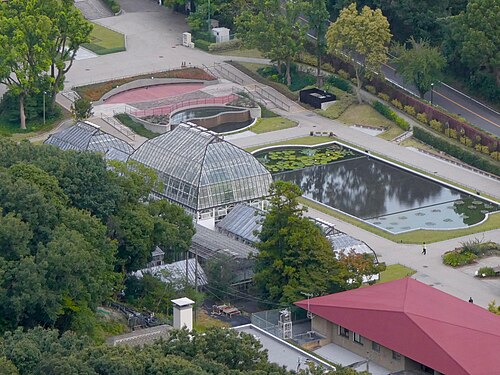
Founded by Miyazaki Prefecture in 1965 across from Aoshima island, to protect a grove of biro palms and to study subtropical plants, this public garden opened in June 1967, its large greenhouse having been completed that January. Ageing and below modern earthquake standards, the facilities underwent a complete renewal unveiled in March 2016: today's steel-framed greenhouse has 779.97 m² of floor space on two levels and a height of 14 metres, with a ramp that circles along its four glazed sides. It holds some 186 species, among them sixteen varieties of bougainvillea.
Affiliate links — booking through Verrière helps fund our research, at no extra cost to you.
History
1 min
Aoshima Prefectural Subtropical Botanical Garden was founded by Miyazaki Prefecture in April 1965 on the shore facing Aoshima island, whose subtropical plant community is a designated Special Natural Monument. Its first purpose was to protect the grove of biro palms and to support research on subtropical plants. As early as October 1965 it signed a sister-garden agreement with the Singapore Botanic Gardens, the start of more than half a century of technical exchange and plant donations, later joined by material from Brazil and Argentina. The large greenhouse was completed in January 1967 and the garden opened to the public the following June; a tropical fruit greenhouse was added in August 1977.
Fifty years on, ageing facilities and earthquake-resistance requirements led the prefecture to a complete renewal, unveiled on 26 March 2016. Under a naming-rights deal the garden took the nickname Miyakō Botanic Garden Aoshima, in use since April 2016. The effect was immediate: before the works the large greenhouse drew about 18,000 visitors a year, while in the six months after reopening it received some 81,000. The tropical fruit greenhouse was renewed in turn in March 2019, a Merlion statue marks fifty years of the Singapore partnership, and in 2025 the park announced the large greenhouse's millionth visitor.
Architecture and engineering
1 min
Today's large greenhouse, the product of the works completed in 2016, is a two-storey steel-framed building with 779.97 m² of floor space and an interior rising to 14 metres. Circulation drives the whole design: a ramp runs right round the building along the glazed walls of all four sides, and pedestrian decks multiply the viewpoints. Visitors thus climb gradually through the planting to an upper gallery that takes in the whole house, while bougainvilleas trained into arches punctuate the route at ground level.
The 2016 programme also included two single-storey timber support buildings, an administration building and a learning centre of 216 m² each. Miyazaki cedar was used extensively throughout the scheme, which was carried out for the prefecture's urban planning division. The smaller tropical fruit greenhouse dates from 1977 and was renewed in 2019. None of the sources consulted names the architect or the builder of the greenhouse.
Plant collections
1 min
The large greenhouse holds about 186 species and 1,500 plants according to Japanese Wikipedia, or some 1,600 specimens according to a 2024 feature. Bougainvilleas, represented by sixteen varieties, flower there all year round, and the house shows trees that Japanese usage counts among the 'world's three great flowering trees', including the kaenboku and the hōōboku. The partnership with Singapore, a source of donated plants, is presented in a dedicated display.
The tropical fruit greenhouse shows 26 species, among them mango, papaya, banana and pineapple. Outside, the open-air garden has some 150 species and 8,000 plants, including ten species of palm, led by the biro that grows wild on Aoshima, as well as the phoenix palm, the prefecture's emblem tree, and the hamayū, its emblem flower.
Visiting
1 min
The garden lines the shore opposite Aoshima island, whose subtropical vegetation is protected, so a visit to the greenhouse pairs naturally with one to the island itself. Inside the large greenhouse it is worth following the ramp all the way up to the gallery, which gives the best overall view of the bougainvilleas and flowering trees. Volunteers lead guided tours of the garden at weekends and on public holidays, and the garden café serves desserts made with mangoes grown in the prefecture, echoing the neighbouring tropical fruit greenhouse.
31.80° N, 131.47° E
More greenhouses — Japan
Do you have a good photo of this greenhouse? Suggest it for this page →