Flower Center, Nagoya Agricultural Culture Park (名古屋市農業文化園 フラワーセンター)
Minato-ku, Nagoya, Aichi Prefecture

Sources checked October 2026
- Style
- Municipal display greenhouse with four themed rooms around a central hall
- Status
- Open to the public (free; closed on Mondays and over the New Year)
In south-western Nagoya, along the Toda river, the Agricultural Culture Park opened on 25 May 1989 to bring city dwellers closer to farming and flowers. Its display greenhouse, the Flower Center, is divided into four rooms of distinct character, a four-seasons garden, a fern forest, a room of aerial roots and water, and a cactus field, arranged around a central hall used for exhibitions and classes; orchids and tropical and subtropical plants are shown there. It stands beside a museum of agricultural science and a teaching farm in the southern section of the large Todagawa park, and admission is free.
Affiliate links — booking through Verrière helps fund our research, at no extra cost to you.
History
The Nagoya Agricultural Culture Park (Nōgyō Bunkaen) was opened by the city on 25 May 1989, at the start of the Heisei era, as a place of recreation meant to convey the importance of farming and foster a love of flowers among residents; it is one of Nagoya's three municipal agricultural parks. It occupies the southern part of Todagawa park, the largest green space in the south-west of the city, laid out on the theme of a "village of health and sport" along both banks of the Toda river for about 2.5 km.
The park is organised around three main facilities: the museum of agricultural science, which keeps about a hundred tools of traditional rice farming and a collection of some 6,000 insects donated to the city, the Flower Center, a display greenhouse with four rooms, and the "rainbow-coloured" teaching farm, where flower seedlings and vegetables are grown. In 1993 the "flower factory" was added, a group of production greenhouses that supplies seedlings for the city's parks and streets using a plug-tray system; only part of it is open to visitors. The Spanish Wikipedia dates the display greenhouse's opening to 1993, the year the Japanese Wikipedia assigns to the flower factory.
Under the designated-manager system, the agricultural park and Todagawa park are run together by Team YMO, based on the second floor of the museum of agricultural science. The site remains busy: in autumn 2026 its diary records the arrival of chestnut tiger butterflies on the boneset, the reddening of the kochia and a sweet-potato harvest festival.
Architecture and engineering
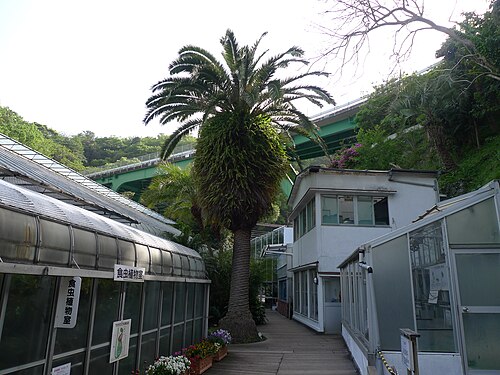
The park's pages describe the Flower Center as a greenhouse divided into four rooms and a central hall; the Japanese encyclopaedia speaks of four greenhouses arranged around a hall, and OpenStreetMap records the building as a greenhouse.
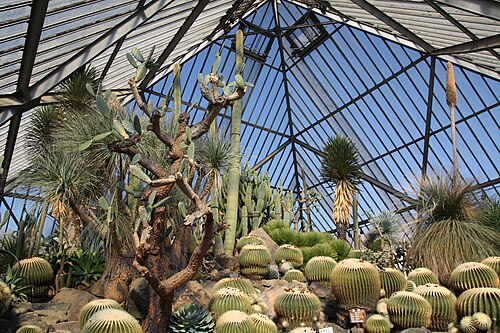
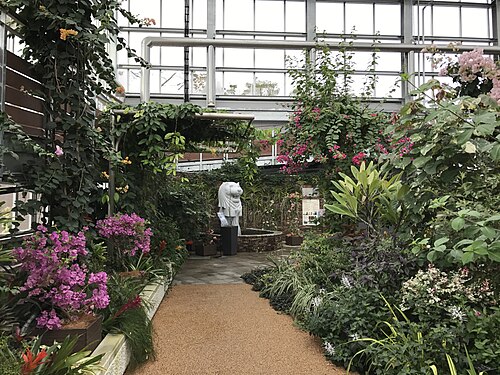
Each room has its own setting: the four-seasons garden is arranged around a statue of a goddess; the fern forest is dotted with objects evoking the ruins of an ancient civilisation; the room of aerial roots and water is devoted to plants whose roots emerge from stems or trunks; the cactus field brings together cacti and plants from Africa and Australia. The central hall, the passage between the rooms, serves as a space for exhibitions and classes on flowers and nature.
The greenhouse stands in the southern section of Todagawa park beside the museum of agricultural science, a two-storey building whose ground floor shows farm tools, a 150-inch theatre and insects, and whose roof carries a model green-roof garden and a kitchen garden in containers made of railway sleepers. The teaching farm, the trial paddies and the trial allotments complete this riverside group.
Plant collections
The Flower Center displays orchids and tropical and subtropical plants, according to the Japanese encyclopaedia and Aichi Prefecture. The four-seasons garden is filled with seasonal flowers of changing colours; the fern forest gathers varied ferns in a jungle-like atmosphere; the room of aerial roots shows plants whose roots, sent out from stems and trunks, serve as supports or breathing organs; the cactus field brings together cacti and oddly shaped plants from Africa and Australia. The central hall hosts exhibitions on flowers and nature.
Around the greenhouse the teaching farm raises flower seedlings and vegetables, with public harvests in season, and the park's flower calendar follows the outdoor plantings: summer sunflowers in the trial garden, boneset visited by chestnut tiger butterflies in September, kochia turning red in October, a jacaranda noted for flowering out of season in September 2026, and paddies where rice-drying racks are set up after the harvest. In spring the cherry trees of Todagawa park bloom along the paths.
Visiting
The Flower Center lies in the southern section of Todagawa park, in Minato ward, at the far south-west of Nagoya. An hour is enough for the greenhouse and the neighbouring museum of agricultural science, with its theatre and insect room; families extend the visit to Todagawa Kodomo Land, the playgrounds, lawns and the picnic and barbecue area, or to the park's central section with its putting course and the Todagawa woods. The Hidamari pavilion sells vegetables from nearby farms. Hands-on vegetable harvests, the October autumn festival and spring cherry blossom mark the year; the greenhouse is closed on Mondays. Tōgokusan Fruit Park and Higashiyama Botanical Gardens, at the other end of the city, round off the trip for greenhouse enthusiasts.
35.12° N, 136.81° E
Greenhouses nearby
More greenhouses — Japan
Do you have a good photo of this greenhouse? Suggest it for this page →
Sources (8)
- bunkaen-todagawa.jp/bun2.html
- bunkaen-todagawa.jp/parkmap.html
- bunkaen-todagawa.jp/bun1.html
- ja.wikipedia.org/wiki/%E5%90%8D%E5%8F%A4%E5%B1%8B%E5%B8%82%E8%BE%B2%E6%A5%AD%E6%96%87%E5%8
- es.wikipedia.org/wiki/Parque_de_cultivos_agr%C3%ADcolas_y_Centro_Floral_de_Nagoya
- wikidata.org/wiki/Q11415127
- pref.aichi.jp/soshiki/nogyo-shinko/nagoya-sisetsu.html
- openstreetmap.org/way/175534888
Affiliate links — booking through Verrière helps fund our research, at no extra cost to you.