Conservatory of the Two Sisters (New Orleans Botanical Garden)
New Orleans, Louisiana
Entry updated on October 5, 2026
- Year
- 1930s · renovated and enlarged (completed by 2003)
- Architect
- Unknown
- Style
- Glasshouse with a central glass dome and two glazed wings, in an Art Deco WPA garden
- Dimensions
- Central dome 40 ft (≈12 m) high
- Status
- Open to the public
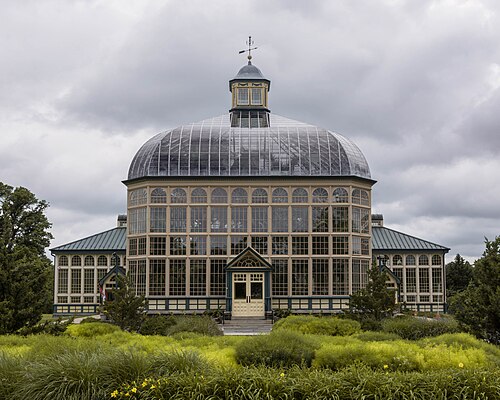
Set in the botanical garden of City Park, which opened in 1936 with Works Progress Administration funding, this conservatory dates back to the 1930s. Renovated and enlarged in the early 2000s with support from the Azby Fund, it is arranged around a central room under a 40-foot glass dome that looks onto the lily pond and echoes the Pavilion of the Two Sisters at the far end of the garden. Its two glass-roofed wings hold the Living Fossils exhibit, devoted to plants older than flowers, and a tropical rainforest with a waterfall and a cave.
Affiliate links — booking through Verrière helps fund our research, at no extra cost to you.
History
1 min
The New Orleans Botanical Garden grew out of the vast public-works programme that reshaped City Park in the 1930s. Funded by the Works Progress Administration, the park project cost some $12 million and employed nearly 20,000 workers, according to Wikipedia. The garden opened in 1936 as the City Park Rose Garden, on about seven acres within a stand of live oaks, and was the city's first public classical garden. Landscape architect William Wiedorn laid it out with architect Richard Koch and sculptor Enrique Alférez, and their Art Deco treatment makes it one of the few surviving WPA public gardens.
The conservatory belongs to this first phase: the park describes it as originally built in the 1930s, and the Cultural Landscape Foundation lists it among the founding structures. Once WPA money ran out after the Second World War, the garden slid into decades of poor upkeep and vandalism. Its revival began in 1982, when Paul Soniat was appointed its first director and Neil Odenwald of Louisiana State University drew up a restoration plan; a 1990 master plan by Jon Emerson and Associates later enlarged the grounds to twelve acres.
The conservatory was then turned into a modern plant showcase, a renovation and expansion paid for by the Azby Fund and completed by 2003, according to Wikipedia. In 2005 Hurricane Katrina left the garden under floodwater for about two weeks (three feet deep by Wikipedia's account, four according to the Cultural Landscape Foundation), killing nearly 90 per cent of the plants; the foundation notes that only the live oaks survived. The garden reopened on 4 March 2006.
Architecture and engineering
1 min
The conservatory is organised around a central room crowned by a glass dome 40 feet (about 12 metres) high. This space, of roughly 1,000 square feet (≈93 m²) according to an event-venue listing, faces the garden's lily pond on one side and is dressed with tropical plants. It is flanked by two glass-roofed wings, one devoted to the Living Fossils exhibit and the other to the tropical rainforest, so that the plan combines a domed pavilion with two lower galleries.
The design deliberately echoes the Pavilion of the Two Sisters at the opposite end of the garden, which the park presents as inspired by a European orangery, with soaring ceilings and large arched windows. Together the two buildings frame the layout inherited from the Art Deco scheme of Wiedorn, Koch and Alférez. Sources disagree on the pavilion's age: Wikipedia says it was dedicated in 1995 to designs by architect Peter Trapolin, whereas the Cultural Landscape Foundation counts it among the 1930s structures. In the rainforest wing the climate is controlled, and the setting incorporates a waterfall and a cave.
Plant collections
1 min
The two wings tell complementary stories. The Living Fossils exhibit brings together plants from around the world belonging to lineages that arose before flowering plants, giving an impression of prehistoric vegetation. The rainforest wing recreates, under climate control, the feel of warm and humid regions: epiphytes cling to tree roots, a waterfall animates the scene and a cave houses tropical animals.
The central room, furnished with tropical plants, acts as a transition between the two displays. Around the conservatory, the garden holds more than 2,000 varieties of plants from around the world, most of them replanted after Katrina wiped out the bulk of the collections in 2005.
Visiting
1 min
The conservatory stands near the entrance of the botanical garden, on Victory Drive in City Park, and is included in garden admission. An hour or two allows time for the glasshouse and then the garden rooms, among them the rose garden, the Japanese garden, the azalea and camellia garden and the historic train garden added after 1990. Alférez's Art Deco sculptures and the paths beneath the live oaks reward an unhurried walk. In spring the garden hosts a Spring Garden Show. The rest of City Park, with its historic carousel and the Sydney and Walda Besthoff Sculpture Garden, easily fills the remainder of a day.
29.99° N, 90.10° W
Greenhouses nearby
More greenhouses — United States
Do you have a good photo of this greenhouse? Suggest it for this page →
Sources (6)
- neworleanscitypark.org/visit-city-park/botanical-garden/
- en.wikipedia.org/wiki/New_Orleans_Botanical_Garden
- tclf.org/landscapes/new-orleans-botanical-garden
- neworleanscitypark.org/venues/pavilion-of-the-two-sisters/
- thevendry.com/venue/168267/new-orleans-botanical-garden-new-orleans-la/space/64494
- openstreetmap.org/way/325825434