Cecil B. Day Butterfly Center (Callaway Gardens)
Pine Mountain, Georgia
Entry updated on October 5, 2026
- Year
- 1988
- Architect
- Jova Daniels Busby, Inc. (Atlanta)
- Style
- Glass dome on a steel frame, tropical butterfly conservatory
- Dimensions
- ≈680 m² (7,300 sq ft)
- Status
- Open to the public year-round
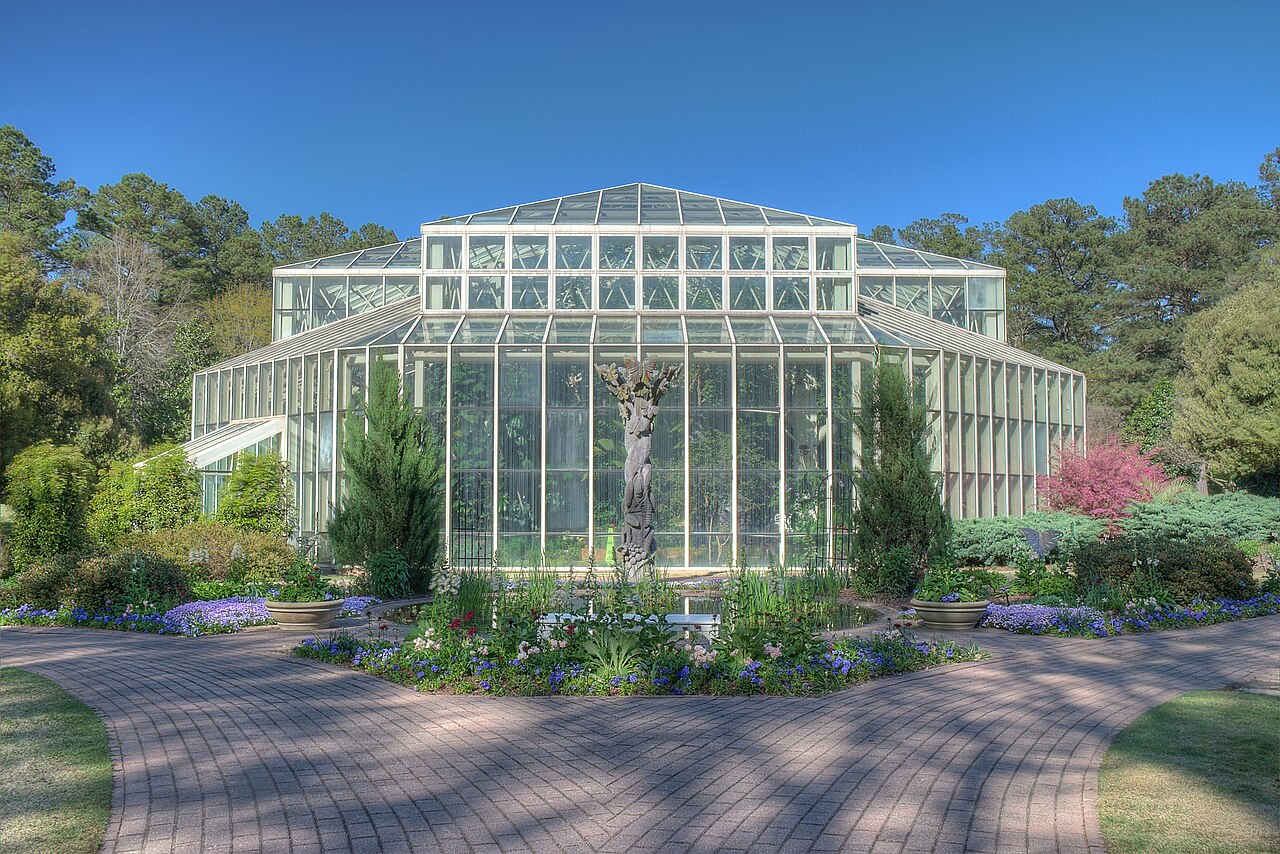
Opened on 25 September 1988 within Callaway Gardens at Pine Mountain, this glass conservatory of about 7,300 sq ft (680 m²) was among the first butterfly centres in the United States. Designed by the Atlanta firm Jova Daniels Busby, it is named after Cecil B. Day, the philanthropist who founded the Days Inn hotel chain. Between 1,200 and 2,000 tropical butterflies, imported as chrysalides from Costa Rica, Ecuador, Kenya and Malaysia, fly freely among nectar plants in air kept at around 80 °F (27 °C).
Affiliate links — booking through Verrière helps fund our research, at no extra cost to you.
History
1 min
Callaway Gardens grew out of land in Harris County, Georgia, that nearly a century of cotton farming had left exhausted. The textile manufacturer Cason Callaway and his wife Virginia Hand Callaway, a knowledgeable horticulturist, bought 2,500 acres there in 1930, the year they came across a rare, bright orange-red azalea near their home. They dammed the creeks into lakes, had more than 20,000 trees and shrubs planted and in May 1952 opened the Ida Cason Gardens, named after Cason's mother; the estate later took the name Callaway Gardens.
The butterfly center opened to the public on 25 September 1988. It was one of the first three such centres in the United States, and the garden now describes it as the second oldest in the country. It honours Cecil B. Day, the philanthropist who founded the Days Inn hotel chain; his wife, Deen Day Sanders, gave artwork and financial support to the gardens in his memory. The general contractor Batson-Cook built it to designs by the Atlanta firm Jova Daniels Busby, for a final contract cost of about 2.98 million dollars.
A renovation costing around 2 million dollars in 2005 allowed the building to take more visitors. It has outlived the estate's other large glasshouse, the John A. Sibley Horticultural Center, a 28,000 sq ft conservatory opened in 1982 and closed in 2015. In 2022 Herschend Family Entertainment agreed to buy the resort's revenue-producing assets from the Ida Cason Callaway Foundation, which remains responsible for the gardens' free attractions.
Architecture and engineering
1 min
The conservatory is a glass envelope carried on a steel frame whose columns and beams are built as trusses. It covers about 7,300 square feet (680 m²). Accounts of its height differ: 35 feet (about 11 m) at the top of the dome according to some sources, more than 40 feet (over 12 m) at the highest point according to the firm that built it. Inside, concrete paver paths loop around a water feature some 12 feet (3.7 m) tall, made from sections of pipe.
The lobby and gift shop occupy an adjoining block, its exterior walls of split-face block on metal studs. Its roof carries a century-old cupola which, according to the builder, came from the childhood home of 'Mrs. Callaway'.
The glasshouse is run as an enclosure regulated by the United States Department of Agriculture. Because exotic butterflies are treated as potential invasive species, a machine at each doorway blows a blast of air inward to prevent escapes, and nothing may be taken out, whether butterfly or plant material, dead or alive. The air is held at around 80 °F (27 °C) and 74 per cent relative humidity: butterflies are cold-blooded and will not take flight until their bodies have warmed to that temperature.
Plant collections
1 min
The center holds between 1,200 and 2,000 butterflies at any one time, and more than fifty species pass through it over the course of a year. They arrive as chrysalides bought from family-run butterfly farms in tropical countries, currently Costa Rica, Ecuador, Kenya and Malaysia. The garden presents this trade as an incentive for local communities to protect the forests on which the farms depend. On arrival the chrysalides are pinned to vertical boards in a controlled environment; one board is usually on show, so that visitors can watch butterflies emerge, dry their wings and make their first wingbeats.
The tropical plants of the conservatory are there first of all to feed its residents, many of them supplying the nectar the butterflies live on. Two seasonal highlights mark the year: in April hundreds of longwing butterflies of every colour fill the dome with their courtship displays, and in September and October the blue morphos take over with their iridescent wings.
Visiting
1 min
The butterfly center lies within Callaway Resort & Gardens at Pine Mountain, about seventy miles (110 km) south-west of Atlanta. An hour is enough for the conservatory and the talks given in its theatre. A sunny day is best: butterflies need warmth to fly and are seen in greater numbers in summer. April and the blue morpho months of September and October are the high points. Strollers must be left at the entrance. The visit combines well with the Callaway Brothers Azalea Bowl, the Overlook Azalea Garden, Cason's Garden, the Callaway Discovery Center and Robin Lake Beach, or, at Christmas, with the Fantasy in Lights display.
32.83° N, 84.85° W
Greenhouses nearby
More greenhouses — United States
Do you have a good photo of this greenhouse? Suggest it for this page →
Sources (6)
- callawaygardens.com/the-gardens/places-to-explore/day-butterfly-center/
- en.wikipedia.org/wiki/Cecil_B._Day_Butterfly_Center
- batson-cook.com/callaway-gardens-1956-2002/
- georgiaencyclopedia.org/articles/geography-environment/callaway-gardens/
- en.wikipedia.org/wiki/Callaway_Gardens
- openstreetmap.org/way/455427315