Palmimaja, Palmse Manor Palm House
Palmse, Lahemaa National Park
Entry updated on October 5, 2026
- Year
- 1870s
- Architect
- Unknown
- Style
- Manor glasshouse: central palm hall flanked by two glazed gable-roofed wings
- Status
- Open to the public in the summer season
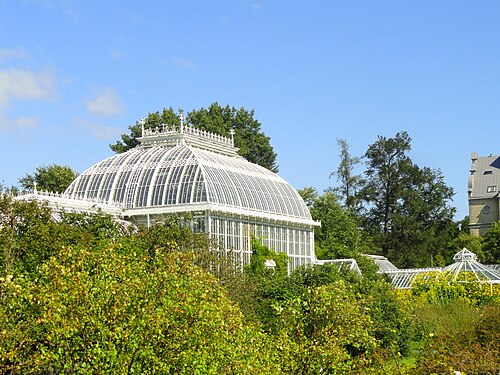
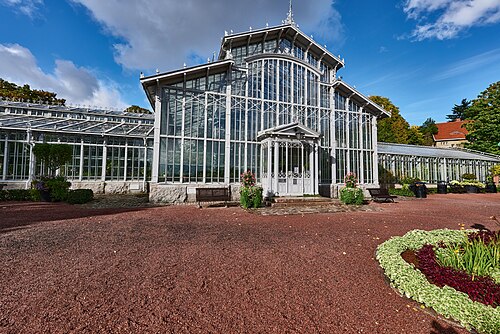
Built in the 1870s for Alexander von der Pahlen, the Palmse Manor palm house pairs a tall, formal central palm hall with two plainer glazed wings: one held peaches and the other grapevines, while palms, lemon and laurel trees filled the middle. Reconstructed about a century later by Lahemaa National Park from old photographs and renovated again in 2014–2015, it now holds more than 130 plant species, which ranks it third among Estonian glasshouses for diversity.
Affiliate links — booking through Verrière helps fund our research, at no extra cost to you.
History
1 min
Palmse belonged to the von der Pahlen family from 1676 until 1919. The manor house was begun in 1697, restored in 1730 and remodelled in 1782–1785 under the architect Johann Caspar Mohr. By the middle of the 19th century several outbuildings had been added and the park had reached its present extent.
The glasshouse, known as the palmimaja ('palm house'), was built in the 1870s, in the time of Alexander von der Pahlen. The museum links it to the period when advances in sheet-glass manufacture made such buildings fashionable. Exotic fruit was grown there, including pineapples, grapes and lemons, along with laurels.
In 1972 it passed to Lahemaa National Park, which undertook one of the most thorough manor restorations in Estonia, carried out mainly between 1973 and 1986. About a hundred years after it was first built, the park reconstructed the palm house on the evidence of old photographs. It went through a further renovation in 2014–2015. The estate is now run as a museum by the Virumaa Muuseumid foundation, whose website lists the palm house among the manor's buildings and exhibitions.
Architecture and engineering
1 min
The Palmse palm house follows a three-part plan. In the middle rises the palm hall, the showpiece: a spacious, tall volume whose windows are divided into small decorative panes. On either side extend two large utility glasshouses, fully glazed and covered with gabled roofs.
The layout served distinct purposes. One wing was given over to peaches and the other to grapevines, while the central block housed palms, lemon trees and laurels. The present building is a reconstruction carried out by Lahemaa National Park from old photographs and renovated again in 2014–2015.
The sources consulted name no designer and give no dimensions or details of the frame materials or heating. The glasshouse stands within the manor ensemble, among the other restored buildings: the manor house, distillery, barn and park pavilions.
Plant collections
1 min
According to the museum, the Palmse palm house ranks third in Estonia for species richness, with more than 130 plant species. The plants come from the Mediterranean, South Africa, Central and South America and Asia.
Its fruit-growing past is still apparent: vines, fig trees, peaches and citrus are grown here, a reminder of the days when the estate produced pineapples, grapes and lemons. Among the plants singled out are Canary Island date palms and a large-flowered cactus known as the 'queen of the night', whose blooms are one of the attractions highlighted by the 'Exotic plants' exhibition.
Visiting
1 min
Palmse lies within Lahemaa National Park, and its manor is among the most thoroughly restored estate ensembles in Estonia. The palm house belongs to the manor ensemble, now a museum, and its 'Exotic plants' exhibition is open during the summer season.
A visit pairs naturally with the manor house and its period interiors, and with the 19th-century landscape park, its romantic pavilions and its bath-house. The exhibition draws attention to the fine flowers of the 'queen of the night'. Half a day allows the estate to be explored without haste.
59.51° N, 25.96° E
Greenhouses nearby
Do you have a good photo of this greenhouse? Suggest it for this page →