Palm House and Greenhouses of the University of Tartu Botanical Garden
Tartu, Tartu County
Entry updated on September 30, 2026
- Year
- 1807 (first greenhouse); palm house 1984
- Architect
- Ingrid Mardi (palm house); Johann Wilhelm Krause (1807 greenhouse)
- Style
- Modern palm house and tropical greenhouses on an early nineteenth-century academic site
- Dimensions
- Palm house 22 m high; over 700 m² of growing space under glass
- Status
- Open to the public
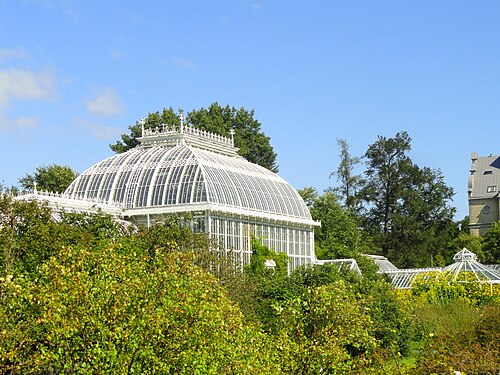
The University of Tartu Botanical Garden, founded in 1803, settled in 1806 on a former bastion on Lai Street, and its first greenhouse was finished in 1807. Rebuilt in 1855-1857 and then damaged by bombing in 1943, it gave way to a modern complex dominated by the 22-metre palm house designed by Ingrid Mardi and completed in 1984. Four climate sections, the palm house, a tropical house, a subtropical house and a desert section, offer over 700 m² of growing space to some 700 species, with turtles, fish and parrots.
Affiliate links — booking through Verrière helps fund our research, at no extra cost to you.
History
1 min
The botanic garden of the Imperial University of Dorpat, now Tartu, was created in 1803 near Vanemuise Street and moved in 1806 to a better site, a former bastion on Lai Street on the northern side of the old town. The first greenhouse was completed in October 1807 and formally opened on the 7th; it followed a design by the architect Johann Wilhelm Krause, with two glazed wings, one heated and one unheated, each divided into three compartments. The gardener Anton Weinmann drew up the layout of the garden, and a description of 1808 already mentions four heated houses.
Weinmann's catalogue of 1810 lists about 4,586 species, of which 16 per cent stood in warm greenhouses, 33 per cent in cool greenhouses and 51 per cent in the open. In 1826 Carl Friedrich von Ledebour's Altai expedition sent 42 cases of plants and seeds, 1,300 species of which 500 had not yet been cultivated here.
In 1855-1857 the architect Karl Rathus had the greenhouse rebuilt: the internal partitions disappeared and a glass roof improved the light. Hit by bombs in 1943, it was repaired and remained almost unchanged for more than a century. The present palm house, 22 metres high and designed by Ingrid Mardi, opened in 1984 and was renovated in 2014; the tropical wing, begun in 2003 under Raul Järg, was renovated in 2006 with an extra floor.
Architecture and engineering
1 min
The present complex has four sections with distinct climates: the palm house, the tropical house, the subtropical (or 'near-tropical') house and an arid section devoted to desert plants. The palm house, 22 metres high, is the dominant volume. It was designed by Ingrid Mardi and finished in 1984; the 2014 renovation brought it up to date.
The tropical wing, by Raul Järg, was begun in 2003; in 2006 it gained an extra floor. The whole exceeds 700 m² of growing space, and a lift serves the greenhouse for visitors with reduced mobility.
The garden's propagation and production buildings, completed in 1990 on Pirni Street, form a separate complex of about 2.5 hectares with several greenhouses and laboratories, outside the visitor route.
Plant collections
1 min
The garden grows more than 10,000 species and varieties, most of them outdoors; the glasshouses hold about 700. The palm house gathers more than fifty palm species, including specimens over a century old. The tropical, subtropical and desert sections present, respectively, rainforest plants, plants of mild climates and plants of arid habitats, drawn from almost every continent.
The greenhouses also shelter a small fauna: turtles, fish and parrots, and large insects according to the official pages, reflecting the educational role of a site that has served teaching for more than 160 years.
Visiting
1 min
The palm house stands in the garden on Lai Street, on the northern side of Tartu's old town, with three entrances (Lai, Emajõgi and Kroonuaia streets). The greenhouses can be visited throughout the year; about an hour is enough, more if the outdoor garden, open to all, is included.
Step-free access is available from Vabaduse Avenue, and the garden's activities include guided tours, family days and nature festivals. The garden combines easily with a walk through the historic centre and along the Emajõgi river, close to the site.
58.38° N, 26.72° E
Greenhouses nearby
Do you have a good photo of this greenhouse? Suggest it for this page →
Sources (6)
- natmuseum.ut.ee/et/botaanikaaia-kasvuhoone
- natmuseum.ut.ee/en/botanical-garden
- entsyklopeedia.ee/artikkel/tartu_%C3%BClikooli_botaanikaaed
- sirp.ee/s1-artiklid/c21-teadus/tartu-ulikooli-botaanikaaed-220/
- visitsouthestonia.com/mida-teha-louna-eestis/tartu-ulikooli-botaanikaaed/
- en.wikipedia.org/wiki/University_of_Tartu_Botanical_Garden