Yurigahara Green Center Greenhouses (百合が原緑のセンター温室)
Kita-ku, Sapporo, Hokkaido

Entry updated on October 5, 2026
- Year
- 1986
- Architect
- Unknown
- Style
- Group of three floral display glasshouses
- Status
- Open to the public
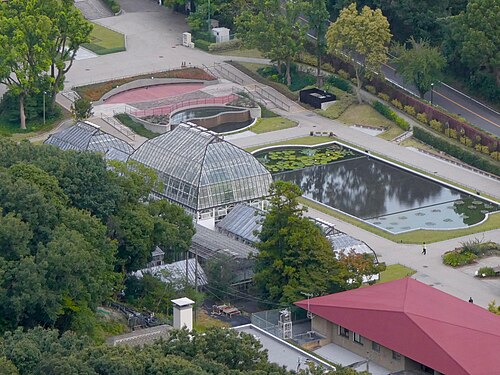
Built for the 1986 Sapporo Flower and Green Exposition, the fourth national urban greening fair, these glasshouses form the core of the Green Center in Yurigahara Park, about 8 km north-east of central Sapporo. Three rooms, large, medium and small, show plants all year round, mostly grown in pots and swapped in as they come into flower, including a collection of around 250 camellia cultivars. The glasshouses reopened in February 2018 after 70 panes were replaced and the floors redone.
Affiliate links — booking through Verrière helps fund our research, at no extra cost to you.
History
1 min
Yurigahara Park, in Sapporo's Kita ward, hosted the 1986 Sapporo Flower and Green Exposition, staged as the fourth national urban greening fair. Several permanent facilities were installed for the event, among them the Green Center and its glasshouses, as well as the Lily Train. The park, covering 25.4 hectares, grows around 6,400 species and cultivars, some 3,500 of them cold-hardy.
After more than thirty years of use the glasshouses were renovated. They reopened on 14 February 2018: 70 clouded or cracked panes had been replaced, and the wood-chip floor had given way to a stabilised soil surface that is brighter, less dusty and accessible to wheelchairs. The sources consulted name neither the architect nor the builder of the 1986 glasshouses.
Architecture and engineering
1 min
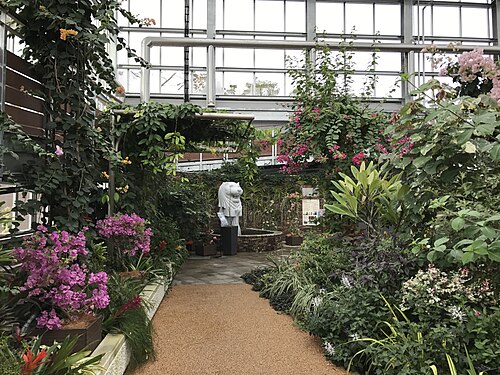
The glasshouses are the heart of the Green Center, a building that also contains a reception area, a plant advice desk and a library. They are divided into three rooms. The medium room, through which visitors enter, is planted to make a bright first impression and often hosts shows by amateur societies. The large room, to the left, is the only one where trees and shrubs grow in the ground, with herbaceous plants beneath them and a central area with benches; it contains a suikinkutsu, a device that turns drops of water poured from a ladle into a lingering, bell-like sound. The small room, to the right, is kept the warmest and is used for exhibitions, classes and workshops.
The 2018 renovation improved the light with new glazing and the accessibility with the new floor. The sources consulted give neither the floor area nor the dimensions of the glasshouses.
Plant collections
1 min
The glasshouses show around 1,500 species and cultivars. Apart from the plantings in the large room, nearly everything is grown in pots and brought out as it reaches full flower, so that several dozen kinds are in bloom at any one time.
Camellias, which do not grow wild in Hokkaido, form the signature collection, with about 250 cultivars, including some with striped petals or stamens turned into petals and a so-called goldfish-leaf camellia with oddly shaped foliage. The sources also mention around a hundred azalea cultivars, fuchsias and geraniums. The large room features a mimosa as its symbolic tree, along with Australian flowering shrubs and a handkerchief tree.
Visiting
1 min
The Green Center stands in Yurigahara Park, about 8 km north-east of central Sapporo; admission to the glasshouses is charged. Half an hour to an hour is enough for the three rooms, longer if the park and its Lily Train are included.
The programme follows the seasons: a camellia show in winter, then spring flowers, lilies, dahlias, orchids, succulents and bonsai, together with talks and gardening classes. In winter, when the park lies under snow, the glasshouses hold most of the flowers on the site.
43.13° N, 141.37° E
Greenhouses nearby
More greenhouses — Japan
Do you have a good photo of this greenhouse? Suggest it for this page →