Display Greenhouse, Mito Botanical Park (水戸市植物公園 観賞大温室)
Mito, Ibaraki Prefecture

Entry updated on October 5, 2026
- Year
- 1987
- Architect
- Mitsuo Taki
- Style
- 'Three-dimensional circuit' display greenhouse: concrete frame, weathering steel, polycarbonate roof
- Dimensions
- 1,561 m²
- Status
- Open to the public
Opened on 29 April 1987 at the heart of Mito Botanical Park, this 1,561 m² display greenhouse was designed by the architect Mitsuo Taki, who conceived it as a three-dimensional circuit rather than a mere growing shelter. It links a flower gallery, cactus and orchid rooms and a large main house, with some 500 species and 15,000 plants. The project grew out of a plan to reuse waste heat from the Kobuki incineration plant, which warmed it until 2020. Damaged in the 2011 earthquake, the greenhouse was refurbished in 2021.
Affiliate links — booking through Verrière helps fund our research, at no extra cost to you.
History
1 min
The park grew out of a heat-recovery scheme. In March 1983 the city of Mito adopted a plan for a facility using waste heat from the neighbouring Kobuki incineration plant: burning refuse would warm a garden of tropical plants. Work on the main greenhouse and the park began in June 1984 on land shaped around Miyanoike pond, and Mito Botanical Park opened on 29 April 1987. A shop and a tropical fruit greenhouse followed in June 1988, then a plant hall in 1994. The site became an urban park in 1991, run by the city's park association, and welcomed its half-millionth visitor in 1990, its millionth in 1995 and its two-millionth in 2009.
The Great East Japan Earthquake of March 2011 damaged the greenhouse and other facilities; the park closed for three months and reopened on 11 June 2011. When the Kobuki plant shut down in March 2020, the greenhouse lost its heat source and a new heating system had to be installed; the city also plans to redevelop the park to take in the site of the demolished plant. In 2021 the greenhouse was refurbished, and its central courtyard gained a 'Peacock Garden' with a peacock topiary.
Architecture and engineering
1 min
The greenhouse is the work of Mitsuo Taki (1936-2016), an architect trained in Kyoto and at Columbia University, whose Tokyo practice, founded in 1972, worked extensively on botanical gardens and horticultural buildings. Taki described his approach as a 'three-dimensional circuit', or a fusion of inside and outside: rather than a growing shelter, the greenhouse is conceived as a place for contemplation, comparable to a museum or exhibition hall. This series of display greenhouses, Mito foremost among them, earned him the Japanese Institute of Landscape Architecture Prize for the 1988 fiscal year.
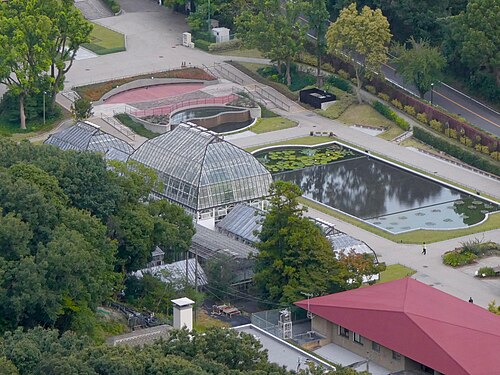
At the centre of the park, the 1,561 m² building strings together a flower gallery, a potted-plant room, a cactus room, an orchid room, the main house and a multipurpose room. The structure combines a concrete frame with weathering-steel members under a roof of polycarbonate sheets. A ramp lets visitors look down closely on the flowers of a handkerchief tree planted by the entrance, and a neighbouring platform overlooks the lawn. Until 2020 the heating came from the incinerator's waste heat.
Plant collections
1 min
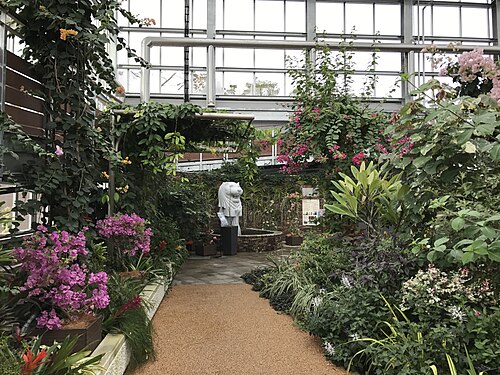
The greenhouse holds about 500 species and 15,000 plants, including hibiscus and bougainvillea, spread across themed rooms for cacti, orchids and flowering pot plants. Since the 2021 refurbishment the central courtyard has housed the Peacock Garden, with its peacock-shaped topiary and a deck laid out for photographs. The neighbouring tropical fruit greenhouse shows tropical plants used in medicine and cosmetics.
Outdoors, the medicinal plant garden, the Mito Yōmeishu Medicinal Herb Garden, combines a herb section with a section of Edo-period medicinal plants linked to the Mito domain, centred on a phellodendron (kihada), the source of a well-known remedy of the time. It grew from a garden of about 50 species drawn from the Kyūmin myōyaku, a book of household remedies compiled on the orders of Tokugawa Mitsukuni and described as the oldest in Japan.
Visiting
1 min
The greenhouse sits at the centre of a park of about 8 hectares that the city presents as its Western-style garden, a counterpoint to Kairaku-en, Mito's Japanese garden. From the entrance a footbridge leads to the terrace garden and its waterfall, whose beds change with the seasons: foxgloves in early May, English roses and laburnum in late May, hibiscus and copper-leaved cannas in summer, salvias in autumn. In summer tropical water lilies flower in the pool of the shaded plaza, and from early summer to early autumn the carp pond fills with yellow pond lilies. Kairaku-en makes a natural companion visit.
36.34° N, 140.42° E
Greenhouses nearby
More greenhouses — Japan
Do you have a good photo of this greenhouse? Suggest it for this page →