Saratov Lemonarium (Saratovsky Limonariy)
Saratov, Saratov Oblast
No freely licensed photo of this greenhouse yet. Do you have one? Suggest it for this page →
Sources checked October 2026
- Year
- 2001
- Style
- Small glass-roofed greenhouse laid out as a visitable tropical garden
- Dimensions
- About 500 m²
- Status
- Open to the public, by advance booking only
Founded in 2001 inside an oil-industry compound on Sokolovaya Gora, north-east of central Saratov, the lemonarium is a small glass-roofed greenhouse of 500 m² turned into a tropical garden. Some fifty species grow there, among them fifteen lemon varieties, oranges, mandarins, kumquats, papayas, a coffee tree and a murraya; the 'Yubileyny' lemon, bred in Uzbekistan, has produced a 1.3 kg fruit here. The visit, of about an hour, is by advance booking only: a short guided introduction, a free stroll among the plants and their resident animals, then the shop selling lemons, jams and young plants.
Affiliate links — booking through Verrière helps fund our research, at no extra cost to you.
History
The Saratov lemonarium presents itself as an exotic garden founded in 2001. It belongs to a small Russian tradition of growing lemons under glass that came from Uzbekistan: the Tonkosti guide counts only three lemonariums in the country, in Saratov, in Ufa and near Magnitogorsk in Chelyabinsk Oblast; the Ufa one, brought into use in 1990, also appears in this atlas. The varieties grown tell of this lineage. The 'Yubileyny' lemon, bred in Uzbekistan, very sour and rich in vitamin C, is the one also found in Ufa; in Saratov one of its fruits reached 1.3 kg. Pavlovo lemons, from Nizhny Novgorod province, fruit here all year round.
The establishment occupies a plot enclosed within the industrial compound of RusNeft / Saratovneftegaz, in the industrial zone of Sokolovaya Gora north-east of the centre; visitors enter through the checkpoint on Geofizika Street. Since its creation the lemonarium has built up a visiting and retail business: tours, photo sessions, a shop selling lemons, 'citronade', jams, lemon soap and young plants. The team also runs its own hybridisation trials, grafting orange and kumquat onto one tree or producing a 'limequat', a cross between lime and kumquat.
Architecture and engineering
The building is a production greenhouse rather than a monument: a hall of about 500 m² that the Tonkosti guide describes as a small greenhouse with a glass roof, and that OpenStreetMap maps both as a greenhouse and as a garden, with a rectangular footprint of roughly 40 m by 16 m running east to west.
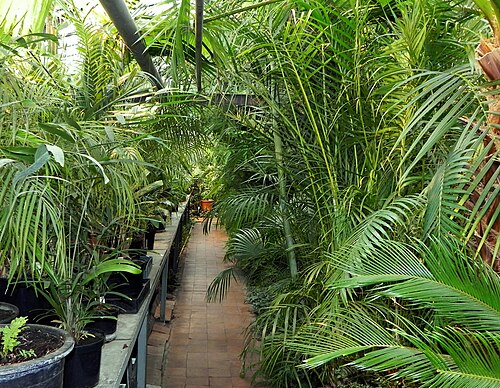
The interior is not a row of crops but a garden: the operator promises 'the atmosphere of real tropics' recreated on these 500 m², with green alleys where visitors stroll and take photographs among lemon trees, papayas, bananas and murrayas. The climate held all year round lets the citrus carry flowers and fruit at the same time and the papayas set fruit. A small shop occupies the entrance, selling young plants and fruit from the house. The lemonarium also hires out the space for photo sessions, without providing a photographer.
Plant collections
Some fifty tropical and subtropical species, including fifteen lemon varieties according to the operator (fourteen according to Tonkosti): giant-fruited 'Yubileyny' lemons, Pavlovo lemons, oranges, mandarins, kumquats and home-made hybrids, but also papayas, many of which fruit, a royal banana, a coconut palm, a carambola, a coffee tree, a myrtle and a murraya with small, intensely scented white flowers. The harvest calendar sets the rhythm of a visit: in winter begonias and fuchsias flower while mandarins, kumquats and papayas ripen; summer brings passion fruit, pitahayas and carambolas.
The plants share the house with a small menagerie, a cat, two iguanas, rabbits and tortoises according to Tonkosti, a lizard according to the operator, which children meet during the visit. The shop sells young lemon, myrtle, coffee and murraya plants, lemons, 'citronade', marmalade, jams, honey, lemon soap and fruit chips.
Visiting
The lemonarium lies off the usual routes, in an industrial zone on Sokolovaya Gora inside an oil-company compound: satnavs should be aimed at the checkpoint at 4 Geofizika Street, not at the official address on Bolshaya Sechenskaya Street. Entry is by advance booking only, with the timetable published a week at a time; allow an hour, with fifteen to twenty minutes of guided introduction, then a free stroll, photographs and a stop at the shop. School groups announce themselves in advance. Winter is the most exotic season, when the mandarins and papayas ripen. City tours pair the lemonarium with Sokolovaya Gora park and its Cranes memorial ('Zhuravli').
51.56° N, 46.07° E
More greenhouses — Russia
Do you have a good photo of this greenhouse? Suggest it for this page →
Sources (7)
- xn--80apbeghhhu.xn--p1ai/
- xn--80apbeghhhu.xn--p1ai/booking
- xn--80apbeghhhu.xn--p1ai/kontakty
- tonkosti.ru/%D0%A1%D0%B0%D1%80%D0%B0%D1%82%D0%BE%D0%B2%D1%81%D0%BA%D0%B8%D0%B9_%D0%BB%D0%B
- onetwotrip.com/ru/blog/travel-ideas/weekend-plan/marshrut-na-vyhodnye-saratov/
- ru.wikipedia.org/wiki/%D0%A2%D1%83%D1%80%D0%B8%D0%B7%D0%BC_%D0%B2_%D0%A1%D0%B0%D1%80%D0%B0
- openstreetmap.org/way/195047935
Affiliate links — booking through Verrière helps fund our research, at no extra cost to you.