Seonyudo Park Greenhouse (선유도공원 온실, "small botanical garden")
Seoul (Yeongdeungpo-gu)
No freely licensed photo of this greenhouse yet. Do you have one? Suggest it for this page →
Sources checked October 2026
- Style
- Two adjoining gabled glasshouses on a metal frame
- Dimensions
- 351 m² in total
- Status
- Open to the public (turned into a small botanical garden in 2020)
On Seonyudo, an island in the Han River, the former drinking-water treatment plant turned park in 2002 has two glasshouses near its entrance, covering 351 m² in all. They were used to propagate the park's plants and shelter those that cannot overwinter outdoors, but drew few visitors; the City of Seoul reworked them over ten months into a "small botanical garden in the city centre", opened to the public on 27 October 2020 with 73 species and 2,015 plants, a pond of tropical water lilies and ferns.
Affiliate links — booking through Verrière helps fund our research, at no extra cost to you.
History
Seonyudo was not always a flat island: according to Visit Seoul it was a peak, the Seonyubong, levelled by a quarry, before the island served as a drinking-water treatment plant, built in the 1970s and closed in 2000. The park that opened in April 2002 recycles the plant's basins and pillars; the official Seoul parks page describes it as an ecological park born of a disused water works.
The greenhouse belongs to this ensemble. The City of Seoul's press release of 26 October 2020 explains that it had been installed to propagate more than 200 species of the park's plants and protect those that cannot survive the winter, that it held about thirty kinds of cacti and succulents, and that the public had neglected it for nearly twenty years. A blog post of October 2024 gives 2002 as the year of creation, with no further source: the municipal texts do not date the construction.
According to the Kyunghyang Shinmun, the City began the remodelling in December 2019 and carried it out over ten months: replacement of the heating and cooling systems, renovation of the pond and paths. The "small botanical garden in the city centre" opened on 27 October 2020, with limited visitor numbers and temperature checks at the door because of Covid-19, and gardening and plant-advice activities announced.
Architecture and engineering
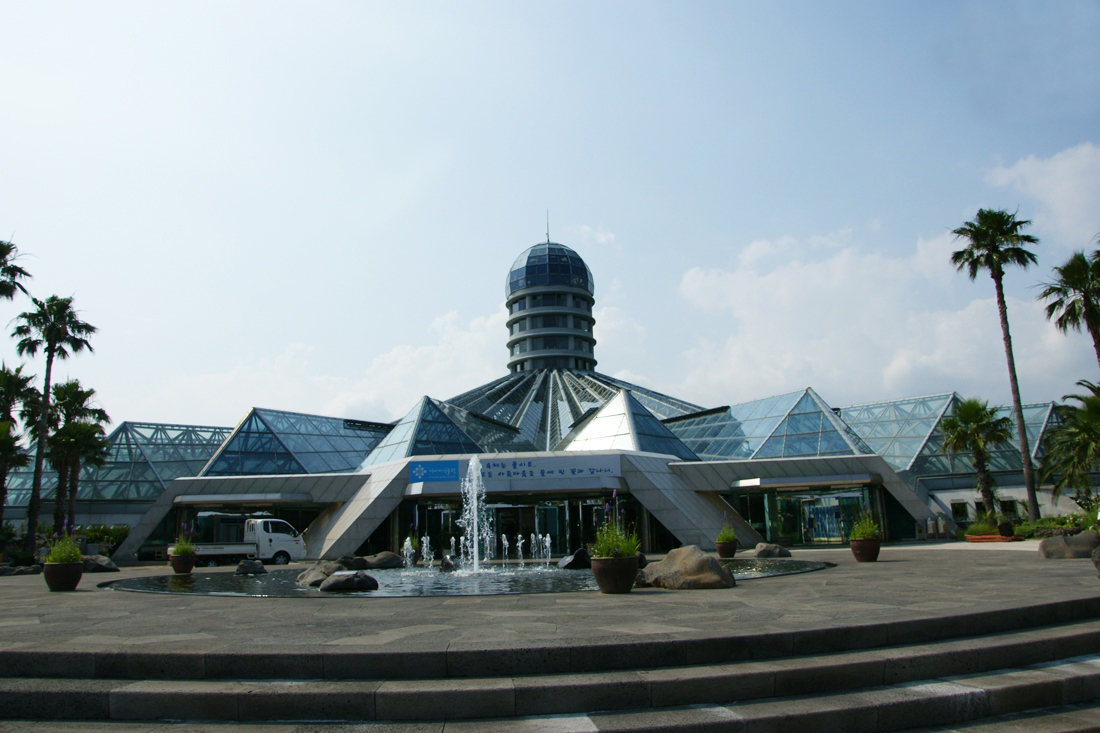
The greenhouse consists of two adjoining glazed buildings with a total floor area of 351 m² according to the 2020 news agency reports. Photographs published by the City of Seoul show glass walls on a light metal frame, gabled glass roofs of different heights and, between the two volumes, a small solid-walled entrance hall with a glazed door. A report on the municipal portal stresses that the walls are fully glazed, so that the interior is visible from outside.
It stands at the entrance of the park: visitors see it almost on arrival, on the right as they enter, facing the Water Purification Garden (수질정화원), the former settling-basin area. The 2020 works replaced the heating and cooling systems. Inside, a visitor path runs through both houses, with a small pond in the first.
Plant collections
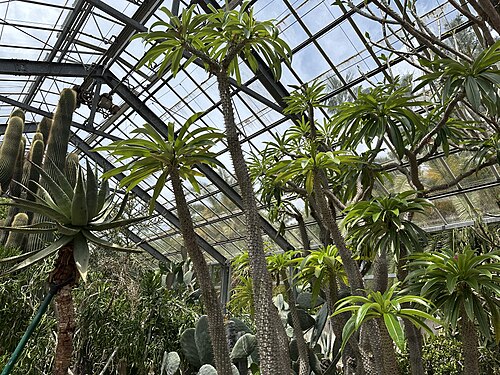
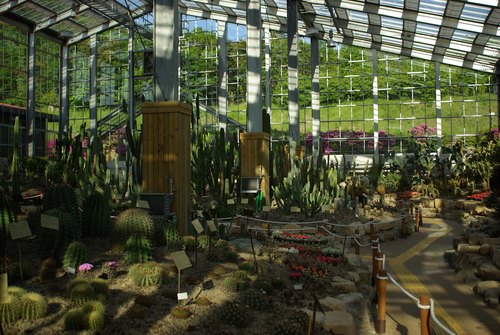
Before 2020 the greenhouse held about thirty kinds of cacti and succulents. The remodelling installed 73 species and 2,015 plants, divided into foliage house plants, aquatic plants, a fern area and tropical plants; the press release mentions a kentia palm, tropical water lilies on the pond and an oak-leaf rubber tree (떡갈잎 고무나무). A report on the municipal portal, written at the start of a spring in the days of Covid rules, saw at once lemons, hagyul (a citrus), a camellia in flower and bananas in fruit, as well as a fern native to Indonesia, and describes tropical aquatic plants and evergreens from southern Korea.
The Visit Seoul page, updated in September 2026, speaks of about 200 species, including gwaneumjuk palms (관음죽) and agaves (용설란); a 2024 blog mentions 80 tropical and temperate species.
Visiting
The greenhouse lies just inside the main entrance of the park, on the right, and fits into the roughly two-hour circuit proposed by Visit Seoul, which places it as the last stop after the Garden of Time, the aquatic garden, the Garden of Green Columns, the Seonyudo Story exhibition hall and the water purification garden.
The island is reached on foot: by the Seonyu footbridge, designed by the French architect Rudy Ricciotti according to Visit Seoul, from Seonyu Han River Park on the riverbank, or through the gate on Yanghwa Bridge. The official Seoul parks page gives about ten minutes' walk from Seonyudo station (line 9) and fifteen from Dangsan, and states that only vehicles of disabled visitors may park on the island.
37.54° N, 126.90° E
Greenhouses nearby
More greenhouses — South Korea
Do you have a good photo of this greenhouse? Suggest it for this page →
Sources (8)
- mediahub.seoul.go.kr/archives/1300057
- newsis.com/view/NISX20201024_0001209260
- khan.co.kr/article/202010260929001
- mediahub.seoul.go.kr/archives/2000786
- korean.visitseoul.net/tours/%ED%95%9C%EA%B0%95-%EC%8B%A0%EC%84%A0%EC%9D%B4-%EB%85%B8%EB%8B
- parks.seoul.go.kr/content.do?key=2604300019
- m.blog.naver.com/jylhee0704/223624883691
- blog.naver.com/together_sh/222170002274
Affiliate links — booking through Verrière helps fund our research, at no extra cost to you.