Shanghai Greenhouse Garden, Expo Culture Park (世博文化公园温室花园)
Shanghai (Pudong)
Entry updated on October 3, 2026
- Year
- 2024
- Architect
- DMAA – Delugan Meissl Associated Architects (Vienna), with the Shanghai institute of the Huajian group
- Style
- Contemporary column-free glass pavilions, cloud-like in plan
- Dimensions
- ≈22,000 m²; tropical hall 22 m high
- Status
- Open to the public since 20 September 2024
Opened on 20 September 2024 with the southern section of the Expo Culture Park on the Huangpu River, this greenhouse garden stands on the site of the former Shanghai No. 3 Steel Works, later Zone C of the 2010 World Expo. Designed by the Vienna practice DMAA with the Shanghai institute of the Huajian group, it covers about 22,000 m² and is promoted as the largest glass greenhouse garden in Asia. Its three halls, desert, rainforest and misty canyon, hold more than 1,300 species beneath glass roofs with no interior columns.
Affiliate links — booking through Verrière helps fund our research, at no extra cost to you.
History
1 min
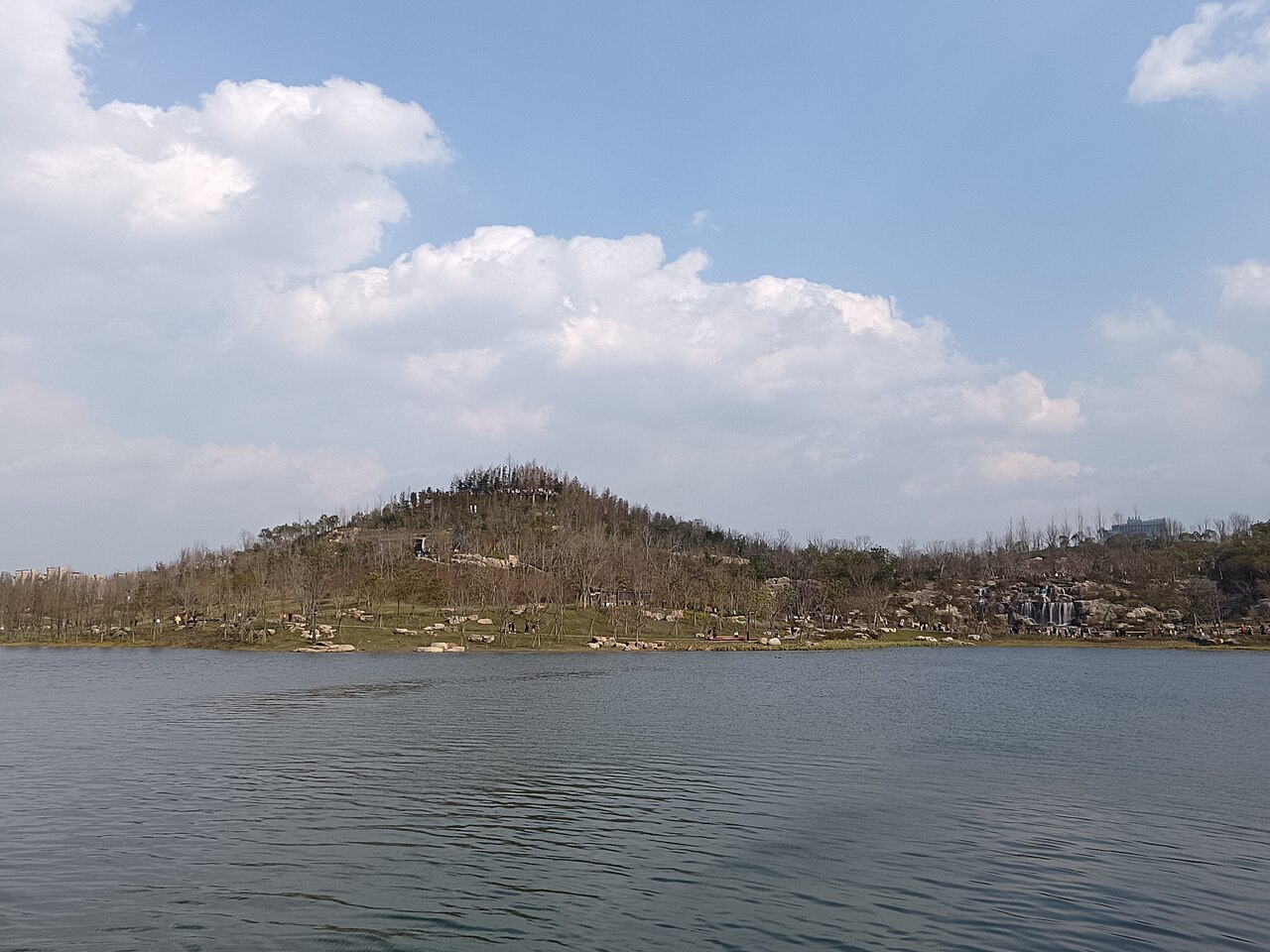
The ground on which the greenhouse stands first belonged to the Shanghai No. 3 Steel Works (上钢三厂), a century-old mill on the Huangpu riverside, before becoming part of Zone C of the 2010 World Expo. After the Expo the area was turned into a large urban park of about 2 km², the Expo Culture Park (上海世博文化公园), whose northern section opened on 31 December 2021.
The greenhouse garden was designed by the Austrian practice DMAA (Delugan Meissl Associated Architects) together with the Shanghai institute of the Huajian group (华建集团上海院), which spent seven years seeing the project through; construction was entrusted to the Eighth Engineering Division of China State Construction (中建八局). The project keeps a trace of the site's industrial past: steel roof trusses stamped '1918', taken from the steelworks' heavy-plate workshop, were preserved and incorporated into the scheme.
The greenhouse opened to the public on 20 September 2024, together with the southern section of the park and the artificial Twin Hills (双子山). Its promoters present it as the largest glass greenhouse garden in Asia, and the contractor as China's first greenhouse designed for night-time visits, with lighting and projections.
Architecture and engineering
1 min
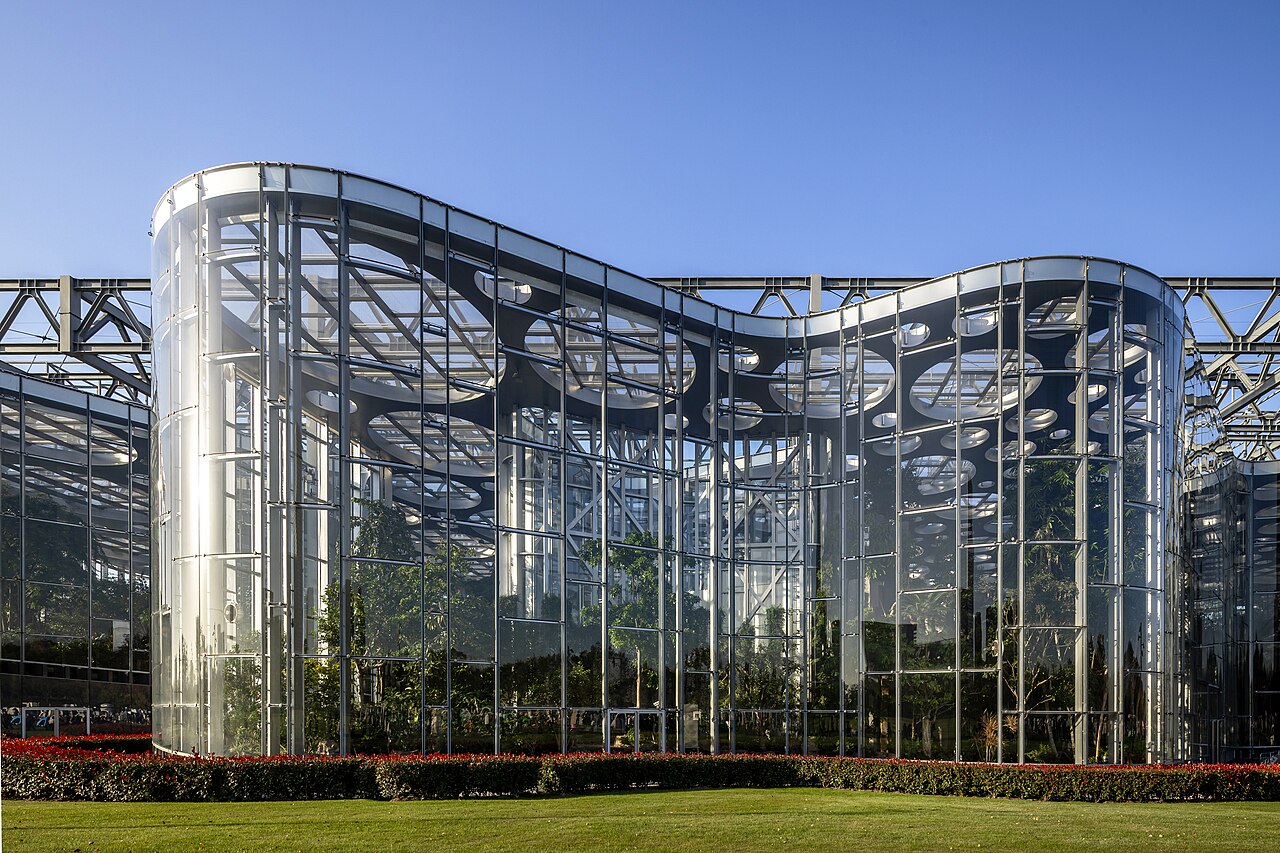
Seen from above, the complex, made up of a visitor centre and three themed halls, looks like a cluster of clouds set down in the park. The architects describe an approach based on nature, concealment and integration: the structure merges into the glass envelope and the columns are broken down into vertical supports built into the facades, so that no column or beam obstructs the interior.
The roofs combine an aluminium lattice with a system of steel cables forming an irregular polygonal grid, joined by rigid 'π-shaped' nodes. The glazing, an ultra-clear tempered laminated glass, transmits 89 per cent of daylight; the roof glazing, of about 10,000 m², is described by the contractor as the largest single glass roof in China. The tropical hall rises to 22 metres.
No windows are visible: ventilation works through underground ducts, automated roof vents and fans, while automatic shading gives protection from ultraviolet light. Two separate systems condition the air for the plants and for visitor comfort.
Plant collections
1 min
The three halls hold more than 1,300 species. Hall 1, 'Mirage Sands' (海市沙洲), of about 3,033 m², is devoted to arid environments, especially African ones: it contains an 800-year-old olive tree, the largest greenhouse-grown baobab in China, an agave more than a century old, tall columnar cacti and welwitschias (百岁兰).
Hall 2, 'Forest above the Clouds' (云上森林), 22 metres high, shelters a rainforest crossed by walkways on several levels and a 12-by-4-metre aquarium given over to a forest of aquatic plants. Hall 3, 'Misty Canyon' (云雾峡谷), the largest, focuses on flowering plants and on misting systems that create drifting fog. Highlighted specimens also include a 30-tonne bodhi tree, climbing figs and mangroves with aerial roots.
Visiting
1 min
The greenhouse lies in the central part of the Expo Culture Park, beside the central lake and backed by the artificial Twin Hills, between the Huangpu River and Lupu Bridge. Allow at least two hours for the three halls, then time for the park itself, which stretches for about 2 km² along the river.
Evening visits, enhanced by lighting and projections, offer a different reading of the halls. A day on the former 2010 World Expo site can combine the greenhouse, a riverside walk and the climb up the Twin Hills.
31.18° N, 121.47° E
Greenhouses nearby
More greenhouses — China
Do you have a good photo of this greenhouse? Suggest it for this page →