Tropical Plant House, Daea Arboretum (대아수목원 열대식물원)
Wanju (Dongsang-myeon), Jeonbuk
No freely licensed photo of this greenhouse yet. Do you have one? Suggest it for this page →
Sources checked October 2026
- Style
- Glass greenhouse with a themed route: nine gardens in ten rooms
- Dimensions
- 1,670 m²; more than 400 species
- Status
- Open to the public, free admission; arboretum closed on 1 January, Seollal and Chuseok
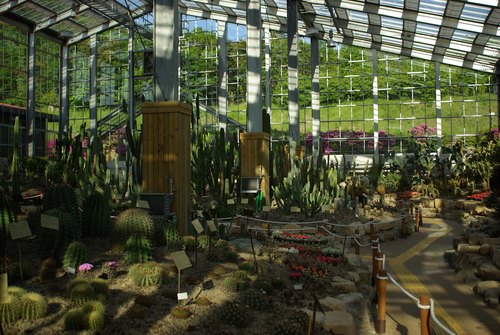
In the public Daea Arboretum, at Dongsang-myeon (Wanju County), the tropical plant house (열대식물원) covers 1,670 m² and holds, according to the arboretum's website, more than 400 species arranged in nine gardens and ten rooms: tropical fruit trees, cacti and succulents, foliage plants, curiosity plants, aquatic plants, carnivorous plants, bonsai and wildflowers. The building is a glass greenhouse. The official site claims that bananas, oranges and pineapples can be seen there even in midwinter. Admission to the arboretum is free.
Affiliate links — booking through Verrière helps fund our research, at no extra cost to you.
History
The Daea Arboretum (대아수목원) is a public arboretum run by the Jeonbuk provincial forest environment research institute, according to the Encyclopedia of Korean Culture. It occupies a forest in Dongsang-myeon, in Wanju County, north of Lake Daea. The official site's chronology gives these milestones: the area was designated on 10 July 1988 over 100 hectares, opened to the public on 17 May 1995, extended to 150 hectares on 8 January 2000 to include the wild colony of bleeding hearts (금낭화), registered with the Korea Forest Service (no. 20) on 22 May 2006, given a provincial management ordinance on 2 November 2007, and designated in 2012 as a forest genetic-resource management institution. The same site recalls that the area was once counted among the eight most remote regions of the country, slash-and-burn farming having stopped only in the early 1970s.
The tropical plant house (열대식물원) is one of the three main facilities that Wanju County cites for the arboretum, alongside the forest culture exhibition hall and the forest ecology experience hall. The official site presents it as a greenhouse "boasting the best facilities in the country", a claim by the operator that cannot be checked.
The figures differ between sources: the official site counts nine gardens in ten rooms and more than 400 species, the Korean encyclopedia (revised in May 2024) ten gardens in thirteen rooms, 410 species and 7,525 plants. In 2016 the Wanju County blog wrote that entry to the greenhouse was free because it had been established for research purposes.
Architecture and engineering
The greenhouse covers 1,670 m². According to the arboretum's website it is organised in nine gardens spread over ten rooms, which the visitor follows in a fixed order: entrance bed and lobby, tropical fruit trees, cacti and succulents, foliage plants, curiosity plants, aquatic plants, carnivorous plants, bonsai, then wildflowers. The Korean encyclopedia describes it differently, as ten gardens and thirteen rooms. A 2022 visitor compares the route to a maze designed to make a single full circuit, and notes a bench at the entrance that serves as a photo spot.
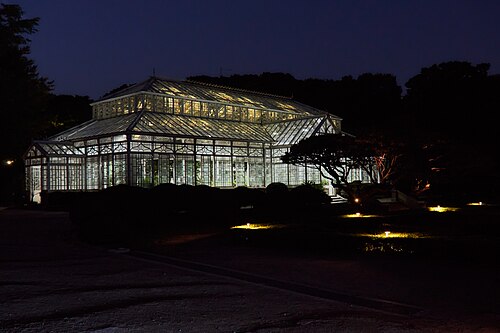
A photograph published by the arboretum on the page of the curiosity garden shows an angel's trumpet under a roof of glass panes held by a fine, light-coloured frame; the same 2022 visitor writes that the whole building is a glass greenhouse, imposing even from outside; Wanju County mentions the glass ceiling that lets sunlight into the bonsai room; tourism press in October 2026 speaks of a greenhouse "built of glass".
The site lies on a steep north-facing slope between 115 and 530 m above sea level. According to the arboretum, the mean annual temperature is 12.8 °C (8.3 °C for the mean minimum), rainfall reaches about 1,300 mm a year and sunshine is rather insufficient.
Plant collections
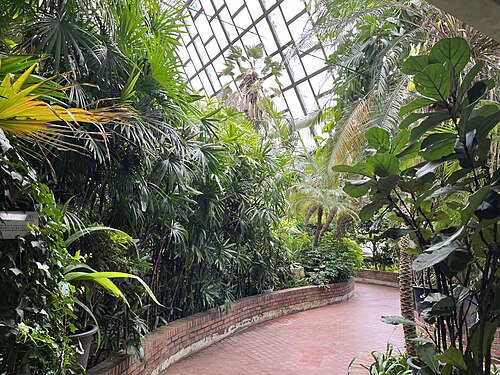
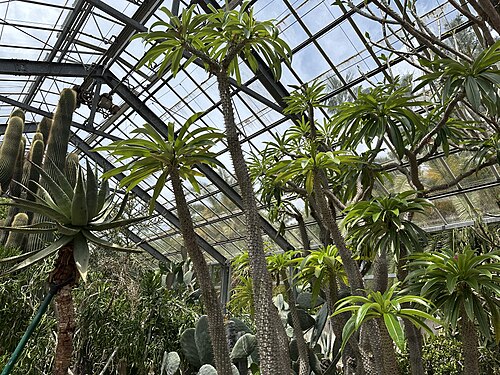
The arboretum's website details each garden of the greenhouse with its numbers. The entrance bed (18 species, 1,637 plants) brings together palms, ivy and seasonal potted plants, including areca palm and bougainvillea. The tropical fruit garden (10 species, 475 plants) shows banana, pineapple, orange and mango. The cactus and succulent garden (38 species, 806 plants) includes geumho cacti (금호), one of them 44 years old and two 34 years old: according to the page, the species lives up to 300 years, reaches 150 cm in diameter and 200 cm in height, and flowers, in red, only from the age of 40. Next come the foliage plants (42 species, 600 plants: dieffenbachia, Brazilian abutilon, agathis), the curiosity plants (30 species, 831 plants: angel's trumpet and bird-of-paradise) and the aquatic garden (35 species, 1,409 plants: water hyacinth, tropical water lilies, papyrus).
The carnivorous garden (31 species, 1,374 plants) shows in particular nepenthes, sarracenias and a long-leaved sundew. The bonsai garden has 123 species and 260 specimens (junipers, pines, azaleas, quinces), the wildflower garden 113 species in 113 pots, including threatened and protected species. Added together, these figures give 7,505 plants, close to the encyclopedia's 7,525.
Visiting
The greenhouse stands in the arboretum's facilities zone, which the official routes link together. The shortest, about two hours, joins the Purumi shelter, the garden of landscapes, the forest culture exhibition hall, the bonsai and sculpture garden, the rose garden, the greenhouse and the aquatic garden; another adds the round trip to the first lookout (about three hours), a third the forest loop of about 3 km. A 2022 visitor allows an hour for the greenhouse.
Further up the same road, the forest ecology experience hall (2012, 1,054 m²) recreates a rocky mountain, a pond and an artificial cave under a roof. The colony of bleeding hearts, the largest in the country according to the encyclopedia, flowers in spring, and attendance peaks in April-May and again in late October and early November, the foliage season. Lake Daea, close by, is one of the nine landscapes chosen by Wanju County.
35.98° N, 127.30° E
More greenhouses — South Korea
Do you have a good photo of this greenhouse? Suggest it for this page →
Sources (8)
- forest.jb.go.kr/daeagarden/content.action?cmsid=103030102001
- forest.jb.go.kr/daeagarden/content.action?cmsid=103020200000
- forest.jb.go.kr/daeagarden/content.action?cmsid=103010300000
- forest.jb.go.kr/daeagarden/content.action?cmsid=103010200000
- forest.jb.go.kr/daeagarden/content.action?cmsid=103020400000
- wanju.go.kr/tour/index.9is?contentUid=ff8080818c5d9e6d018ca465541c689b
- encykorea.aks.ac.kr/Article/E0075255
- blog.naver.com/kspak56/222723629942
Affiliate links — booking through Verrière helps fund our research, at no extra cost to you.