Subtropical Greenhouse of Gowon Hwamokwon (고원화목원 아열대식물원)
Jinan (Baegun-myeon), North Jeolla
No freely licensed photo of this greenhouse yet. Do you have one? Suggest it for this page →
Sources checked October 2026
- Year
- 2014
- Style
- Pyramid-shaped exhibition glasshouse
- Dimensions
- 979 m² in total (966 m² on the ground floor); 261 species and 6,755 plants in 2017
- Status
- Open to the public all year, free entry
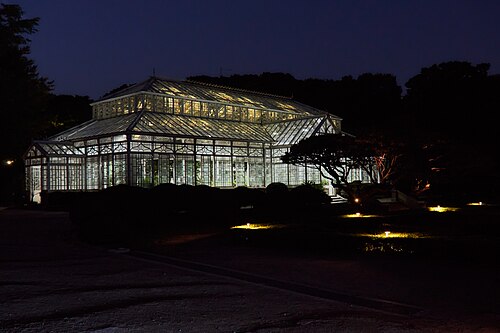
Below Mount Naedongsan, at about 400 metres above sea level, the Gowon Hwamokwon garden of North Jeolla Province has a pyramid-shaped greenhouse devoted to subtropical plants. The province's official blog says it was finished in 2014, after works that began in 2012; the garden itself opened only on 13 October 2017. The greenhouse covers 979 m², machine room included, and held 261 species and 6,755 plants at its opening, among them banana, the geumho cactus and the Hawaiian hibiscus. It is one of the 23 specialist gardens of a site that gives pride of place to the upland flora of the region.
Affiliate links — booking through Verrière helps fund our research, at no extra cost to you.
History
Gowon Hwamokwon is a garden of North Jeolla Province, laid out at Deokhyeon-ri, in Baegun township, around the provincial Forest Environment Research Institute. According to the province's official blog, the institute began in 1946 as a forestry test station, became the Forest Environment Research Institute in 1993 and moved to Jinan in 2010.
The garden's overview page sets out the works year by year: a master plan and execution designs in 2011, the nature-learning area in 2012, then, in 2013, construction of the greenhouse, listed with other works under an annual budget of 2 billion won, the flower and tree gardens in 2014 and completion works from 2015 to 2017. The total cost comes to 6.3 billion won. The province's blog dates the completion of the pyramid greenhouse and the 23 specialist gardens to 2014, and an article of January 2018 also gives 2014 for the greenhouse.
The garden was inaugurated on 13 October 2017 in the presence of the provincial governor and the heads of the Korea Forest Service and the Korea National Arboretum, according to the press release reproduced by the institute. It covers 11.8 hectares and holds 850 species and more than 610,000 trees and shrubs by the institute's count; entry and parking are announced as free and open all year. The Korea Forest Service register lists it among public arboreta since 11 March 2021.
Architecture and engineering
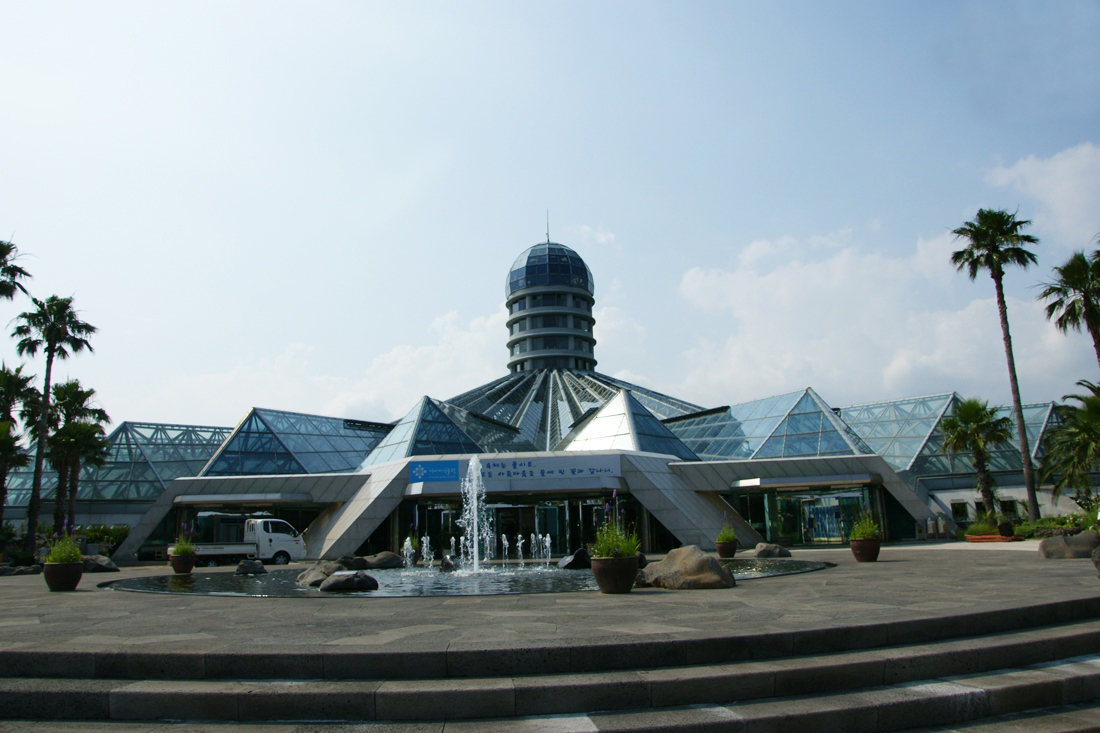
The greenhouse is pyramid-shaped: tourist listings and Jinan County's blog speak of a "pyramid-type greenhouse" (피라미드형 온실), which the province's blog calls the garden's pride. The institute's table gives the whole at 979.19 m², that is 966.32 m² on the ground floor and 12.87 m² of machine room in the basement. A blogger in January 2018 calls it a glass greenhouse (유리온실), and the tourist listing promises tropical plants in flower all year.
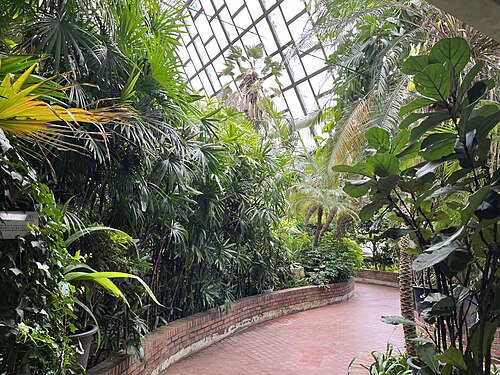
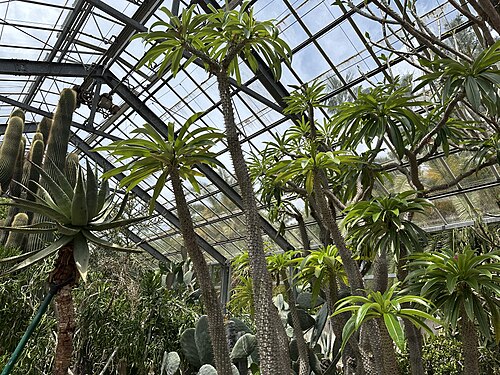
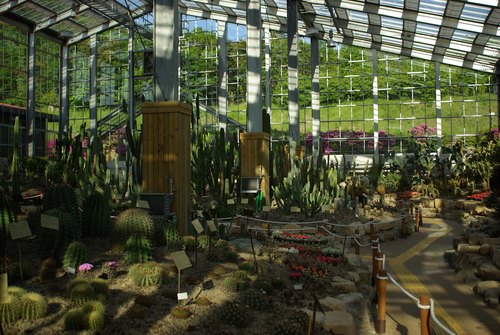
Inside, a visitor in November 2025 describes a humid heat from the entrance, so strong that he took off his coat and his glasses fogged, and notes a section of cacti and succulents. In front of the greenhouse a resting viewpoint looks over the garden; higher up, a spiral observation tower gives an overview, according to the same account. The whole stands at about 400 metres above sea level, on the slope of Mount Naedongsan, and the greenhouse is surrounded by the specialist gardens, laid out in twelve zones.
Plant collections
The institute announces 261 species and 6,755 plants in 2017; tourist listings speak of about 260 species and 7,000 plants. The opening press release names the Hawaiian hibiscus, the geumho cactus (금호) and bananas. The province's blog, in October 2017, adds bougainvilleas, lantanas and birds of paradise in flower, and ranks by value, in decreasing order, the Mediterranean olive, the Mexican geumho cactus and the South American Butia palm.
An article of January 2018 notes, in midwinter, bougainvilleas, Hawaiian hibiscus and clerodendrums in flower, bananas, pineapples, lemons and papayas, as well as ripe kumquats and Hallabong. It also mentions a tunnel of flowers formed by the pajanghwa (파장화), a tropical climber of the Bignoniaceae family. Outside the greenhouse, the garden gives pride of place to the upland plants of the Jinan region, such as the gureum-gukhwa (구름국화), the hallagujeolcho (한라구절초) and the Korean fir (구상나무).
Visiting
The greenhouse stands near the entrance, close to the forest institute's buildings, in front of which one visitor advises parking. It combines with the walk through the specialist gardens: an account from November 2025 took about two hours, and the site plan speaks of three hours for the full circuit. A wooden staircase then climbs through the Naedongsan forest to the Naedongjeong pavilion.
In autumn the reddened metasequoia avenue at the entrance accompanies the visit; in winter the greenhouse flowers while the gardens are bare, as the province's blog and a January 2018 article note. According to the tourist listing, the village of Wonchon lies 2.1 km away and the Yeongmojeong pavilion 4.9 km.
35.68° N, 127.38° E
More greenhouses — South Korea
Do you have a good photo of this greenhouse? Suggest it for this page →
Sources (8)
- forest.jb.go.kr/main/content.action?cmsid=101050100000
- forest.jb.go.kr/main/photo.action?cmsid=101060800000&target=&st=0&sk=&method=v&idx=106&pag
- m.blog.naver.com/jbgokr/221107705964
- j.breaknews.com/11247
- ktriptips.com/kor/tourspot/2774110
- forest.go.kr/kfsweb/kfi/kfs/cms/cmsView.do?cmsId=FC_000874&mn=AR03_07_01
- m.blog.naver.com/elion68/224081837317
- tanda246.tistory.com/600
Affiliate links — booking through Verrière helps fund our research, at no extra cost to you.