University Village (Silver Towers), New York University
New York (Greenwich Village)
Sources checked November 2026
- Year
- 1964-1967
- Architect
- I. M. Pei
- Type
- Three concrete residential towers (New York City landmark)
- Access
- Residential buildings; complex designated a New York City landmark in 2008
Built from 1964 to 1967 for New York University south of Washington Square, University Village, also called the Silver Towers, is made up of three apartment towers of thirty stories. I. M. Pei & Associates designed it, and James Ingo Freed was its chief designer. The Brutalist concrete towers surround a lawn with the Bust of Sylvette, after a work by Picasso.
History
The land is a superblock of five acres in Greenwich Village, bordered by West Houston Street and Bleecker Street, that formed part of a vast urban renewal plan Robert Moses devised in 1953. When New York University took over the site in 1960, it agreed with the city to set aside a third of the units for middle-income households. Pei, who won the commission that year, put James Ingo Freed in charge of the design team.
The design evolved over more than three years: a first scheme had three long buildings, then a mix of shapes and heights, until the university's purchase of Washington Square Village at the end of 1963 led to replacing a low building with a third tower. Three identical towers cut construction costs and, in Freed's words, left as much land as possible free for future use. A groundbreaking ceremony took place on August 12, 1964. The shell of the first tower was complete by December 1964, and all three were close to finished by the end of 1966.
Pei, who had long wished for a monumental sculpture matching the scale of modern architecture, had announced a personal "crusade" to obtain a monumental Picasso for one of his projects. The university announced the commission in November 1967, financed by Allan D. and Kate S. Emil; Carl Nesjar's team worked from January to June 1968, and the Bust of Sylvette was dedicated on December 9, 1968.
Awards came from the Concrete Industry Board, the City Club of New York and the American Institute of Architects, and Fortune magazine listed it in 1966 among its "Ten Buildings That Climax an Era". The New York City Landmarks Preservation Commission designated it on November 18, 2008.
Architecture
Three identical thirty-story reinforced-concrete towers stand at the center of the site, as a pinwheel around a lawn measuring 100 by 100 feet. Two face north, toward Bleecker Street, and the third faces west, toward LaGuardia Place: each seems independent, and the open spaces frame views of each tower. The towers turn away from the surrounding streets and rise from a platform that raises the south end of the block by nearly ten feet and hides two garages.
The warm buff-colored concrete is cast in place in fiberglass molds; the style is Brutalist and owes a debt to Le Corbusier, whom Pei admired. Each tower shows two sets of gridded facades projecting from a central core. On each level, four or eight horizontal window bays sit deep in recesses beside a sheer wall 22 feet wide, which makes light and shadow contrast strongly. At ground level, the T-shaped columns, more than twice as tall as the residential floors, form a continuous entrance arcade.
At the center of the site, near the southeast corner of the lawn, stands the Bust of Sylvette: a bust 36 feet tall (about 11 m), a sandblasted-concrete enlargement of a cubist Picasso work of 1954, made in 1968 by the Norwegian sculptor Carl Nesjar.
Use today
The two eastern towers house New York University faculty and students; the western tower is a cooperative residence held under a long-term lease from the university.
Visiting
The three towers are apartment buildings, two blocks south of Washington Square, between Bleecker Street and West Houston Street. The central lawn and the Bust of Sylvette are part of the designated site.
40.73° N, 74.00° W
Greenhouses nearby
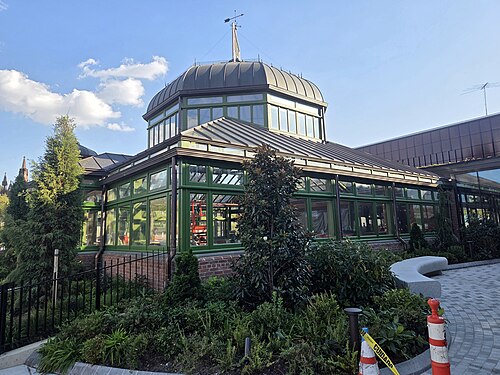
Architecture nearby