Southern Cross railway station
Melbourne
Sources checked November 2026
- Year
- 2006
- Architect
- Nicholas Grimshaw
- Type
- Railway station, coach interchange
- Access
- Station in service (operator, November 2026)
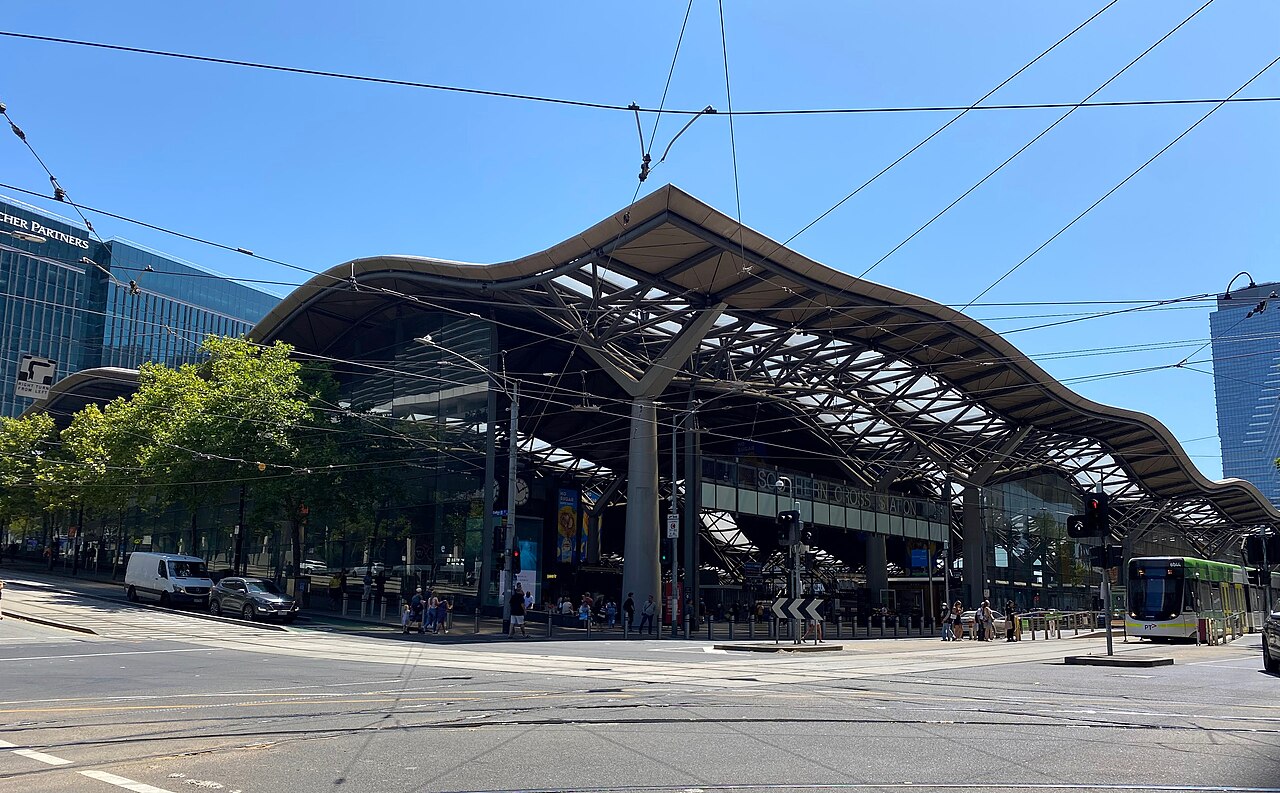
Rebuilt between 2002 and 2006, the former Spencer Street station became Southern Cross station in Melbourne. Grimshaw, for whom it was the first project undertaken in Australia, designed it together with the local practice Jackson Architecture; in 2007 it won the Royal Institute of British Architects' Lubetkin Prize.
Affiliate links — booking through Verrière helps fund our research, at no extra cost to you.
History
The station opened in 1859 as Spencer Street, five years after Melbourne's other main rail terminus, Flinders Street. In 1960 a modernisation began, tied to the building of a standard-gauge line to Sydney: the iron sheds of the 1880s were largely swept away for a new station building and a 413 m platform 1. The Water Tower Clock, put up at Flinders Street in 1882 and moved to Spencer Street in 1910, was taken down in that mid-1960s rebuilding and came back to the station only in 2014.
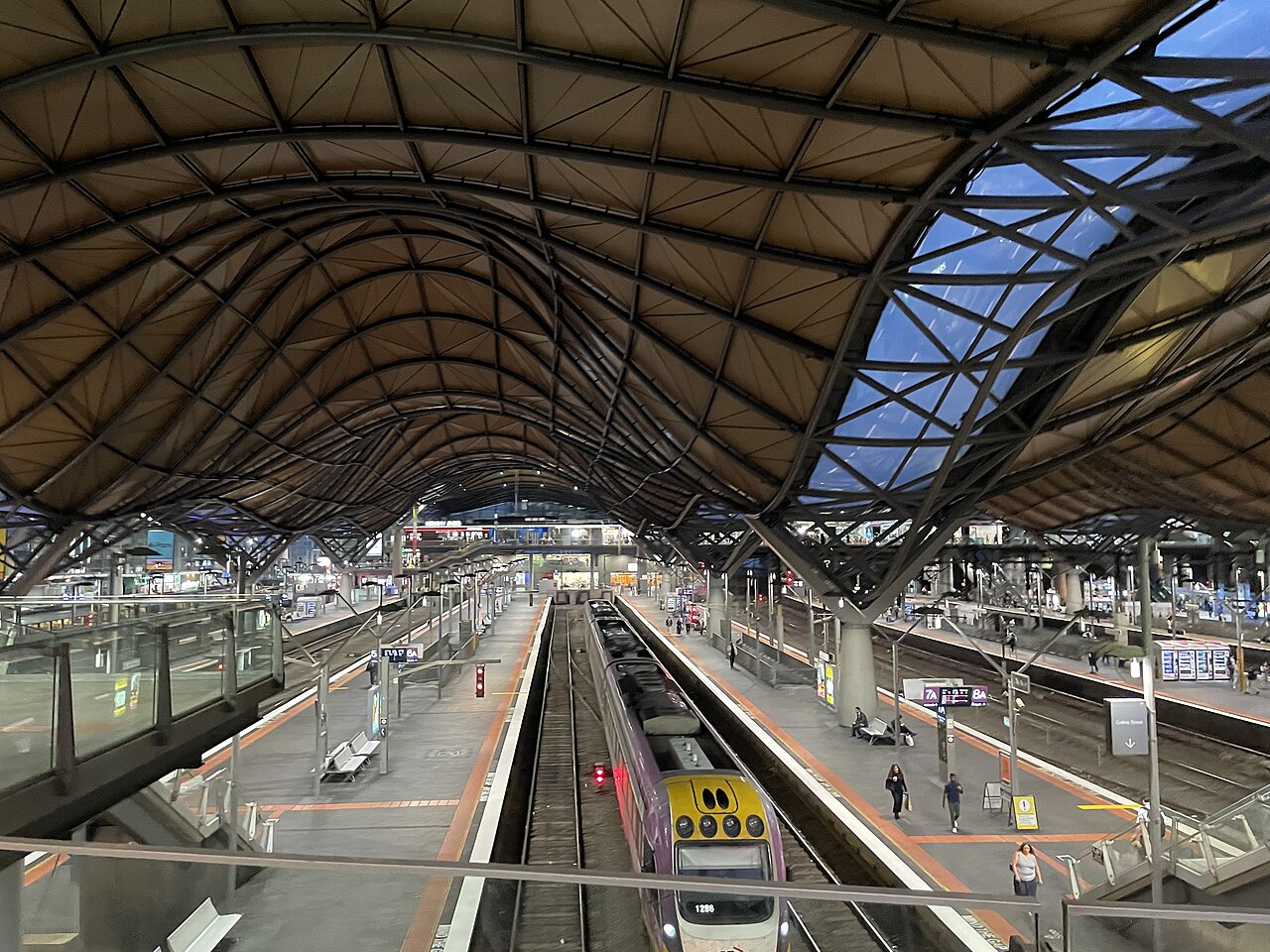
The rebuilding of the 2000s was carried out by the Civic Nexus consortium, to a design by Grimshaw and Jackson Architecture. Work started in October 2002 and ended in late 2006, with most of the transport facilities ready for the 2006 Commonwealth Games. The scheme added a new Collins Street entrance with its own concourse, a food court and shops within the station, and a coach interchange; a shopping centre of its own was built on the stretch from Bourke Street to La Trobe Street. Because the station had to keep running throughout the works, the roof was designed as a prefabricated whole: each of its individually designed parts had to stand on its own during erection and clear the tracks.
It was the first project Grimshaw undertook in Australia. In 2007 the Royal Institute of British Architects gave it an RIBA International Award and the Lubetkin Prize, meant for the most outstanding building outside the European Union.
Architecture
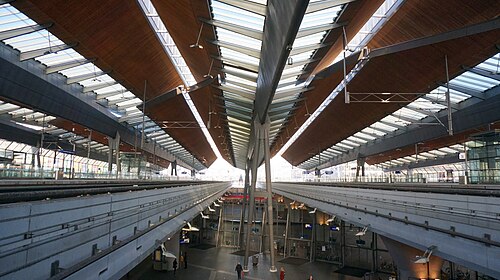
The design is built around a rippling, dune-shaped roof that spans an entire city block above the platforms. The roof also forms part of the station's environmental envelope: its shape answers the hot climate outside and is meant to draw out diesel fumes and cool the space by natural ventilation, with no mechanical ventilation. Fumes from the regional and interstate trains rise, are held under the roof in upturned wells, then escape with airborne particles through louvres built into the peak of every vault; venturi caps shield these louvres against down draughts. The roof's geometry was refined through a computer analysis of its fluid dynamics at different temperatures.
Beneath it, freestanding pods break up the views across the interior; they house administrative functions and mark out a retail space below. From the Collins Street concourse the eye runs through to the Bourke Street Bridge concourse, and a broad glass facade opens the station to Spencer Street. The footpaths either flow into the station or rise to take up changes of level, so people can enter it as a destination, to catch a train, or cross it on the way to Docklands, which it links to the central city grid.
The brief was driven by practical performance, easy passenger circulation and a better working environment for staff. Ticketing, baggage handling and waiting areas are sheltered and fitted with seating, lighting and passenger information displays.
Use today
The station links suburban, regional and interstate trains with coaches, and has 16 platforms. The operator, Southern Cross Station Pty Ltd, is the working arm of Civic Nexus, a subsidiary of Infranexus, and looks after the station under contract to the Department of Transport and Planning. The Bourke Street Bridge links it to the neighbouring Marvel Stadium.
Visiting
This is a working transport hub at the corner of Spencer Street and Collins Street. Any photography or filming beyond personal photography needs the operator's permission.
Photos
37.82° S, 144.95° E
Greenhouses nearby
Architecture nearby
By the same architect
Sources (8)
- infranexus.com.au/southern-cross-station/our-heritage
- infranexus.com.au/asset/southern-cross-station
- infranexus.com.au/southern-cross-station/faqs
- grimshaw.global/projects/rail-and-mass-transit/southern-cross-station/
- jacksonarchitecture.com.au/project/southern-cross-station/
- architectureau.com/articles/bridging-the-void
- whatson.melbourne.vic.gov.au/things-to-do/southern-cross-station
- e-architect.com/australia/southern-cross-station
Affiliate links — booking through Verrière helps fund our research, at no extra cost to you.