New Sanctuary of Meritxell
Meritxell, Canillo
Sources checked November 2026
- Year
- 1974-1976
- Architect
- Ricardo Bofill
- Type
- Sanctuary and minor basilica (Andorran cultural heritage asset)
- Access
- Open to all, free admission (Museums and Monuments of Andorra website, November 2026)
Ricardo Bofill's Taller de Arquitectura designed this sanctuary at Meritxell, in the parish of Canillo, after the 1972 fire that had ravaged the Romanesque chapel dedicated to Saint Mary. Inaugurated in 1976 while the works were still unfinished, the building is organised around a distorted Greek-cross nave, with a copper-clad bell tower and a cloister. A minor basilica since 2014, it can be visited today.
Affiliate links — booking through Verrière helps fund our research, at no extra cost to you.
History
On the night of 8 to 9 September 1972, a fire ravaged the sanctuary of Meritxell, a chapel of Romanesque origin dedicated to Saint Mary. The disaster was felt as the loss of a part of Andorran identity and heritage.
The practices of Moragues, Bohigas-Martorell-Mackay and Bofill took part in the first talks about rebuilding. The first two withdrew, and the commission went to Ricardo Bofill's Taller de Arquitectura, which presented its project in 1974; the team was made up of Emilio Bofill, Ricardo Bofill Levi, Peter Hodgkinson and Xavier Llistosella. The scheme was a colossal one: a viaduct linking the mountains of the valley, an artificial lake crossed by a bridge-street of shops and restaurants, a great stair with terraces, and amphitheatres for popular gatherings. Only a small part of it was built, as the economic crisis, the political situation and the popular reaction prevented its full execution.
The first stone was laid on 8 September 1974, and the sanctuary was inaugurated on 8 September 1976, although the works were not finished. The part that was built was very hard to take in: social consensus to accept it came only after some years. The old chapel, rehabilitated, became in 1994 the setting for the permanent exhibition Meritxell Memòria. Both buildings are declared cultural heritage assets of interest under the Andorran law of 12 June 2003 on cultural heritage, and in 2014 Pope Francis granted the sanctuary the title of minor basilica.
Architecture
The central building is organised around a distorted Greek-cross nave extended by an apse with a square plan, and it is covered by a barrel vault. The other spaces are arranged around this cross; their layout, measurements and proportions attempt to take up the golden section of the Greco-Roman temples, revived by Renaissance churches.
The exterior is of black schist stone, finished with white prefabricated pieces; the walls, about 90 cm thick, were put up by masons who shaped, on the spot, the stone dug out of the ground. The paving plays with geometric figures in black and white. Huge white round arches support and decorate the building: the architect paid tribute there to the burnt ruins of the old chapel. Arches and towers, with an unfinished look, recall the Romanesque remains of the old sanctuary. The arches of the church are closed by frameless glazing, hung from the top and braced by glass buttresses, while the other openings are fitted with dark-stained wood and smoked glass. Large openings let the landscape in, and the outside is wrapped in vegetation.
The bell tower is a large square tower inspired by the bell towers of Catalan Romanesque monasteries, covered with copper sheets that the architect had intended to turn green with time and humidity. On the south side, the cloister with rib vaults, designed to recall medieval monastic cloisters, also has copper sheets; on the north side, a patio recalls those of Islamic architecture, and the water fountain at the centre of the cloister is likewise inspired by Islamic art.
Inside, the Virgin of Meritxell presides over the nave; seven sculptures by Sergi Mas, set around the church, represent the patron saints of the seven parishes of Andorra.
Use today
The sanctuary has become a central place in the religious life of the country: it has hosted liturgical celebrations, popular festivals and institutional events. The Virgin of Meritxell is honoured there as patron of Andorra, and the feast of Meritxell is held there on 8 September.
Since 2014 the sanctuary has been part of the Ruta Mariana, a cultural and religious route whose stops are El Pilar, Torreciudad, Lourdes, Meritxell and Montserrat, in France, Spain and Andorra. It also houses the permanent exhibition Bibles of the World, opened in September 2016.
Visiting
The sanctuary is open every day from 9 am to 8 pm; these hours may be changed during religious services. The visit is adapted for people with reduced mobility; it can be made on one's own, with an audioguide, and guided visits are also offered. A nature path leads from there to the oratories of Meritxell and the village of Prats.
42.55° N, 1.59° E
Greenhouses nearby
Architecture nearby
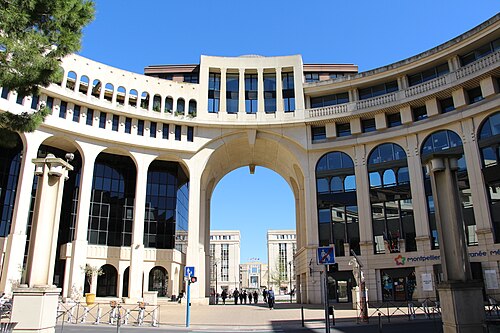
By the same architect
Sources (8)
- museus.ad/monuments/santuari-de-meritxell
- museus.ad/en/monumentos/sanctuary-of-meritxell
- museus.ad/exposicions/meritxell-reneix.-50-anys-sota-la-mirada-d-un-poble.-1976-2026
- museus.ad/media/files/esglesies-i-monuments/santuari-de-meritxell/meritxell_cat-r.pdf
- bofill.com/projects/meritxell-sanctuary/
- openstreetmap.org/way/202635437
- openstreetmap.org/relation/2804754
- wikidata.org/wiki/Q1024946
Affiliate links — booking through Verrière helps fund our research, at no extra cost to you.