Greenhouse (orangery) of the Jardin Massey
Tarbes, Occitanie
Entry updated on October 1, 2026
- Year
- 1880-1886
- Architect
- Saint-Éloy ironworks of Orléans (builder)
- Style
- Metal greenhouse with glazed rotunda, iron and glass on a brick base
- Status
- Listed historic monument (1995); reported under renovation by the regional heritage inventory
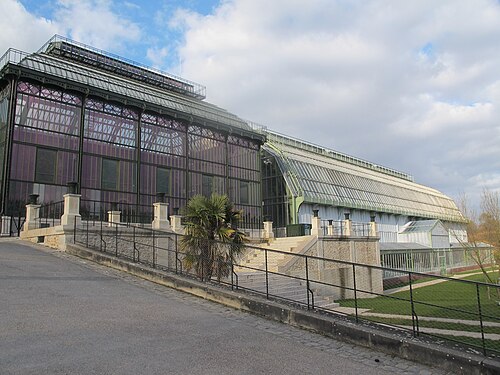
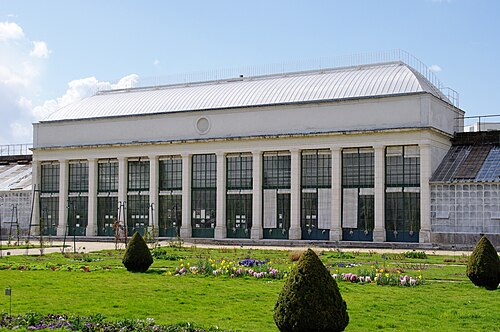
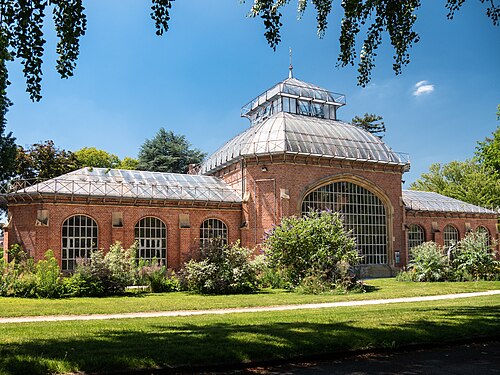
The Jardin Massey in Tarbes contains a metal greenhouse known as the "orangerie", whose construction the city council decided in 1880. The design by the Saint-Éloy ironworks of Orléans, chosen by competition in 1882 for 28,000 francs, was completed in December 1884 and formally accepted in March 1886. The building, of iron and glass on a brick base, combines two wings with a central rotunda crowned by a glazed dome. Listed as a historic monument in 1995 and rehabilitated in the 1980s, it holds, according to the regional inventory, a collection of succulent plants, but is reported to be under works.
Affiliate links — booking through Verrière helps fund our research, at no extra cost to you.
History
1 min
The Jardin Massey is named after Placide Massey (1777-1853), a horticulturist who had served Louis-Philippe and overseen gardens at Versailles, and who bequeathed his estate to the city of Tarbes. According to Wikipedia, his plan for a winter garden was abandoned after his death in 1853; the municipality later decided to build a greenhouse to take its place.
In 1880 the city council voted to build a monumental greenhouse, the "orangerie", on the west side of the garden near the small propagation houses. A competition launched in 1882 selected the design of the Saint-Éloy ironworks of Orléans, for 28,000 francs; the masonry went to the contractor Ballas. The works were carried out by December 1884, but formal acceptance only came in March 1886, after defects had been corrected and finishing completed.
The programme provided for orange trees in the centre, with a hot house and a temperate house on either side. The building was rehabilitated in the early 1980s (sources give 1980, 1981 or 1983) and then given an exhibition function. An order of 27 July 1995 listed it as a historic monument.
Architecture and engineering
1 min
The greenhouse is a rectangular building with two wings arranged around a central rotunda on a square plan, fully glazed and crowned by a glazed dome with a circular lantern; Wikipedia describes it rather as a small bell turret. The frame is of iron, the glazing of glass, and the roof coverings are metal.
The base is of brick, punctuated by pilasters of Chauvigny stone, while the north wall is built of pebbles and stone.
The programme distinguished three spaces: at the centre the part meant for orange trees, and on either side a hot house and a temperate house. The regional inventory notes that the original aesthetic was preserved during the restoration. Precise dimensions are not given in the notices consulted.
Plant collections
1 min
According to the heritage inventory of the Occitanie region, the greenhouse now holds a collection of succulent plants, in particular cacti, whereas the original programme provided for orange trees at the centre and hot- and temperate-house plants in the wings.
The same notice reports that the building is currently closed for renovation work, so the content of the collections and the conditions of access should be checked with the city of Tarbes.
The Jardin Massey itself, recognised as a "Remarkable Garden" in 2004 according to English Wikipedia, brings together rare or interesting trees, flowers and animals, and forms the planted setting for which the greenhouse was designed.
Visiting
1 min
The greenhouse stands on the west side of the Jardin Massey, a municipal park of about 11.5 hectares in the centre of Tarbes. Before visiting, it is worth checking whether the renovation work reported by the inventory has been completed; if not, the building can be seen from outside, which is enough to appreciate its rotunda and dome.
The garden also houses the Massey museum, devoted notably to the history of the hussars, and a cloister brought from the abbey of Saint-Sever-de-Rustan, making it easy to put together a walk of about two hours in a garden known for the quality of its plantings.
43.24° N, 0.08° E
Greenhouses nearby
More greenhouses — France
Do you have a good photo of this greenhouse? Suggest it for this page →