Stone Sculpture Museum
Bad Münster am Stein-Ebernburg (Bad Kreuznach), Rhineland-Palatinate
Sources checked October 2026
- Year
- 2010
- Architect
- Tadao Ando
- Type
- Foundation museum (stone sculpture)
- Access
- Open Saturdays, Sundays and public holidays, 2 p.m.-5 p.m., with a winter break; visits outside these hours by booking (official website, October 2026)
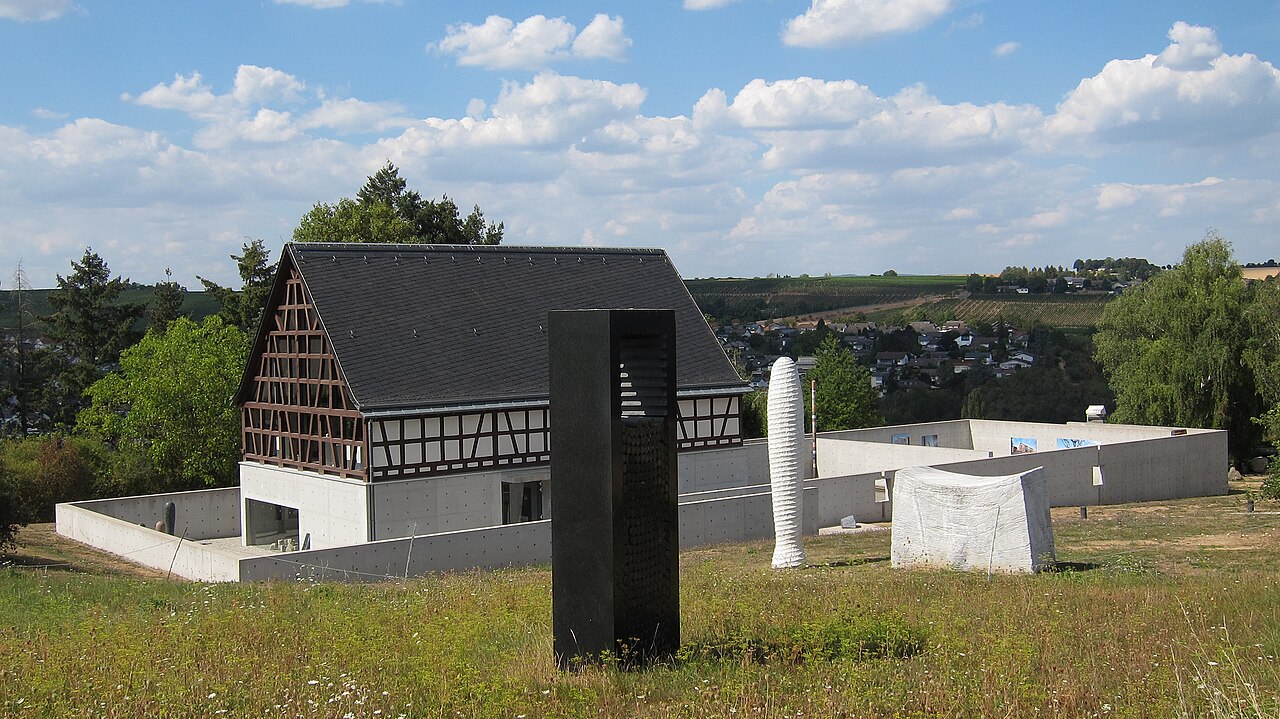
Tadao Ando designed this museum for the sculptors Anna Kubach-Wilmsen and Wolfgang Kubach. At its centre, an 18th-century half-timbered barn turned exhibition space; around it, exposed-concrete walls enclosing two courtyards, a reflecting pool in one and gravel in the other. Opened in 2010 at Bad Münster am Stein-Ebernburg, the museum shows the couple's stone sculptures.
Affiliate links — booking through Verrière helps fund our research, at no extra cost to you.
History
Anna Kubach-Wilmsen and Wolfgang Kubach have worked together as stone sculptors since 1968. That year they set up their open-air studio at Bad Münster am Stein-Ebernburg, not far from the Rotenfels massif. In 1998 they established the Fondation Kubach-Wilmsen, a charitable foundation to bring a museum into being: their gift of 65 stone sculptures forms its core, and they set aside about 15,000 m² of land for the sculpture park. Since 2001 they have been turning former vineyards into a park open to the public.
To design the museum they turned to Tadao Ando of Osaka; it took persistence, and the assurance that only he could design this museum, to win him over. Ando presented his design in September 2005. The architects Dorian and Bodo Zapp produced the construction and detail drawings. The museum opened on 14 August 2010 and describes itself as the world's first and only museum of contemporary stone sculpture. It is Ando's third building in Germany, after the conference pavilion in Weil am Rhein and the Langen Foundation museum in Neuss.
Wolfgang Kubach died in 2007 and Anna Kubach-Wilmsen in 2021; the foundation's purpose was then extended to include the work of the artist couple Livia Kubach and Michael Kropp.
Architecture
Ando's design starts from a half-timbered barn of the 18th century, which originally stood nearby in Sponheim. It is rebuilt on the museum grounds in its original manner of construction (earth walls, timber frame, slate roof) and serves as the exhibition space. Ando adds an intermediate floor and several windows, turning its closed interior into a space flooded with light and open to nature.
Free-standing walls of exposed concrete surround the barn and enclose the museum and its terraces at different levels. Openings cut rhythmically into the walls create views between architecture, sculpture, the park and the landscape. A reflecting pool marks the upper courtyard and a gravel surface the lower one. Visitors approach along a narrow lane formed by two walls, whose few square slits give a view of the first courtyard; a few steps lead up to the upper courtyard.
The building reads in two parts: a cubic ground floor in exposed concrete, and an upper floor with light-brown clay-plaster walls on the long sides, under a slate-covered gabled roof carried by a dark oak frame. At the gable ends the small-panelled timber framing is kept, with large-scale glazing on the inside. Upstairs, timber beams span an exhibition space of 16 m by 14. The ground floor takes its light through floor-to-ceiling openings onto the Zen-style sculpture garden: the light glimmers diffusely on the concrete and creates a subdued mood. With its many windows, the building is conceived as a daylight museum.
The concrete is Ando's own: smooth panels the size of tatami mats (1.80 m by 0.90 m), pierced by six evenly spaced holes. The building is a monolithic reinforced-concrete structure with 24 cm exterior walls; the aggregate comes from the back wall of the Rotenfels.
Use today
The museum shows the sculptures of Anna Kubach-Wilmsen and Wolfgang Kubach, whose gift of 65 pieces forms its core. The dialogue continues with the work of Livia Kubach and Michael Kropp, whose studio and sculpture garden are next door, and with the sculpture park, whose stones come from all five continents.
Visiting
The museum is open on Saturdays, Sundays and public holidays from 2 p.m. to 5 p.m., with a winter break. Outside these hours, and in winter, it can be visited on a guided tour booked in advance with the foundation. Admission is free up to age 18. Public guided tours, without booking, take place on Sundays and public holidays.
Address: Heilquelle, 55583 Bad Kreuznach-Ebernburg. Cars cannot drive up to the museum: park at the museum car park or at the public car parks on Königsgartenstraße. The sculpture park is open to the public. The nearby studio and garden of Kubach & Kropp can be visited only by appointment, as part of a guided tour.
49.81° N, 7.82° E
Greenhouses nearby
Architecture nearby
Sources (8)
- fondation-kubach-wilmsen.de/
- fondation-kubach-wilmsen.de/architektur-des-steinskulpturenmuseums.html
- fondation-kubach-wilmsen.de/stone-sculpture-museum.html
- fondation-kubach-wilmsen.de/steinskulpturenpark.html
- kuladig.de/Objektansicht/KLD-252774
- baunetzwissen.de/beton/objekte/kultur/steinskulpturenmuseum-in-bad-muenster-1311913
- bad-kreuznach-tourist.de/en/points-of-interest/museums-and-exhibitions/stone-sculpture-par
- openstreetmap.org/way/539462442
Affiliate links — booking through Verrière helps fund our research, at no extra cost to you.