Greenhouses of Midongsan Arboretum (미동산수목원 난대식물원·다육식물원·식충공중식물원)
Cheongju (Miwon-myeon), North Chungcheong
No freely licensed photo of this greenhouse yet. Do you have one? Suggest it for this page →
Sources checked October 2026
- Style
- Group of exhibition houses (warm-temperate plants, succulents, carnivorous and air plants)
- Dimensions
- Warm-temperate house 1,162 m², succulents 697 m², carnivorous and air plants 128 m²
- Status
- Open to the public (arboretum closed on Mondays, free entry)
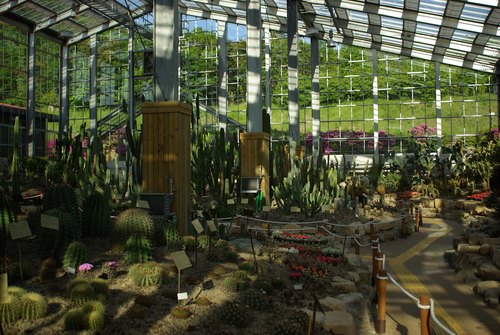
Opened on 4 May 2001 in Miwon township, near Cheongju, Midongsan public arboretum covers 250 hectares. It has three exhibition greenhouses close to the forest science museum: the warm-temperate plant house (1,162 m²), which shows species of the south coast, the succulent house (697 m², opened in 2013), described as glazed on all sides, and a small pavilion of carnivorous and air plants (128 m²). A 173 m² butterfly house extends the first. According to the official site, entry is free and the arboretum is closed on Mondays.
Affiliate links — booking through Verrière helps fund our research, at no extra cost to you.
History
Midongsan Arboretum was created by the North Chungcheong provincial Forest Environment Research Institute: site preparation began in 1996 and the garden opened on 4 May 2001, on the slopes of Mount Midong (557.5 m), in Miwon township. Entered in the Korea Forest Service register on 30 November 2011 as a public arboretum, it was described in 2023 as the only arboretum in Cheongju. A 2025 article supplied by the province credits it with 51 themed gardens and 1,593 species, or 310,000 plants.
The greenhouses were added over time. The succulent house opened in 2013, according to a 2023 article repeated from the province's news feed. The warm-temperate plant house is already described in March 2018.
Entry, free at first, became chargeable in January 2022; the province gave this up on 1 February 2023, attendance having fallen from 320,000 visitors in 2019 to 190,000 after the pandemic, then 170,000 in 2022. The provincial gardening education centre opened in July 2025 in the building of the site's forest education centre.
Architecture and engineering
The official site gives the area of each house: 1,162 m² for the warm-temperate one, 697 m² for the succulent house, 128 m² for the carnivorous and air-plant pavilion, and 173 m² for the butterfly house. The succulent and carnivorous pavilions stand behind the forest science museum, next to the mugunghwa garden (무궁화원); the warm-temperate house is a short walk away, halfway up the slope, about 300 metres from the wood culture hall according to a 2018 article.
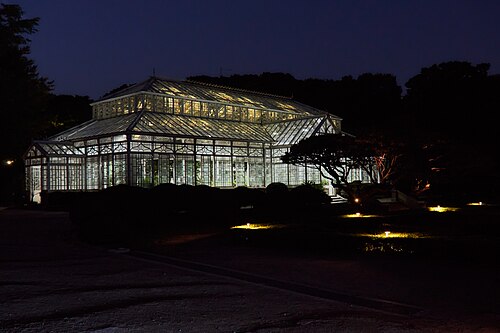
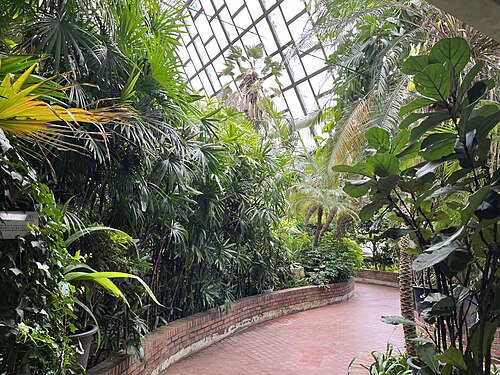
That article describes the warm-temperate house as a glass greenhouse; the province's 2023 article describes the succulent house as glazed on all sides, with a glass-decked walkway inside that lets visitors see the plants beneath their feet, and the city's blog notes a decked route accessible to wheelchairs and pushchairs. In the warm-temperate house, a path winds among labelled plants and a room of miniature potted landscapes (분경) opens onto the butterfly house. The carnivorous-plant pavilion has its own entrance.
Plant collections
The warm-temperate house presents plants of the evergreen forest of the south, normally found only on the south coast, on Jeju and on Ulleungdo: the official site names the geummokseo (금목서), the camellia (동백나무), the 후피향나무, the 먼나무, the 후박나무, the 완도호랑가시나무, the 꽝꽝나무 and the 돈나무, to which the 2023 article adds the nandina (남천) and the 돌단풍. Figures vary: more than 200 species in 2018, 288 species and about 16,000 plants in 2020 and 2023.
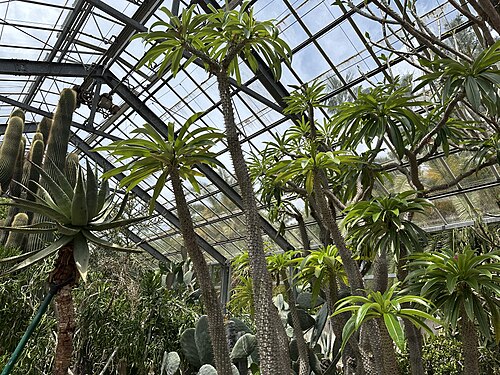
The succulent house holds about 270 species and 2,000 plants, among them the geumho cactus, the 염좌 and the 꽃기린; the city's 2020 blog notes a baobab planted in the ground beside young potted baobabs and a crested cactus (용신목 철화) of human shape. The neighbouring pavilion brings together the Venus flytrap (파리지옥), the sundew (끈끈이주걱), the pitcher plant (네펜데스) and the old man's beard tillandsia (수염 틸란드시아). The butterfly house shelters, among others, the 호랑나비 (a swallowtail) and the 배추흰나비 (a cabbage white).
Visiting
The greenhouses stand in the lower part of the estate, near the forest science museum, the mugunghwa garden and the plant maze (미로원, 1,000 m²). They serve as shelter in rain, great heat or hard cold; the butterflies of the connected house change with the seasons. A 2018 article cites as a popular route the one that follows the one-kilometre metasequoia avenue, taking about an hour and a half, and notes that a longer trail climbs to the summit at 557 metres.
The arboretum covers 250 hectares. The official site says it is served by bus line 211, which terminates there. The two-level forest science museum and the wood culture hall complete the visit.
36.63° N, 127.67° E
More greenhouses — South Korea
Do you have a good photo of this greenhouse? Suggest it for this page →
Sources (8)
- midongsan.chungbuk.go.kr/midongsan/contents.do?key=9
- midongsan.chungbuk.go.kr/midongsan/contents.do?key=10
- welfarehello.com/community/hometownNews/%EC%B2%AD%EC%A3%BC%EC%8B%9C%EB%AF%BC%EC%9D%98-%ED%
- m.blog.naver.com/cjcityblog/221758756553
- m.blog.naver.com/cbkb21/222570093649
- joongang.co.kr/article/22471555
- gardening.news/news/articleView.html?idxno=32716
- blog.naver.com/PostView.nhn?blogId=himawari_tw&logNo=221794496207
Affiliate links — booking through Verrière helps fund our research, at no extra cost to you.