Four Seasons Exhibition Greenhouse, Sejong National Arboretum (국립세종수목원 사계절전시온실)
Sejong
Entry updated on October 3, 2026
- Year
- 2020
- Style
- Contemporary three-winged glasshouse based on the petals of an iris
- Dimensions
- 9,815 m², up to 32 m high
- Status
- Open to the public
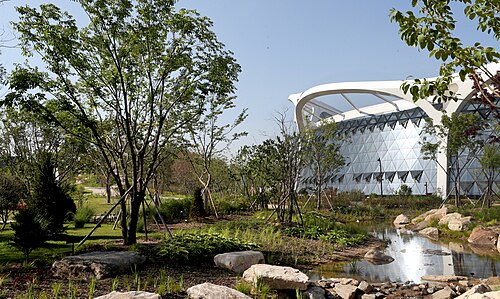
Opened in October 2020 at the heart of the Sejong National Arboretum, South Korea's first urban arboretum, the Four Seasons Exhibition Greenhouse takes the three petals of an iris as the basis of its plan. Rising to 32 metres over 9,815 m², it combines a Mediterranean house whose water channels draw on the Alhambra in Granada, a tropical house with a mangrove, a waterfall and a raised walkway, and a gallery for themed exhibitions. At the opening, the two permanent houses held 665 species and more than 8,600 plants.
Affiliate links — booking through Verrière helps fund our research, at no extra cost to you.
History
1 min
The Sejong National Arboretum (국립세종수목원) was created in the new administrative capital of Sejong, on 65 hectares, as the country's first urban-type arboretum. Work began in 2016; the opening, first planned for 2017, was postponed, and the site was only completed on 29 May 2020. The arboretum opened to the public in mid-October 2020, with the botanist Lee Yu-mi as its first director.
From the outset the Four Seasons Exhibition Greenhouse (사계절전시온실) was presented as the arboretum's landmark. In September 2020, a few weeks before the opening, the local press described it as the emblem of this new national arboretum under the Korea Forest Service. The first show in its temporary gallery, devoted to gardens that 'embrace happiness', ran until 29 November 2020.
The arboretum as a whole holds some 2,450 species and about 1.1 million plants, spread between the greenhouse, a traditional Korean garden, a garden of rare and endemic plants, a systematic garden, a children's garden and a garden of plants from folk tradition, around a visitor centre and research buildings.
Architecture and engineering
1 min
The plan of the greenhouse translates the iris flower, a monocot whose floral parts come in threes: three glazed wings spread out like petals. The highest point reaches 32 metres and the whole complex covers 9,815.16 m², roughly one hectare.
Each wing has its own programme. The Mediterranean house is organised around channels and pools inspired by the gardens of the Alhambra in Spain and includes a lookout from which the whole planting can be seen; sources differ on its height. The tropical house recreates a mangrove and features an artificial waterfall, a water-lily pool and a walkway raised 5.5 metres above the ground that gives views over the planting. The third wing, the special exhibition gallery, hosts themed displays linking plants, culture and nature, changed with the seasons.
Plant collections
1 min
At the opening the Mediterranean house held 228 species and 1,960 plants: olives, date palms, bougainvilleas and bottle trees evoke landscapes with very dry summers and wetter winters. The tropical house, the richest, gathered 437 species and 6,724 plants, among them mangroves, bananas, tree ferns (Cyathea), ebonies (Diospyros) and sacred figs (Ficus religiosa), around a water-lily pool.
In all, the two permanent houses brought together 665 species and more than 8,680 plants. The special exhibition gallery adds themed gardens that change through the year, which gives good reason to come back in different seasons.
Visiting
1 min
The greenhouse holds a central place in the arboretum and is its main landmark. Allow at least an hour to walk through the three wings, climbing to the lookout in the Mediterranean house and onto the walkway of the tropical house.
In winter the tropical house makes a striking contrast with the cold outside; in spring and autumn the visit combines well with the arboretum's outdoor gardens, notably the traditional Korean garden and the garden of rare plants. The themed shows in the gallery make it worth checking the programme before setting out.
36.49° N, 127.28° E
Greenhouses nearby
More greenhouses — South Korea
Do you have a good photo of this greenhouse? Suggest it for this page →