Sansugyeong Greenhouse, Garden of Morning Calm (산수경온실)
Gapyeong (Sang-myeon), Gyeonggi
No freely licensed photo of this greenhouse yet. Do you have one? Suggest it for this page →
Sources checked October 2026
- Style
- Exhibition greenhouse with a glass roof and a small indoor waterfall
- Dimensions
- Small greenhouse
- Status
- Open to the public with the garden ticket, all year; chrysanthemum show from 17 October to 15 November 2026
At the Garden of Morning Calm, a mountain arboretum in Gapyeong (Gyeonggi), the Sansugyeong greenhouse is one of the garden's four indoor exhibition facilities, with the alpine greenhouse, the art gallery and the history hall. Described by the press as surrounded by glass, it stands near the entrance and stays open all year with the garden ticket. A small waterfall marks its entrance; each spring it hosts a wildflower show, often of threatened species, and each autumn a chrysanthemum show.
Affiliate links — booking through Verrière helps fund our research, at no extra cost to you.
History
The Garden of Morning Calm (아침고요수목원) was designed and built by Han Sang-kyung, a horticulture professor at Sahmyook University. According to English Wikipedia, the idea dates from 1992, the land was bought in 1994, and the garden opened to the public on 11 May 1996 with ten themed sections; it has twenty-two as of 2024. It covers about 330,000 m² at the foot of Mount Chukryeong (879 m), at Haenghyeon-ri in Sang-myeon.
Korean Wikipedia lists the Sansugyeong greenhouse (산수경온실) among the garden's four indoor exhibition facilities, alongside the alpine greenhouse, the art gallery and the history hall. The reference list of the Korean greenhouse builder Mokmin does mention a "glass greenhouse of the Achim Goyo Arboretum" in 2010 and again in 2018, and a "herb greenhouse" in 2014, but without saying which building is meant; those years are therefore not used.
The greenhouse hosts a wildflower show in spring and a chrysanthemum show in autumn. A press release of October 2016 already announced the 18th edition of the latter "in the Sansugyeong greenhouse", and the garden, which turns thirty in 2026, is holding it again from 17 October to 15 November.
Architecture and engineering
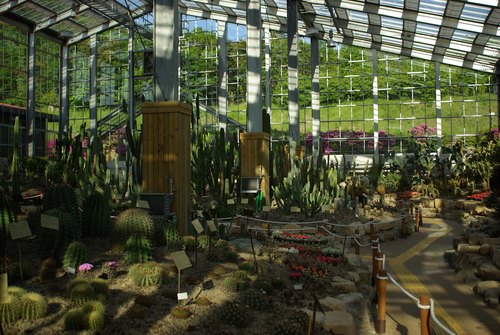
The sources call the greenhouse small. An article of March 2025 describes it as a space "surrounded by glass", and a photograph of the interior published by the garden shows a roof of glass panes on a pale frame, a brick-paved path, potted plants arranged on shelves and large jars. The official text compares the whole to a painted landscape of mountains and water in the jingyeong sansuhwa tradition, and water is indeed present: two visitors, one of them in April 2018, mention a small waterfall at the entrance, surrounded by planted beds.
The building connects with the Hometown House Garden (고향집정원), which one follows while climbing slightly from the garden's entrance. A visitor in April 2018 notes that it did not feel hot inside, contrary to what the word "greenhouse" suggests. The garden has two greenhouses: this one, near the entrance, and the alpine greenhouse, higher up, above the mugunghwa garden devoted to Korea's national flower.
Plant collections
The plants change with the exhibitions. In spring 2025 the show "A Quiet Morning Spring, Steeped in Wildflowers" (until 13 April) featured a yellow rhododendron (노란만병초), 동강할미꽃, 붉은대극, 광릉요강꽃 and 깽깽이풀; the article says many of these are threatened species, and signs gave their ecology and things to look for. Outside the shows, a blog names as representative plants the Japanese camellia (Camellia japonica), the Japanese apricot (Prunus mume) and the rhododendron 만병초 (Rhododendron brachycarpum). Other visitors have seen a white bleeding heart (금낭화) in April 2018, and hydrangeas, bergamot (베르가못) and daisies around the waterfall.
In autumn the greenhouse becomes a chrysanthemum hall. In 2026 it is due to show about 400 large-flowered chrysanthemums of some forty-four varieties (150 multi-stem plants, 250 single-stem), two large multi-bloom works and one multi-bloom dome; the Achimmaru space, another venue of the show, presents cascading forms and shapes such as a peacock, angel wings, a heart and a butterfly. In 2019, chrysanthemum bonsai were also on show.
Visiting
The greenhouse stands near the entrance but off the loop that most visitors follow: a visitor in 2018, though familiar with the garden, wrote that he found it only after many visits. It stays open all year with the garden ticket, whereas the alpine greenhouse, higher up, sometimes closes in winter because of ice. The two exhibition seasons are mid-March (wildflowers) and mid-October (chrysanthemums).
Its small size makes it a short stop, to be combined with the neighbouring Hometown House Garden, which holds the garden's history hall, with the art gallery at the entrance or, in winter, with the garden's festival of lights, which runs from early December to mid-March.
37.74° N, 127.35° E
More greenhouses — South Korea
Do you have a good photo of this greenhouse? Suggest it for this page →
Sources (8)
- morningcalm.co.kr/info/info01.php
- morningcalm.co.kr/use/use01.php
- ko.wikipedia.org/wiki/%EC%95%84%EC%B9%A8%EA%B3%A0%EC%9A%94%EC%88%98%EB%AA%A9%EC%9B%90
- en.wikipedia.org/wiki/Garden_of_Morning_Calm
- telltrip.com/domestic-travel/the-garden-of-morning-calm/
- youngnong.co.kr/news/articleView.html?idxno=71000
- blog.naver.com/PostView.naver?blogId=wkdtn1208&logNo=223954855618&redirect=Dlog
- hye6813.tistory.com/639
Affiliate links — booking through Verrière helps fund our research, at no extra cost to you.