Walled garden glasshouses, Crathes Castle
Crathes Castle, near Banchory (Aberdeenshire), Scotland

Sources checked October 2026
- Year
- Around 1886 per the NTS; rebuilt in 1978 per HES
- Architect
- Mackenzie & Moncur
- Style
- Five stepped three-quarter lean-to glasshouses, timber frames and iron brackets
- Dimensions
- Five stepped glasshouses
- Status
- In the walled garden, open to the public with the garden token; access to glasshouses to be checked
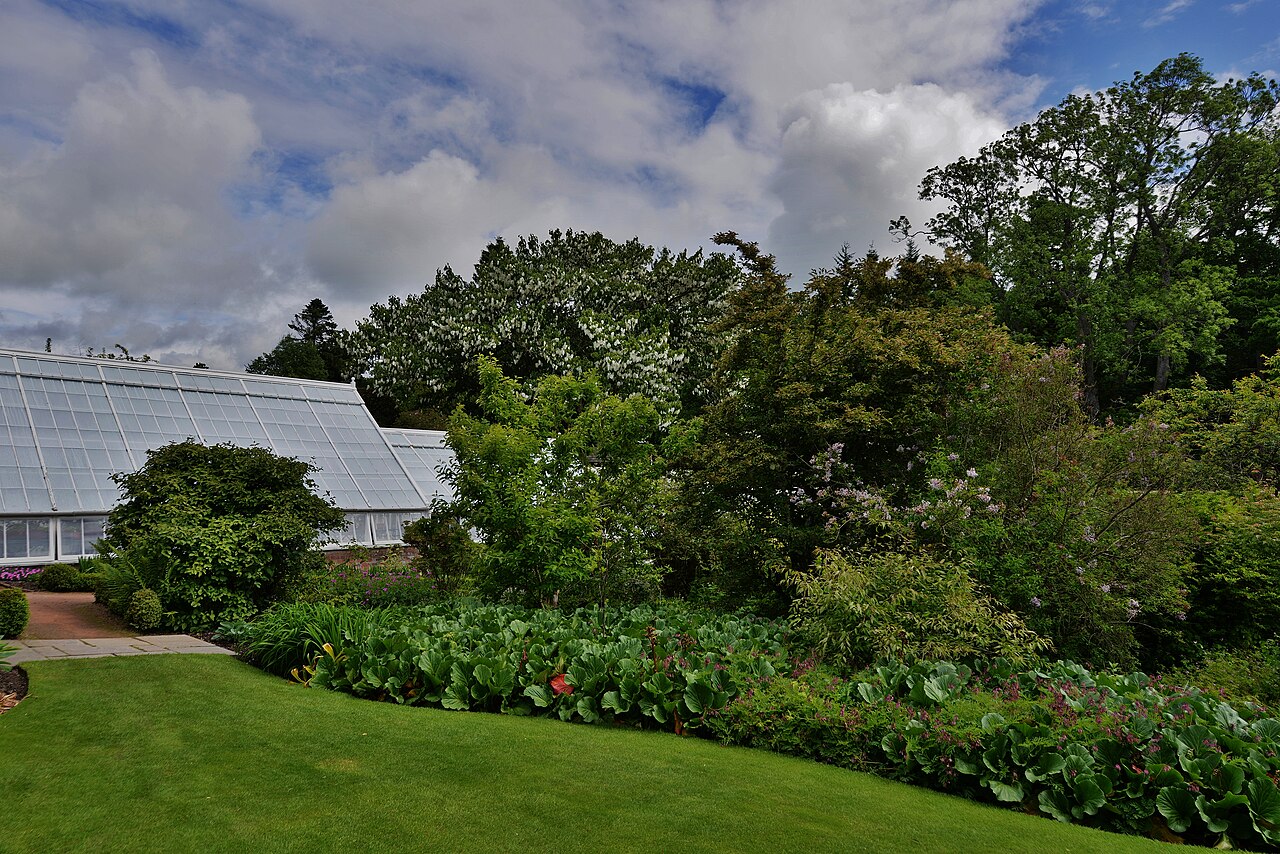
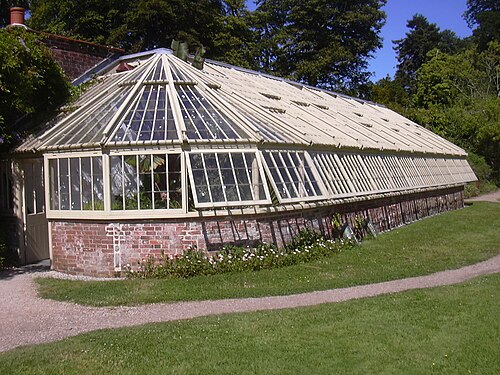
In the walled garden of Crathes Castle, in Aberdeenshire, five stepped glasshouses lean against a wall. The National Trust for Scotland, which runs the estate, attributes them to Mackenzie & Moncur and dates them to around 1886; the Historic Environment Scotland gardens inventory instead describes glasshouses by the same firm demolished in 1978 and rebuilt as a replica, two accounts the sources do not reconcile. Originally heated with coal or coke, they are now used to grow and display plants, and a traditional glasshouse in the walled garden holds Malmaison carnations listed by Plant Heritage.
Affiliate links — booking through Verrière helps fund our research, at no extra cost to you.
History
The National Trust for Scotland (NTS), which now manages the estate, recalls in a blog post by its garden guide (April 2022) that there have been glasshouses at Crathes since the mid-19th century: a large ornamental one at the north end of the croquet lawn was demolished in 1884. The five stepped glasshouses now in the walled garden are said to be by Mackenzie & Moncur and to date from around 1886. The firm, set up in Edinburgh in 1869 according to the NTS (around 1850 according to the Dictionary of Irish Architects) by two joiners, Alexander Donald Mackenzie and George Greig Moncur, became famous for its foundry work and its glasshouses. Again according to the NTS, the Crathes glasshouses were nearly replaced by aluminium ones in the 1970s, the period when house one was cut from five bays to three.
The Historic Environment Scotland gardens inventory gives another account: the Mackenzie & Moncur glasshouses, built in the 1900s, are said to have been demolished in 1978 and replaced by a replica made by a local contractor named Stewart; Parks & Gardens UK repeats that version. The castle, begun in 1553, was given to the NTS in 1951, and the garden has been in the inventory since 1 July 1987.
Architecture and engineering
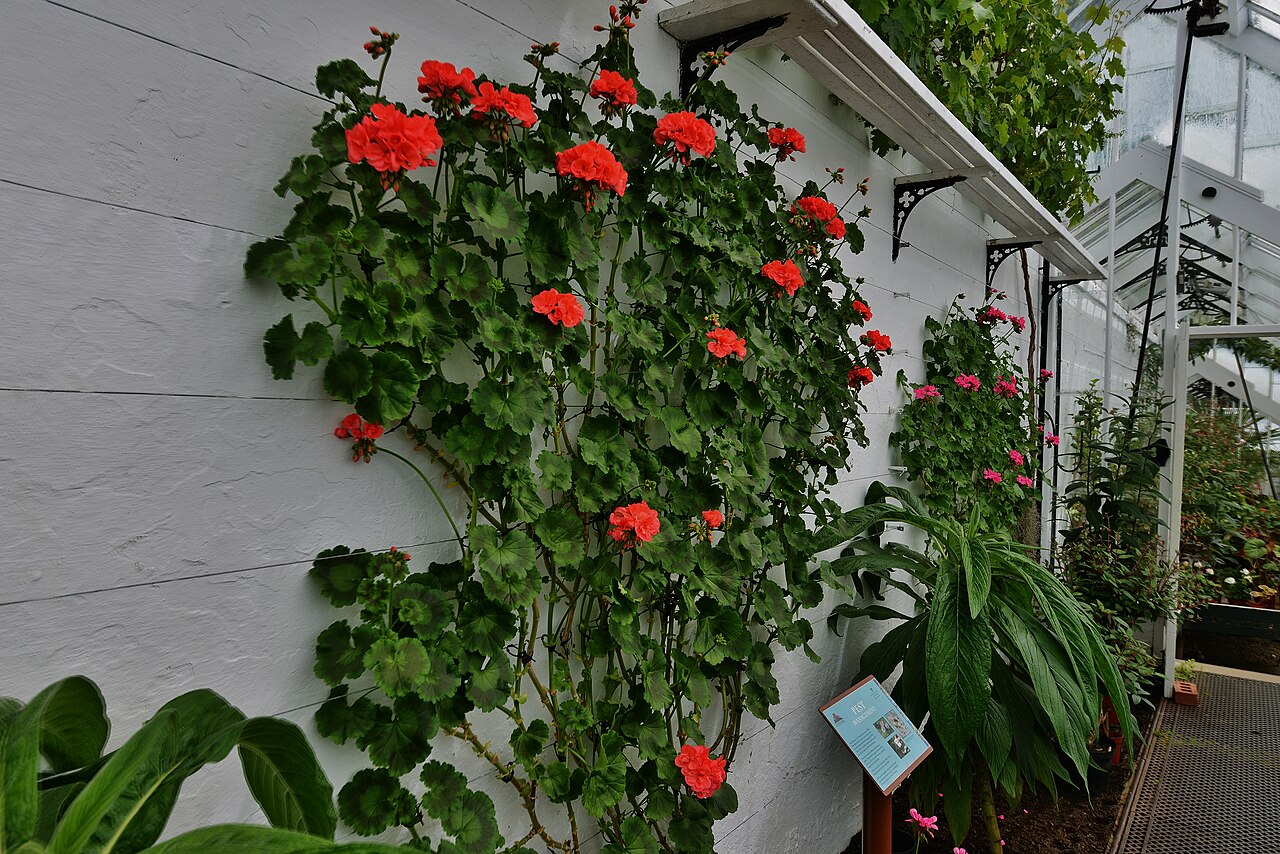
According to the NTS, the glasshouse design at Crathes is a three-quarter lean-to, simple and functional: black-painted iron brackets contrast with parallel lines of white-painted woodwork. The five houses are stepped within the walled garden; the third is a vinery. Each one except the vinery has a tank under its staging that collects rainwater from the gutters, with an overflow; the stored water still helps to stabilise the temperature. Originally, coal or coke burned in a stove house outside the wall, in the gardeners' yard, but still connected to house five; some of the heat vents survive in houses four and five.
Over the years the woodwork has been renewed several times, the glazing replaced by strengthened glass and the opening of the windows motorised. A dipping pool, which may have been part of the 1886 scheme, lies nearby. The NTS has contracted a local firm to monitor deterioration of the timber, and the question of heating remains open.
Plant collections
According to Plant Heritage, a traditional glasshouse in the walled garden holds a collection of Malmaison carnations (Dianthus) of seven cultivars; the NTS names this collection, with one of very rare conifers, among the nationally significant collections of its garden, and the Historic and Botanic Garden Training Programme adds that the glasshouses serve for display and propagation.
The NTS blog of August 2021 reports calla lilies (Zantedeschia) on show there and a devil's tongue, Amorphophallus rivieri, from western Yunnan; the April 2022 post notes Kraus's clubmoss (Selaginella kraussiana), introduced from South Africa, in the nooks of houses one and two, and in house five a fern that looks like Pteris cretica. March and April are busy months: seed sowing, cuttings and potting up. The glasshouses are run on an organic regime with biological control, including green lacewing larvae against mealybug.
Visiting
The glasshouses stand inside the walled garden, east of the castle. Divided into eight sections, the garden has yew hedges planted as early as 1702, herbaceous borders that the NTS recommends seeing in summer and a recently completed Evolution Garden. The NTS blog speaks of plants on show in one of the glasshouses.
Most of the walled garden is wheelchair accessible; only assistance dogs are allowed in. Combine it with the 16th-century castle, the estate's six waymarked trails and Café 1702. The castle, shop and garden open daily from April to October, with shorter hours the rest of the year.
57.06° N, 2.44° W
Greenhouses nearby
More greenhouses — United Kingdom
Do you have a good photo of this greenhouse? Suggest it for this page →
Sources (9)
- nts.org.uk/stories/crathes-garden-blog-12-a-victorian-legacy
- portal.historicenvironment.scot/designation/GDL00119
- parksandgardens.org/places/crathes-castle
- nts.org.uk/visit/places/crathes-castle/planning-your-visit
- nts.org.uk/visit/places/crathes-castle/highlights/walled-garden
- nts.org.uk/stories/crathes-garden-blog-4-carnivorous-plants-and-new-discoveries
- plantheritage.org.uk/national-plant-collections/search-the-national-plant-collections/coll
- en.wikipedia.org/wiki/Crathes_Castle
- hbgtp.org.uk/?p=562
Affiliate links — booking through Verrière helps fund our research, at no extra cost to you.