Tropical Greenhouse, Akita Prefectural Museum of Agricultural Science "Sun Agrin" (秋田県立農業科学館 熱帯温室)
Daisen, Akita Prefecture

Sources checked October 2026
- Style
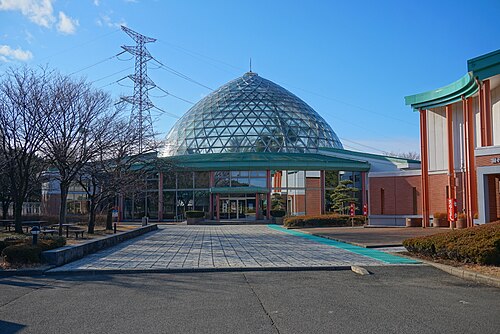
- Tropical greenhouse with a metal frame under a translucent roof, at the end of a linear museum with a barrel roof
- Dimensions
- About 473 m²
- Status
- Open to the public, free admission
In northern Honshū, the Akita museum of agriculture, nicknamed "Sun Agrin" and opened on 22 May 1991, has a tropical greenhouse of about 473 m², linked to the exhibition rooms by the entrance hall. According to the museum, it keeps a constant temperature all year; about 200 tropical and subtropical species bear flowers and fruit there, among them bananas, bird of paradise, hibiscus and Meyer lemon. An orchid festival is held in it every winter, from January to February. Admission to the museum is free.
Affiliate links — booking through Verrière helps fund our research, at no extra cost to you.
History
The Akita museum of agriculture began with a committee set up in August 1980 to study a project for an agricultural museum. A preparatory office was created in April 1982, an overall plan was drawn up in September 1985, and the development of an 89,899 m² site began in September 1986. In January 1988 the project was renamed the "museum of agricultural science". According to Japanese Wikipedia, it was built at the centre of an area called "Waku-waku Land", near the then-future Ōmagari exit of the Akita Expressway, as part of a development programme for the Ōmagari region that drew on special measures from Japan's former Ministry of Home Affairs.
Work on the main building's structure (reinforced concrete, steel, and some timber) began in June 1989 and was completed in October 1990; the museum opened on 22 May 1991, after a completion ceremony the day before. Admission became free in April 1999, and the museum took its nickname "Sun Agrin" in September 2007, when its renovated second exhibition room reopened.
Japanese Wikipedia lists the greenhouse among the museum's facilities and notes that the entrance hall links the exhibition wing to the tropical greenhouse; its own construction date, designer and builder are therefore not documented.
Architecture and engineering
The museum is a linear building with a large rounded barrel roof, built in reinforced concrete, partly steel and timber. Japanese Wikipedia attributes the design to a joint venture of the firm Sato Sogo Keikaku and the Akita Prefecture Architectural Design Cooperative, citing the 1991 journal Hakubutsukan kenkyū, and gives a building area of 3,949 m² for 4,699 m² of floor area. The museum stands on a hill overlooking the Senboku plain and the Ōu mountains.
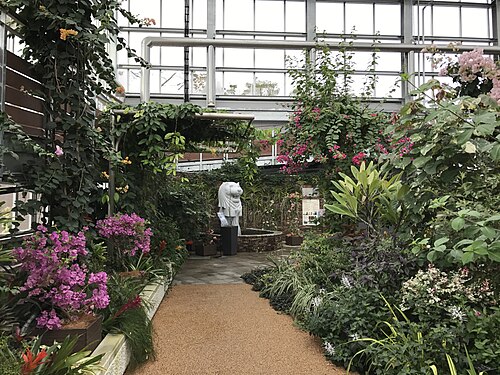
The tropical greenhouse covers about 473 m², according to the museum, and keeps a constant temperature all year. In a 2020 photograph on Wikimedia Commons, the interior shows a tall white metal frame under a translucent roof divided into a grid, lamps hung from a steel structure, a floor paved with pink bricks with a resting corner and a table among banana plants and palms, edged with rockwork.
Plant collections
The museum records about 200 tropical and subtropical species, whose flowers and fruit follow one another through the seasons. Its page on the greenhouse names Meyer lemon, banana, bird of paradise (gokuraku-chōka), Medinilla speciosa, Eucharis grandiflora, Justicia carnea, Ixora chinensis, a calliandra, angel's trumpet and several hibiscus, among them a fūrin-bussōge hibiscus.
Every winter, the "Yōran Festa" (orchid festival) shows rare orchids in the greenhouse, mainly botanical species; the edition announced for 2027 runs from 9 January to 28 February. Camellias, uncommon in the Tōhoku region, are also shown as they come into flower. The museum also publishes a photo gallery of the flowers on display.
Visiting
The greenhouse is part of the museum visit, which is free, and is reached through the entrance hall. It can be visited in any season, but winter suits it particularly well, with the January–February orchid festival. Around the museum, the rose garden (about 200 varieties and 300 plants according to the museum) is best seen during the rose festival in early June and the autumn flower festival, from late September to late October, with dahlias and autumn roses; the magariya farmhouse, built between 1900 and 1903 and later relocated, has been a registered cultural property since February 2000 and is open free of charge outside winter. The two exhibition rooms present Akita's agriculture. The museum lies about 6 km west of JR Ōmagari station.
39.44° N, 140.44° E
Greenhouses nearby
More greenhouses — Japan
Do you have a good photo of this greenhouse? Suggest it for this page →
Sources (8)
- obako.or.jp/sun-agrin/01_tenji/03_onsitu/onsitu.html
- obako.or.jp/sun-agrin/01_tenji/tenji.html
- obako.or.jp/sun-agrin/14_other/enkaku.html
- obako.or.jp/sun-agrin/02_sisetu/sisetu.html
- ja.wikipedia.org/wiki/秋田県立農業科学館
- wikidata.org/wiki/Special:EntityData/Q11595517.json
- totalmedia.co.jp/works/works1991_akita-nogyo.html
- commons.wikimedia.org/wiki/File:Greenhouse_of_the_Akita_Prefectural_Museum_of_Agricultural
Affiliate links — booking through Verrière helps fund our research, at no extra cost to you.