Rosine Smith Sammons Butterfly House and Insectarium (Texas Discovery Gardens)
Dallas, Texas
Entry updated on October 5, 2026
- Year
- 1936 (Garden Room) · 2009 (butterfly house)
- Architect
- Oglesby Greene (2008–2009 restoration and enlargement); 1936 architect not identified
- Style
- Art Deco exhibition hall (1936) and its conservatory, enlarged into a two-level butterfly house
- Dimensions
- Two levels, in a 7.5-acre (≈3 ha) garden
- Status
- Open to the public
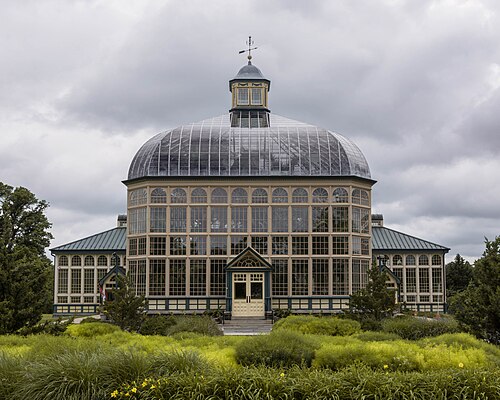
Built in Fair Park for the 1936 Texas Centennial Exposition, the Hall of Horticulture is an Art Deco building with terrazzo floors and towering bas-relief panels, whose glass Garden Room is presented as the first public conservatory in the Southwest. It became the Dallas Garden Center in the 1940s and Texas Discovery Gardens in 2000. Restored by the architects Oglesby Greene, it saw its conservatory enlarged into a two-level butterfly house, opened in September 2009, where hundreds of tropical butterflies fly freely among large tropical plants.
Affiliate links — booking through Verrière helps fund our research, at no extra cost to you.
History
1 min
The building that houses the butterfly house was put up in Fair Park, Dallas, for the Texas Centennial World Exposition of 1936. Named the Hall of Horticulture, it included a glass Garden Room that the institution describes as the first public conservatory in the American Southwest: for many visitors from the region it offered a first chance to see exotic plants under glass.
The hall did not always serve horticulture. During the Second World War it housed the headquarters of the War Rationing Board, and it was also used for a time as the Women's Building of the State Fair of Texas. It became the Dallas Garden Center in the 1940s, and the landscape architect Joe Lambert Jr. then began a twenty-year association with the institution that produced the Circular Lawn, the Leftwich Reflecting Pool and the Callier Garden. Additions to the building followed in 1955 and 1969; the centre was renamed Dallas Civic Garden Center in 1982 and Texas Discovery Gardens in 2000.
The butterflies arrived in 1995, when the conservatory hosted North Texas's first live tropical butterfly immersion exhibit during the fair. The Hall of Horticulture was later restored by the architects Oglesby Greene and its conservatory enlarged to become a permanent butterfly house: the Cultural Landscape Foundation dates the work to 2008, while the gardens give 12 September 2009 as the grand opening of the Rosine Smith Sammons Butterfly House and Insectarium. Fair Park has been a National Historic Landmark District since 1986.
Architecture and engineering
1 min
The Hall of Horticulture is an Art Deco building whose interior is marked by dramatic terrazzo floors and towering bas-relief panels. According to the Clio local-history entry, the original structure, with its glazed Garden Room, was only half the size of the present one; additions were made in 1955 and 1969.
Oglesby Greene renovated and redesigned the whole complex so that, besides the butterfly house, it could hold the institution's offices, a research library, a laboratory and children's classrooms. The enlarged conservatory is a two-level, climate-controlled tropical habitat kept between 70 and 85 °F (about 21 to 29 °C) all year round. Circulation is the central design idea: visitors enter at the upper level, above the tree canopy, and follow a spiralling route down through the planting to below the tropical zones. On the lower level, a glass-fronted emergence chamber puts chrysalises and moth cocoons on view. In the insectarium, a honeybee colony lives inside a tree trunk behind two layers of plexiglass.
Plant collections
1 min
The butterfly house holds hundreds of free-flying tropical butterflies from around the world; the gardens list more than fifty species in rotation, among them swallowtails, morphos, postmen, charaxes, glassywings and lacewings. Species featured recently include the blue-banded swallowtail from Africa; the blue glassy tiger, chocolate pansy and leopard lacewing from Asia; the black and gold birdwing from the Philippines; and, from Central and South America, the Grecian shoemaker, piano key postman, ruby-spotted swallowtail, king shoemaker, variable cracker and the iridescent blue morpho.
Large tropical plants line the walkways and supply nectar and cover. Every day at noon, staff release butterflies that have just emerged in the chamber. The insectarium adds atlas moths, African moon moths and the honeybee tree. Outside, the garden became in 2003 the first public garden in Texas to be certified 100 per cent organic.
Visiting
1 min
Texas Discovery Gardens occupies the southernmost 7.5-acre parcel of Fair Park, at 3601 Martin Luther King Jr. Boulevard, and the butterfly house is reached through the main building. About an hour covers the butterfly house and insectarium, followed by a walk through the organic gardens, around the Circular Lawn and into the Faerie Banton Kilgore Rose Garden, dedicated in 1990.
Arriving before noon allows one to see the daily release of newly emerged butterflies. The grounds also keep the Portland Cement House, one of the four Houses of the Future built for the 1936 exposition. The rest of Fair Park, a listed historic district, extends the visit, and the gardens take part each year in the State Fair of Texas, which is held there.
32.78° N, 96.76° W
Greenhouses nearby
More greenhouses — United States
Do you have a good photo of this greenhouse? Suggest it for this page →
Sources (8)
- txdg.org/about-us/
- txdg.org/butterfly-house-and-insectarium/
- txdg.org/texas-discovery-gardens-and-the-state-fair-of-texas-a-partnership-rooted-in-histo
- txdg.org/visit-the-magical-world-of-butterflies-in-dallas-2025-at-texas-discovery-gardens/
- tclf.org/landscapes/texas-discovery-gardens
- theclio.com/entry/167255
- oglesbygreene.com/texas-discovery-gardens-butterfly-house
- openstreetmap.org/way/1535284391